On Friday, 6 November 2026, COMEX silver futures closed at $51.80 an ounce. A week earlier the price had dropped to $49.10, its lowest close in a year. In January it had closed at a record $115.08. So if you are asking how much silver is worth, the answer has two parts: what the market says today, and what you would actually pay or get for the silver in your hand.
Those two numbers are not the same. The price on the news is a wholesale price for large bars. A coin shop will charge you more than that, and pay you less.
The short answer: at the 6 November close, one troy ounce of pure silver was worth $51.80, a gram about $1.67 and a kilogram about $1,665. That is the melt value, the worth of the metal alone. On 7 November, one large dealer was selling a 1 oz American Silver Eagle for $56.06 and buying one back for $47.85.
Silver was worth $51.80 per troy ounce at the COMEX close on Friday, 6 November 2026. That is the closing price of the most-traded US silver futures contract, the figure most price tickers and news reports track. Dealer websites that weekend showed spot quotes of $51.82 to $52.24 an ounce, within about 1% of the close. Prices change every minute the market is open, so check a live quote on the day you buy or sell.
For context, here is where that number sits:
COMEX front-month silver futures (SI=F) daily closes via Yahoo Finance. Our calculation; the script and data are published with this article.
So silver is worth less than half of its January peak, and only a little more than a year ago. If you bought in 2024 or earlier you are probably still ahead. If you bought in the first half of 2026, you are probably behind.
The spot price is the price for one troy ounce of pure silver traded in large wholesale amounts for immediate delivery. It is the reference point for every coin and bar price, but almost no individual buys at it.
You will see slightly different "spot" numbers depending on where you look, for three reasons:
The differences are usually under 1%. The gap between spot and what you pay for a coin is much bigger, as the sections below show. Our explainer on how the gold price is set walks through the auction and futures system, which works the same way for silver.
Silver is priced per troy ounce, a unit used only for precious metals. One troy ounce is exactly 31.1034768 grams. The ounce used for food and postage, the avoirdupois ounce, is 28.35 grams. The Perth Mint notes that the troy ounce is about 10% heavier.
That gap matters when you weigh silver at home. If a piece of sterling or a bar weighs one ounce on a kitchen scale, it holds 0.91 troy ounces, worth about $47.21 of pure silver at $51.80, not $51.80.
Two more conversions catch people out:
The same units apply to gold; our guide to troy ounces, karats and fineness covers the method in more detail.
Here is what the silver in common sizes was worth at the 6 November 2026 close. This is the melt value: weight in troy ounces times purity times the spot price. For .999 bars and coins, purity barely changes the result.
Melt value only, pure silver at the COMEX close of 6 November 2026. Our calculation.
To update any row, multiply the troy ounce column by today's spot price. Every $1 move in silver changes a 100 oz bar by $100.
The largest bars are mostly for banks and funds. The LBMA's rules say a London Good Delivery silver bar must contain between 750 and 1,100 troy ounces of silver at a minimum fineness of 999.0 parts per thousand, so a "1,000 oz bar" is a nickname, and each bar is priced on its own recorded weight.
A 1 oz silver bullion coin contains one troy ounce of silver, so its metal is worth the spot price: $51.80 at the 6 November close. What you pay for it is higher, usually by 7% to 10% on that weekend.
The two most common coins in the US are:
On 7 November, Gainesville Coins listed a 2026 Silver Eagle at $57.24 by check or wire, 9.6% over its own spot price of $52.24, and a 2026 Maple Leaf at $55.74, 6.7% over. Paying by card added about $2 a coin. The same day, Kitco's online store asked $56.06 for a 1 oz Silver Eagle, 7.7% over its ask spot.
The face value stamped on the coin is irrelevant to its worth. A Silver Eagle is legal tender for $1, but no one would spend it at that.
Junk silver is the dealer term for old US dimes, quarters and half dollars made of 90% silver, which are traded for their metal, not as collectibles. Liberty Coin Service puts the silver in $1 face value of these pre-1965 coins at 0.715 troy ounces. At $51.80 an ounce, that makes each $1 of face value worth about $37 in silver. Kitco was selling a $100 face value bag for $3,838.06 on 7 November, about 3% over the value of its silver. We will cover junk silver in its own guide.
When you sell silver to a dealer, you are paid the dealer's buyback price, which is usually below spot. The dealer needs room to cover handling, testing, storage and a profit before reselling it.
Here is a same-day snapshot from one large dealer. On 7 November 2026, Kitco's silver bars page and sell-to-Kitco page showed these prices, against its own spot of $52.07 ask and $51.82 bid:
Kitco Online Store, viewed Saturday 7 November 2026 with markets closed. Card payments cost about 4% more. The 100 oz RCM bar was listed for Canadian buyers only; a Valcambi 100 oz bar was $5,874.00. Kitco listed a $5,000 minimum on physical bullion orders.
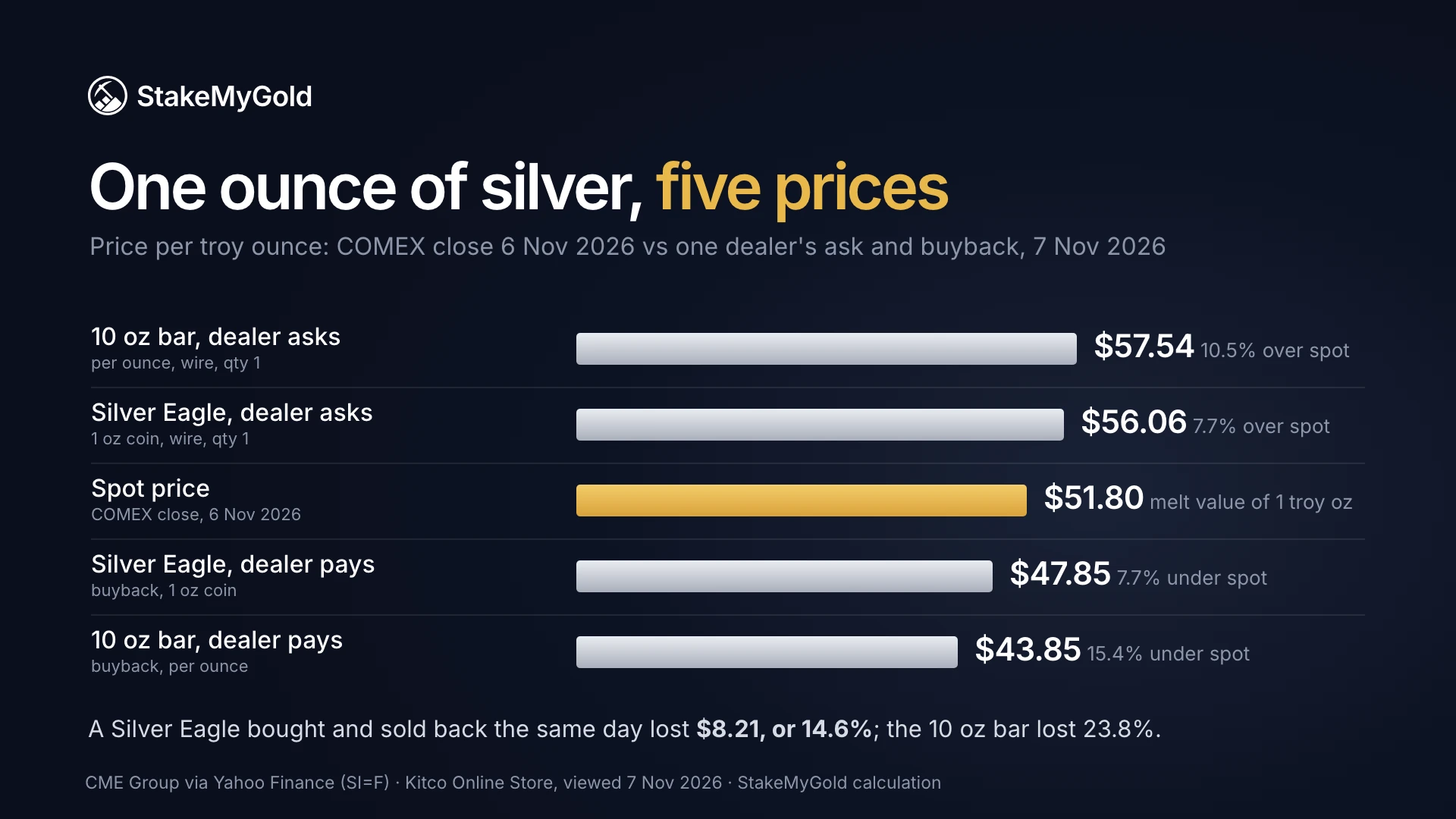
Three terms explain the table:
The surprise is the bars. The usual rule says bars carry lower premiums than coins, but on this day the 10 oz bar cost more per ounce than the Eagle and was bought back for less. We found the same pattern at a different dealer in October, in our guide on how to invest in silver. One price tracker has described dealers holding inventory bought below spot after heavy selling by the public this year, which may explain the low bids. Treat this as one dealer on one day, and get at least two quotes before you trade.
Say you bought one Silver Eagle and one 10 oz bar from Kitco on 7 November, paying by wire, and changed your mind the same day.
| Date | COMEX silver close (per troy oz) | Change to 6 Nov 2026 |
|---|
| 6 November 2025 | $47.79 | +8.4% |
| 31 December 2025 | $70.13 | -26.1% |
| 26 January 2026 (record close) | $115.08 | -55.0% |
| 30 October 2026 (2026 low after the record) | $49.10 | +5.5% |
| 6 November 2026 | $51.80 |
| Size | Grams | Troy ounces | Silver value at $51.80/oz |
|---|
| 1 gram | 1 | 0.032 | $1.67 |
| 1 everyday ounce | 28.35 | 0.912 | $47.21 |
| 1 troy ounce | 31.1 | 1 | $51.80 |
| 10 troy ounces | 311 | 10 | $518.00 |
| 1 kilogram | 1,000 | 32.15 | $1,665.41 |
| 100 troy ounces | 3,110 | 100 | $5,180.00 |
| 1,000 troy ounces | 31,103 | 1,000 | $51,800.00 |
| Product | Dealer asks (wire, qty 1) | Premium over spot | Dealer pays back | Gap as % of what you paid |
|---|
| 1 oz American Silver Eagle | $56.06 | 7.7% | $47.85 (7.7% under) | 14.6% |
| 10 oz silver bar .999 | $575.40 ($57.54/oz) | 10.5% | $438.50 ($43.85/oz, 15.4% under) | 23.8% |
| 100 oz Royal Canadian Mint bar | $5,838.50 ($58.38/oz) | 12.1% | $4,585.00 ($45.85/oz, 11.5% under) | 21.5% |
| 1 oz Canadian Maple Leaf | out of stock | n/a | $47.85 (7.7% under) | n/a |
| 1 oz Silver Eagle | 10 oz bar |
|---|
| Silver content at $51.80 | $51.80 | $518.00 |
| You pay | $56.06 | $575.40 |
| Dealer pays back | $47.85 | $438.50 |
| Loss on a same-day round trip | $8.21 (14.6%) | $136.90 (23.8%) |
| Silver rise needed to break even | 17.2%, to about $60.70 | 31.2%, to about $68.00 |
Kitco prices viewed 7 November 2026. Break-even assumes the dealer keeps paying the same percentage under spot. Ignores taxes and shipping.
The steps for the Eagle:
Silver closed above $60.70 as recently as 6 October, so this is not an extreme hurdle for a metal this volatile. The 10 oz bar's $68 break-even, though, is a price silver has not closed at since 27 August. The lesson: the value of silver you own is closer to the dealer's bid than to the spot price, and it starts below what you paid.
For a bigger version of this calculation over a full position, see our breakdown of whether now is a good time to buy silver.
Silver's worth has more than halved since January because the forces behind its record reversed: interest rates rose, borrowed money left the market, and the shortage of physical metal eased. We go through each one, with dates and data, in why silver is falling, so here is only the scale of the moves.
That is why any "silver is worth" figure needs a date on it. A price quoted a week ago can be off by 5% or more.
The gold-silver ratio, which compares the two metals' prices, was 78.7 at the 6 November close, with gold at $4,074.90. Our gold-silver ratio guide explains what that number can and cannot tell you.
In dollars, yes; after inflation, no. Silver averaged $38.90 an ounce in January 1980, according to World Bank monthly data. Adjusted with the US Bureau of Labor Statistics consumer price index, that equals about $167.50 in August 2026 dollars. At $51.80, silver is about 69% below that level in real terms.
Even in January 2026, the month of the record, silver averaged only about $95 an ounce in today's dollars, more than 40% below the 1980 level. We ran the full 55-year record, including how long silver took to recover from past crashes, in is silver a good investment.
What this means for the question "how much is silver worth": a low price compared with a past peak is not, by itself, a sign that silver is cheap. It can stay low for decades, as it did after 1980.
The prices here are a snapshot from one Friday close and one weekend of dealer pages, viewed while the market was shut. Silver can move several percent in a day, so re-check the spot price and get live quotes before you act.
The dealer data comes mainly from one large dealer, plus coin prices from a second. Local coin shops and pawnbrokers can pay noticeably less. We did not find published buyback prices for kilo bars or junk silver bags, so we do not show them.
We also leave out sales tax, which some US states charge on bullion, and capital gains tax when you sell. Collectible coins, graded coins and silverware are priced differently from bullion and are not covered here. None of this says where the silver price will go next.
StakeMyGold does not offer a silver product. It does not sell silver coins or bars, does not buy them back and has no silver token. If you want silver, you will need a bullion dealer, a broker for a silver fund, or a mint program.
StakeMyGold is a platform for gold. Holders of GGBR, a gold-backed token, can stake it to earn a return paid in gold. The site's FAQ states that the target return is not guaranteed and lists the risks, including smart contract and counterparty risk. GGBR is backed by certificates for gold still in the ground, not bars in a vault, which is a different risk from holding metal yourself. If you are comparing the two metals, our guide to gold vs silver as investments is a better starting point than this page. To see how the gold product works, start at getting started.
How much is 1 ounce of silver worth right now? At the COMEX close on 6 November 2026, one troy ounce of pure silver was worth $51.80. Dealers sold 1 oz bullion coins for about $56 to $57 that weekend and bought Silver Eagles back for about $48.
How much is silver worth per gram? About $1.67 per gram at the 6 November 2026 close. Divide the per-ounce spot price by 31.1, the number of grams in a troy ounce.
How much is a 1 oz Silver Eagle worth? Its silver is worth the spot price, $51.80 at the 6 November close. On 7 November, Kitco sold one for $56.06 and paid $47.85 to buy one back.
How much is a 10 oz silver bar worth? It holds $518 of silver at $51.80 an ounce. On 7 November, Kitco sold a generic 10 oz bar for $575.40 and paid $438.50 to buy one back.
How much is a 100 oz silver bar worth? It holds $5,180 of silver at the 6 November price. Kitco's asking prices for 100 oz bars that weekend were $5,838.50 to $5,874.00, and it paid $4,585 for a Royal Canadian Mint bar.
Why is the price I get lower than the spot price? Dealers buy below spot to cover handling, testing and profit. On 7 November, one large dealer paid 7.7% under spot for Silver Eagles and 15.4% under for generic bars.
Is a troy ounce the same as a regular ounce? No. A troy ounce is 31.1 grams and a regular ounce is 28.35 grams, so a troy ounce is about 10% heavier. Silver prices are always quoted per troy ounce.
At the 6 November 2026 close, silver was worth $51.80 a troy ounce, $1.67 a gram and about $1,665 a kilogram. That is the value of the metal. What you pay is higher and what you get back is lower: on 7 November, a Silver Eagle cost $56.06 and sold back for $47.85 at the same dealer.
Before you buy or sell, check today's spot price, confirm whether the weight is in troy ounces, and ask the dealer for both its selling and buying price on your exact item. The second number is closer to what your silver is really worth to you.
This article is for informational purposes only and is not financial advice.
