On Friday, 30 October 2026, COMEX silver futures closed at $49.10 an ounce, down 5.9% in a single session. It was silver's lowest close since 7 November 2025, and it left the metal 57% below its record close of $115.08 on 26 January 2026. Gold fell too, but only 3.3% that day and about 27% from its own peak. So why is silver falling so much harder?
The answer is not one event. It is four forces that have been working since January, plus a stock-market selloff that pushed the price through $50 last week.
The short answer: silver is falling because the Federal Reserve has turned from cutting rates to raising them, because the borrowed money that drove January's spike was forced out, because the physical shortage behind the record has eased, and because solar panel makers are using less silver. Silver is more volatile than gold and more tied to industry, so each of these hits it harder.
Silver is falling in 2026 for four reasons, roughly in order of weight:
The latest leg, the drop below $50 on 30 October, came from a fifth, short-term factor: a sharp technology-led selloff on Wall Street that triggered selling across precious metals.
The drop has not been a straight line. Silver rebounded in February and again in August before falling to new lows. This table uses COMEX front-month closes from our own download of the Yahoo Finance silver futures history.
COMEX futures closes, not spot. Spot silver's intraday record was $121.64 on 29 January 2026, per 24/7 Wall St and Trading Economics; spot and futures differ by a few percent.
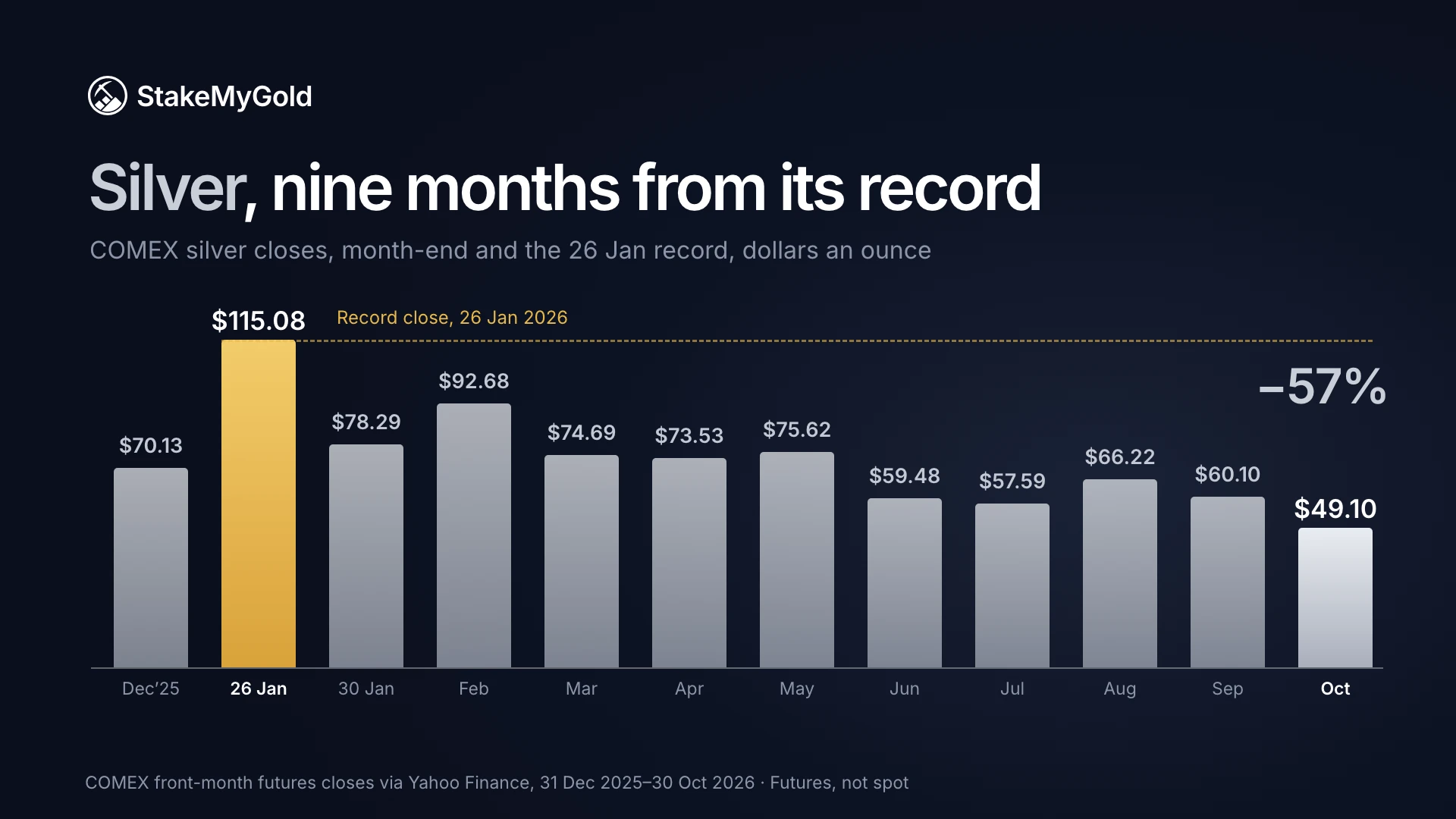
Two months did most of the damage: January, with the single-day crash, and June, when oil-driven Fed rate-hike bets pushed silver down 21%. Since the record, silver has had 16 sessions with a fall of 5% or more.
Rising interest rates are the biggest single reason silver is down. Silver pays no interest or dividend. When cash and Treasury bills pay more, the opportunity cost of holding silver rises. Opportunity cost is the return you give up by owning one asset instead of another.
At the start of 2026, markets expected rate cuts. That changed as the conflict around the Strait of Hormuz pushed oil higher. On 16 September 2026, the Federal Reserve raised its target range by a quarter point to 3.75% to 4%, saying "inflation remains elevated." On 28 October it held rates, but two policymakers, Lisa Cook and Beth Hammack, voted for another hike.
The data since then has not helped. US GDP grew at a 3.4% annual rate in the third quarter, and September PCE inflation rose to 3.6%, according to Trading Economics. On 29 October, CME FedWatch showed an 80% chance of a December hike, as reported by Kitco. The 10-year Treasury yield, 4.21% when silver peaked, closed at 4.93% on 30 October.
For a fuller look at how metals behave in hiking cycles, see our study of . Silver usually follows the same pattern, with bigger swings.
| Date | Silver close ($/oz) | Change from record close |
|---|
| 31 Dec 2025 | 70.13 | n/a (before the record) |
| 26 Jan 2026 (record close) | 115.08 | 0% |
| 30 Jan 2026 | 78.29 | -32% |
| 27 Feb 2026 | 92.68 | -19% |
| 31 Mar 2026 | 74.69 | -35% |
| 30 Apr 2026 | 73.53 | -36% |
| 29 May 2026 | 75.62 | -34% |
| 30 Jun 2026 | 59.48 | -48% |
| 31 Jul 2026 | 57.59 | -50% |
| 31 Aug 2026 | 66.22 | -42% |
| 30 Sep 2026 | 60.10 | -48% |
| 30 Oct 2026 | 49.10 | -57% |
Silver's January crash was mainly a forced unwinding of borrowed positions. On 30 January 2026, COMEX silver closed 31% lower in one session. Gold fell 9.8% the same day, its sharpest one-day drop since 1983, Reuters reported.
The trigger was political. Reuters linked the move to President Trump naming former Fed governor Kevin Warsh as his pick for Fed chair, which lifted the dollar. The size of the fall came from leverage, meaning trades funded with borrowed money. Futures traders only post a fraction of a contract's value as margin, a deposit held by the exchange. When the exchange raises that deposit, traders must add cash or sell.
CME Group raised precious-metal margins three times in a week: on 30 January, 2 February and 6 February. The last move took COMEX silver margins from 15% to 18% of contract value. "It is definitely creating a sort of feedback loop," one OANDA analyst told Reuters at the time: falling prices trigger margin calls, which trigger more selling.
The supply squeeze that pushed silver to its record has largely disappeared. The Silver Institute's World Silver Survey 2026 described "an unprecedented liquidity squeeze" in October 2025, with falling inventories and surging coin and bar demand.
That has reversed. In a report covered by Kitco on 29 October, Metals Focus said London vault stocks rose to 932 million ounces by the end of September, the highest in nearly four years. Stocks available to the market, excluding metal held by ETFs, were about 267 million ounces, nearly double their October 2025 low. The same report found:
With metal easy to find again, buyers no longer need to pay up to get it.
Industrial demand, the part of silver's story that gold does not share, is weakening. Solar panels are one of silver's largest uses, and high prices have pushed manufacturers to use less of it. The Silver Institute reported that thrifting (using less silver per unit) and substitution with other metals cut photovoltaic demand in 2025, and it forecast total industrial demand to fall 3% in 2026.
Banks have gone further. JPMorgan expects solar demand for silver to fall about 30% this year, roughly 60 million ounces, according to a 24/7 Wall St report on Yahoo Finance. Metals Focus expects the global deficit to narrow this year and the market to move into surplus in 2027. A deficit means the world uses more silver than it mines and recycles in a year; a surplus is the reverse. The deficit was the core of the bull case, so the prospect of a surplus weighs on the price.
Silver's fall below $50 last week came from forced selling across markets, not news about silver itself. Silver closed the week at $49.10, down 8.6% from the previous Friday.
On 30 October, the Nasdaq fell 2.9% and the S&P 500 had its worst day since June after weak tech earnings, Kitco's PM report noted. Brent crude settled at $117.64 after another tanker attack in the Strait of Hormuz. Treasury yields actually fell that day, which usually supports precious metals. Silver dropped anyway, which Kitco read as "forced liquidation" outweighing safe-haven demand: investors sold what they could to raise cash.
Our weekly gold and silver price recap tracks these moves day by day.
Some explanations for the silver price drop do not hold up well against the data:
Yes, twice in the past 50 years, and both times recovery took years. What is unusual about 2026 is the speed: silver lost 57% in nine months.
| Episode | Peak | Fall | How long the fall took | What followed |
|---|---|---|---|---|
| 1980 (Hunt brothers) | Above $50 (Jan 1980) | To $10.80 on 27 Mar 1980, about -79% | About 2.5 months | Did not close above $50 again until Oct 2025 |
| 2011 | $48.58 close (29 Apr 2011) | -57% by June 2013, -76% at the 2020 low | 26 months to -57% | Regained the 2011 peak only in Oct 2025 |
| 2026 | $115.08 close (26 Jan 2026) | -57% so far | 9 months | Unknown |
1980 figures from the SEC staff report; 2011 and 2026 from COMEX closes.
The 1980 collapse followed an attempt to corner the market. The SEC's 1982 staff report on the silver crisis describes how exchange margin rules and liquidation-only trading broke the Hunt family's position, and silver closed at $10.80 on what became known as Silver Thursday. Margin rules played a role in 2026 too, though nobody has shown a corner this time.
These episodes are not a forecast. They show that silver can fall further after a 57% drop, and that long recoveries are normal. Our 55-year review of silver as an investment covers the long record.
Nobody knows the timing, but the conditions for a turn are fairly clear. Silver would likely need some of these to change:
Forecasts vary widely. Trading Economics' model, for example, puts silver around $60 in 12 months. Treat any such number as a model output, not a promise. If you are weighing whether to buy after the drop, our guide on whether now is a good time to buy silver covers the timing question, and our silver price prediction for 2030 sets out the long-term scenarios.
Take an investor who bought 100 ounces of silver at the record close of $115.08 on 26 January 2026:
An investor who bought at the end of 2025, at $70.13, is down 30%, or $2,103 on 100 ounces, and needs a 43% rise to break even. The same amount put into gold at its January peak is down about 27%. Our gold vs silver comparison explains why silver's swings are roughly twice as large in both directions.
These figures ignore dealer premiums, which would make the loss larger for anyone who bought coins or bars.
StakeMyGold does not offer a silver product, so it is no way to buy this dip in silver. The platform lets holders of gold-backed tokens stake them for yield. This year gold has been the steadier of the two metals: down about 27% from its peak against silver's 57%. If you are thinking about precious metals more broadly, our explainer on tokenized gold covers how gold tokens work, and the StakeMyGold FAQ lists current terms and risks. A yield does not protect you from a falling gold price.
Why is silver dropping today? On 30 October 2026, silver fell 5.9% as a tech-led stock selloff triggered selling across precious metals, while strong US data and high oil prices kept a December Fed rate hike in play.
Why did silver crash in January 2026? Silver fell 31% on 30 January 2026 after the Fed chair nomination of Kevin Warsh lifted the dollar, and CME margin increases forced leveraged traders to sell.
Will silver go back up? It may, but no one can time it. A turn would likely need lower Fed hike odds, cheaper oil or a rally in gold. After the 2011 peak, silver took more than 14 years to regain its high.
Is silver going to crash further? It can. Silver fell about 79% in 1980 and 76% after 2011, so a 57% drop is not a floor. Analysts at Metals Focus see further downside risk while rates and yields stay high.
Why is silver falling if there is a supply deficit? Because a deficit is measured over a year, and stockpiles can cover it. London vault stocks are at a four-year high and ETFs have released about 60 million ounces in 2026, so there is no shortage of metal to buy.
Silver is falling because the conditions behind its January record have reversed. Rates are rising instead of falling, the borrowed money has left, the physical shortage has eased and solar demand is softening. The 57% drop is fast, but not unprecedented. In 1980 and 2011, recoveries took years. Anyone holding or buying silver now should size the position for swings of this kind, not for a quick rebound.
This article is for informational purposes only and is not financial advice.
