On Friday, 9 October 2026, silver climbed more than 2% to about $60.50 an ounce, recovering from a two-month low as the dollar and oil prices eased. That is roughly half of the all-time high of $121.64 set in January 2026, and still about 22% above where silver traded a year earlier, $49.39 in October 2025.
A price that can halve in eight months makes a lot of people ask how to invest in silver, and whether the way they buy it matters. It does. Two people who are both "long silver" can end up with very different results because of premiums, fund fees, taxes and the price they get when they sell.
The short answer: there are six main ways in. You can buy coins or bars, buy a silver ETF, trade futures, buy mining or streaming stocks, or hold tokenized silver, a digital token backed by vaulted metal (a silver IRA is a seventh, tax-sheltered version of the first). Pick the one that matches what you actually want to own, then check what it costs to get in, to hold, and to get out.
The best way to invest in silver depends on one question: do you want the metal itself, or only its price? The table compares the main routes on what you own, what it costs and how gains are taxed in the US.
Costs are dated snapshots from the sources cited below; check live quotes before buying.
Physical silver means bullion coins, bars and rounds that you hold yourself or store with a vault. It is the only route with no fund manager or token issuer between you and the metal. The trade-off is cost.
The spot price is the price for large wholesale lots of silver. Retail buyers never pay it. They pay spot plus a premium, the dealer's markup to cover minting, shipping and profit. When they sell, they get spot minus a discount.
Here is one dealer's posted pricing on 11 October 2026, with the spot ticker at $61.13 (bid $60.75):
Source: Gainesville Coins product, category and buyback pages, viewed 11 October 2026. Card payments cost about 3.5% more ($68.44 for the same Eagle).
Two things stand out. First, the buyback gap is large: about 7% under the bid for Eagles and about 12% for generic bars. Second, bars were not cheaper than coins on a round trip that day, which is the opposite of the usual rule of thumb. After January's spike, sellers sent so much metal back that one price tracker described dealers holding inventory bought below spot. Whatever the cause, silver has to rise by about 15% before a coin or bar bought that day breaks even.
Government coins such as the Silver Eagle or Canadian Maple Leaf cost more to buy but are recognized everywhere, which helps when you sell. Bars, especially 10 oz and 100 oz sizes, usually carry lower premiums per ounce but can be harder to sell in small amounts. Our guide to what the coin premium buys you and how fakes get caught covers the same trade-off for gold, and the logic carries over.
Counterfeit silver coins exist, and the good ones match the weight. In 2023 the grading company NGC examined a fake 2023 Silver Eagle that weighed 31.54 grams instead of 31.103, had only 149 reeds on its edge and contained less than 0.5% silver. Basic defenses:
Silver is bulky. At about $60 an ounce, $10,000 of silver weighs more than 10 pounds, so home storage needs a safe and insurance. Vault storage costs a yearly fee.
A silver IRA is a self-directed individual retirement account that holds metal. The IRS normally treats buying a collectible inside an IRA as a taxable distribution, but it makes an exception for certain coins and for bullion of a set fineness held by a bank or approved trustee. You cannot keep IRA silver at home.
A silver ETF (exchange-traded fund) is a share you buy in a brokerage account, backed by silver bars held by a custodian. You get the price without storing anything, and you can sell in seconds during market hours.
The fee comes out of the metal. Each year the trust sells a little silver to pay its costs, so the silver behind each share shrinks slowly. Over five years, a 0.50% fee takes about $250 from a $10,000 position. A 0.30% fee takes about $150.
Structure also changes your tax bill. Accountants told CNBC that the IRS treats ETFs backed by physical precious metals as collectibles, which applies to trusts such as SLV and SIVR. PSLV is different: Sprott says its trusts are passive foreign investment companies (PFICs), and that US holders who file a QEF election can qualify for the ordinary long-term capital gains rate instead of the collectibles rate. That guide dates from 2019, so check the current version and ask a tax adviser.
Probably not, unless you trade actively. A futures contract is an agreement to buy or sell a set amount of silver at a set price on a future date. You put up margin, a deposit that is a fraction of the contract's value, so gains and losses are leveraged.
On COMEX, part of CME Group, the benchmark silver contract covers 5,000 troy ounces, about $300,000 of silver at October prices. The Micro Silver contract covers 1,000 ounces. In January 2026, CME said it would launch a 100-ounce silver contract on 9 February 2026, settled in cash, to meet record retail demand.
Futures make sense for traders and businesses that hedge. For most savers they do not: contracts expire and must be rolled, and a 10% move against a leveraged position can wipe out the margin. In the US, gains on regulated futures are taxed 60% as long-term and 40% as short-term under Section 1256, whatever the holding period.
Silver mining stocks are shares in companies that dig silver out of the ground, often as a by-product of gold, lead, zinc or copper mines. They can rise faster than silver when prices climb, because fixed costs stay the same while revenue grows. They can also fall harder, and they carry risks silver does not: strikes, cost overruns, debt and politics in the countries where they operate.
A streaming company is a financer, not a miner. It pays a mine owner a large sum up front in exchange for the right to buy part of the mine's future silver at a low price. In 2026, Wheaton Precious Metals agreed to pay BHP $4.3 billion up front for a share of the Antamina mine's silver, plus 20% of the spot price for each ounce delivered. Streamers avoid most mining costs, but their results depend on someone else's mine.
If you want a basket, the Global X Silver Miners ETF (SIL) charges 0.65% a year and held 39 stocks on 8 October 2026. Its largest holding was Wheaton itself, at 24% of the fund. That is concentration worth knowing about before you call it a silver investment.
Tokenized silver is a digital token on a blockchain where each token is a claim on a fixed amount of physical silver, usually one troy ounce, held in a vault by the issuer. You can send it between wallets at any hour, hold fractions of an ounce, and in some cases redeem it for bars. It is the silver version of tokenized gold, which we explain in what tokenized gold is and how it is backed.
The market is small. CoinGecko's tokenized silver category was worth about $230 million on 11 October 2026. CoinGecko's own research found that tokenized commodities grew to $5.55 billion by the end of March 2026, with gold-backed tokens accounting for 89% of that growth. Silver is a small corner of a market that gold dominates.
KAG and XAGm sizes from CoinGecko's category page. SLVon from CoinGecko's RWA Report 2026.
Note the difference in the last row. SLVon tracks shares of an ETF, so you hold a claim on a claim on silver. KAG and XAGm point to bars directly.
The US tax rule that surprises most silver buyers is the collectibles rate. The IRS says net capital gains from selling collectibles such as coins are taxed at a maximum 28% rate, while most stocks held over a year are taxed at 0%, 15% or 20%. Short-term gains on anything held a year or less are taxed as ordinary income.
For the full picture on precious metals, including reporting and state taxes, see how gold is taxed. The same collectible rules apply to silver.
Here is what $10,000 looks like after five years if the silver price ends exactly where it started. That isolates the cost of each route. It ignores taxes, storage and insurance for physical metal, and brokerage spreads.
Dealer prices from Gainesville Coins on 11 October 2026. ETF fees compound on the remaining balance. Illustration only.
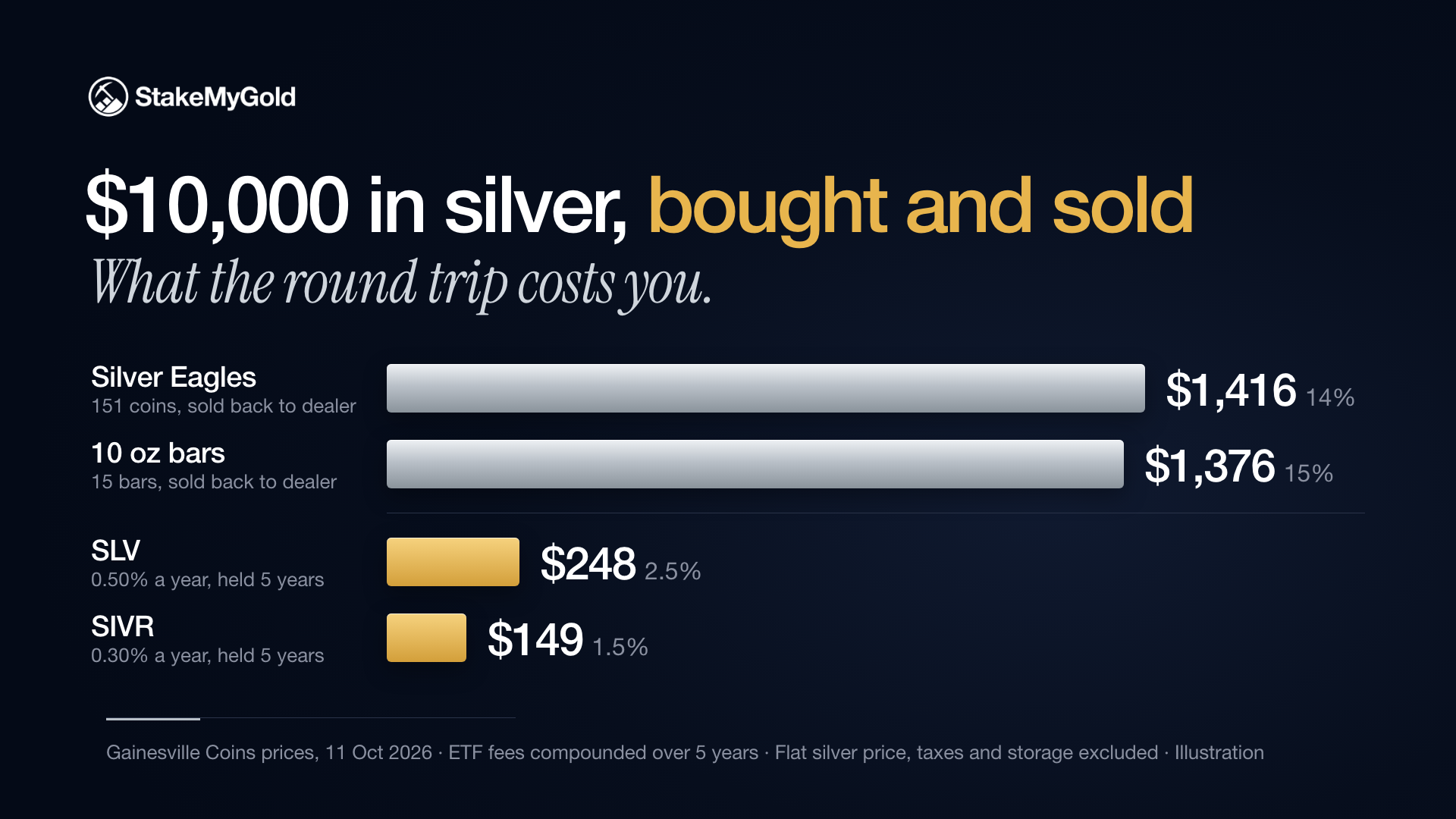
Coins can still make sense, but physical silver needs a long holding period or a large price rise to pay for its entry and exit costs. If you will want to sell within a year or two, an ETF is far cheaper. If you want metal you can hold through a crisis, the premium is the price of that.
Tokens are harder to put in the table because fees differ by issuer and platform. Before buying one, add up three numbers: the trading fee in and out, any custody fee per year, and the gap between the token's price and spot on the day you buy.
There is no correct allocation. Precious metals do not pay interest or dividends, and silver is more volatile than gold: in 2026 it went from its January record to opening below $60 on 24 June. That is why many investors keep it to a small share of a portfolio. If you are choosing between the two metals, our gold vs silver comparison covers that question. For where prices might go, see our silver price prediction for 2030 and our guide to the gold-silver ratio, which stood near 69 on 9 October 2026.
A simple way to start:
| Route | What you own | Typical cost (Oct 2026) | US tax on long-term gains | Best for |
|---|
| Coins and bars | Metal in your hands or a vault | Pay ~3-12% over spot, sell ~7-12% under | Collectible, up to 28% | People who want metal outside the financial system |
| Silver ETF (SLV, SIVR, PSLV) | Shares of a trust that holds bars | 0.30-0.52% a year | Collectible for SLV and SIVR; PSLV differs | Cheap, liquid price exposure in a brokerage account |
| Futures | A contract to buy or sell silver later | Margin, roll costs, leverage | 60% long-term, 40% short-term | Experienced traders and hedgers |
| Mining and streaming stocks | Shares in companies | Stock commissions; SIL fund 0.65% a year | Ordinary stock rates | People who accept company risk for possible leverage to silver |
| Tokenized silver | A blockchain token backed by vaulted silver | Trading and custody fees vary by issuer | Unsettled; may be a collectible | Crypto users who want 24/7 transfer and small units |
| Silver IRA | Approved coins or bars held by a trustee | Setup, custody and dealer fees | Taxed under IRA rules | Long-term holders using retirement accounts |
| Product | Dealer asks (check/wire) | Dealer pays you | Round-trip gap |
|---|
| 1 oz American Silver Eagle | $66.13 (about 8% over spot) | $56.75 | about 14% |
| 10 oz silver bar | $629.20 ($62.92/oz) | $537.49 ($53.75/oz) | about 15% |
| 1 oz generic round | n/a | $53.75 | n/a |
| Fund | Structure | Annual fee | Size (as of date) |
|---|
| iShares Silver Trust (SLV) | US grantor trust | 0.50% sponsor fee | $29.7 billion, 493.9 million oz (9 Oct 2026) |
| abrdn Physical Silver Shares (SIVR) | US grantor trust | 0.30% expense ratio | n/a |
| Sprott Physical Silver Trust (PSLV) | Canadian closed-end trust | 0.52% MER (period to 30 Jun 2026) | n/a |
| Token | Issuer | What backs it | Size (viewed 11 Oct 2026) |
|---|
| Kinesis Silver (KAG) | Kinesis | 1 oz of investment-grade silver per token, in Kinesis vaults | ~$224 million |
| Matrixdock Silver (XAGm) | Matrixdock | Allocated LBMA Good Delivery bars (launched 17 March 2026) | ~$4.7 million |
| iShares Silver Trust tokenized (SLVon) | Ondo Global Markets | Shares of SLV, not silver directly; for non-US investors only | about $32 million at end of March 2026 |
| How you hold silver | Long-term gains (held more than 1 year) |
|---|
| Coins, bars, rounds | Collectible, up to 28% |
| SLV, SIVR (grantor trusts) | Collectible, up to 28% |
| PSLV with a QEF election | Regular long-term rates, per Sprott |
| Futures | 60/40 split, any holding period |
| Mining stocks, SIL | Regular long-term rates |
| Tokenized silver | Unsettled; may be treated as a collectible |
| Inside an IRA | No tax until withdrawal (Roth: none, if rules are met) |
| Route | Buy | Five years of fees | Sell (same spot price) | Cost of the round trip |
|---|
| 151 Silver Eagles at $66.13 | $9,986 | none | 151 x $56.75 = $8,569 | about $1,416 (14%) |
| 15 ten-ounce bars at $629.20 | $9,438 | none | 15 x $537.49 = $8,062 | about $1,376 (15%) |
| SLV (0.50% a year) | $10,000 | about $248 | about $9,752 | about $248 (2.5%) |
| SIVR (0.30% a year) | $10,000 | about $149 | about $9,851 | about $149 (1.5%) |
The dealer prices above are one dealer on one weekend. Premiums and buyback bids change daily and differ between dealers, so get at least two quotes. The worked example holds silver flat, which it never does, and leaves out storage, insurance and taxes.
Nothing here predicts the silver price. Fund fees, CME contract terms, token sizes and tax guidance also change, and the IRS has not issued final rules on tokens backed by metal. Check each number on the day you act.
StakeMyGold is a gold platform. It offers GGBR, a gold-backed token, and stGGBR, the token you receive when you stake GGBR. Its site lists PAXG and XAUT as coming soon. It offers no silver token and no silver staking. If you want silver specifically, the routes above are where to look, and a gold product is not a substitute.
Where we may be relevant is if you are weighing silver against gold as a metal to hold on-chain. Tokenized gold is a far larger and more liquid market than tokenized silver, and some gold tokens can earn a return when staked. Current terms are on the staking page. Staking adds its own risks, which we set out in is gold staking safe.
What is the best way to invest in silver for beginners? For most beginners, a low-cost silver ETF such as SIVR or SLV is the simplest and cheapest way to track the price. Buy physical coins only if you want metal you hold yourself and plan to keep it for years.
Is it better to buy silver coins or bars? Coins cost more per ounce but are easier to sell. Bars usually have lower premiums, but on 11 October 2026 one large dealer's round-trip cost was about 14% for Silver Eagles and 15% for 10 oz bars, so compare live quotes.
How are silver investments taxed in the US? Coins, bars and trust-based ETFs such as SLV are collectibles, taxed at up to 28% on long-term gains. Mining stocks get normal capital gains rates, and futures are taxed 60% long-term and 40% short-term.
Is there a crypto that is backed by silver? Yes. Kinesis Silver (KAG) and Matrixdock Silver (XAGm) are tokens backed by vaulted silver bars. The whole tokenized silver market was worth about $230 million on 11 October 2026, much smaller than tokenized gold.
Is tokenized silver safe? It is as safe as its issuer, custodian and smart contract. Check that the silver is allocated and audited, what the redemption minimum is, and how easily the token trades before you buy.
What is the downside of buying silver? Silver pays no income, swings sharply, and physical metal costs a lot to buy and sell. It fell from $121.64 in January 2026 to about $60 by October.
Learning how to invest in silver comes down to matching the route to the goal. If you want price exposure, a low-fee ETF is hard to beat. If you want metal in hand, accept that the round trip can cost around 15% and plan to hold for years. Miners are a bet on companies, futures are for traders, and tokenized silver is real but young and small.
Whichever you choose, price the exit before the entry, remember the 28% collectibles rate, and size the position for a metal that halved in 2026.
This article is for informational purposes only and is not financial or tax advice.
