
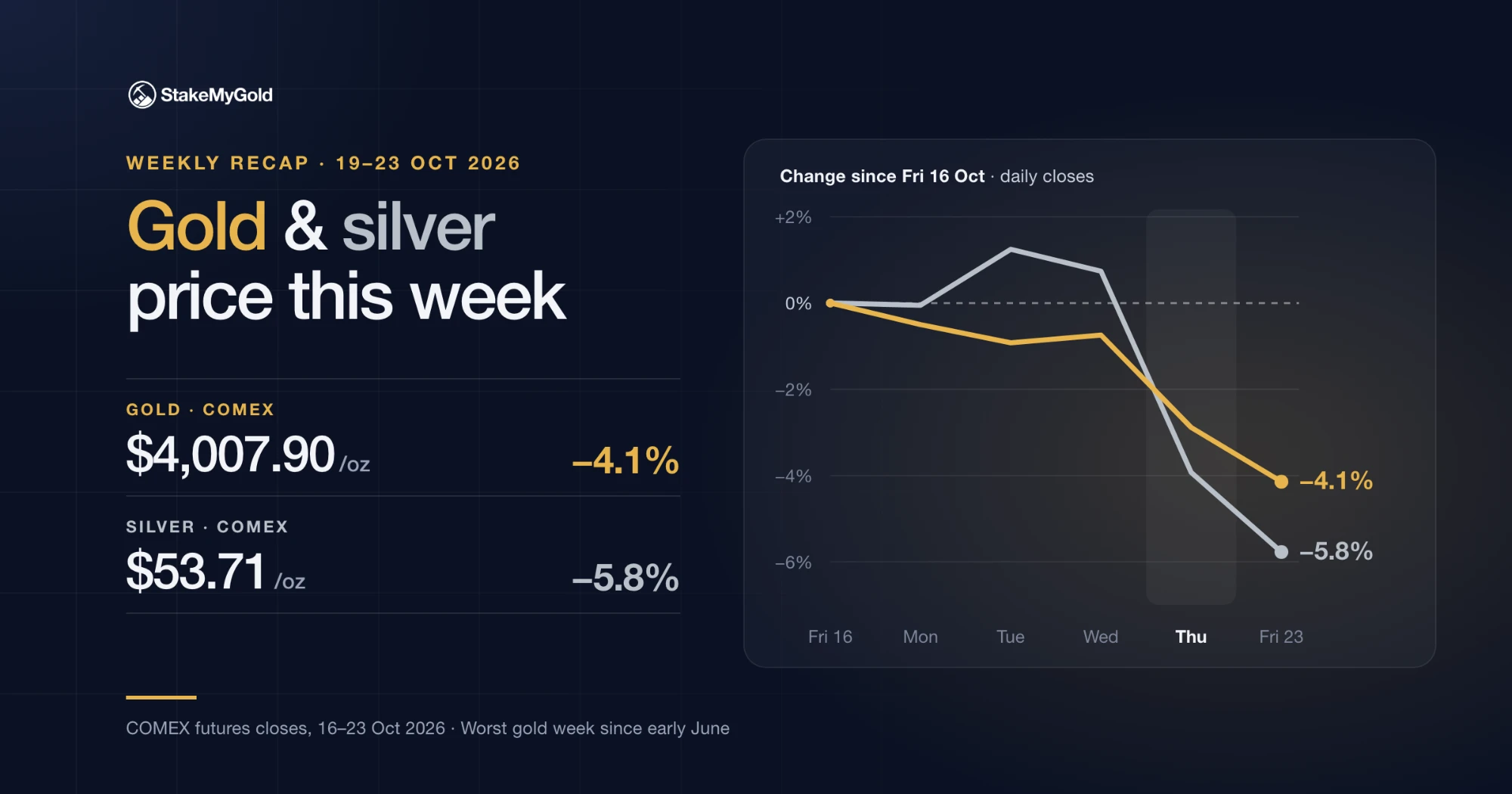
On Friday, 23 October 2026, spot gold closed at $3,993.96 an ounce, a three-month low. The gold price this week fell 4.1% on COMEX futures, from $4,181.10 to a $4,007.90 settlement. Silver fell harder, down 5.8% to $53.71, its lowest close since November 2025.
The main reason was oil. Houthi attacks in Saudi Arabia and on shipping near the Strait of Hormuz pushed Brent crude above $117 a barrel, a four-year high. Traders read higher oil as higher inflation, and higher inflation as a Federal Reserve more likely to raise interest rates. Gold pays no interest, so it usually suffers when rate hikes look closer.
Most of the damage came on Thursday, 22 October, when gold fell 2.2% and silver 4.6% in one session as tech stocks sold off. Next week the Fed meets on 27 and 28 October.
Gold and silver both fell on four of five days, and Thursday did most of the damage. The table shows daily closing prices for front-month COMEX futures.
COMEX front-month futures closes via Yahoo Finance (gold) and Yahoo Finance (silver). Spot prices quoted by dealers run a few dollars lower.
The gold-silver ratio is how many ounces of silver one ounce of gold buys. It rose from 73.4 to 74.6, meaning silver lost more ground than gold. We explain what the gold-silver ratio measures in a separate guide.
Other markets, Friday 16 October to Friday 23 October:
| Close | Gold ($/oz) | Silver ($/oz) | Gold-silver ratio |
|---|
| Fri 16 Oct (prior week) | 4,181.10 | 57.00 | 73.4 |
| Mon 19 Oct | 4,160.10 | 56.97 | 73.0 |
| Tue 20 Oct | 4,142.60 | 57.71 | 71.8 |
| Wed 21 Oct | 4,150.00 | 57.42 | 72.3 |
| Thu 22 Oct | 4,060.40 | 54.76 | 74.1 |
| Fri 23 Oct | 4,007.90 | 53.71 | 74.6 |
| Week | -4.1% | -5.8% | +1.3 |
| Market | 16 Oct | 23 Oct | Week |
|---|
| Platinum (COMEX, $/oz) | 1,623.30 | 1,554.20 | -4.3% |
| US dollar index (DXY) | 101.84 | 101.81 | 0.0% |
| US 10-year Treasury yield | 5.10% | 4.99% | -0.11 points |
| WTI crude oil ($/barrel) | 101.41 | 103.27 | +1.8% |
| S&P 500 | 7,659 | 7,624 | -0.5% |
| Nasdaq Composite | 26,140 | 25,955 | -0.7% |
Daily closes via Yahoo Finance (COMEX, ICE, CBOE, NYMEX). Our calculations.
Gold and silver fell this week because an oil spike raised inflation fears, which raised the odds of a Fed rate hike, and a Thursday stock sell-off added forced selling. Here is each driver, with who reported it.
Houthi attacks in Saudi Arabia lifted Brent crude to a four-year high, Trading Economics reported on 23 October. Kitco counted 28 incidents against ships in the Hormuz waterway in October alone, the most of any month since the conflict began. Oil feeds straight into gasoline, which already drove more than half of September's price rise: the September CPI showed energy prices up 20.4% over 12 months and headline inflation at 3.7%.
On 22 October, CME FedWatch put the odds of a December hike near 90%, according to GoldSilver. By Friday, traders saw about a 10% chance of a hike at next week's meeting and about 80% for December. Fresh data added to the worry: a business survey released Friday showed selling prices rising at their fastest pace since August 2022, and US consumers' one-year inflation expectations rose to 4.7%, both reported by Kitco.
On Thursday the Nasdaq fell 2.6%, its worst day of the week, as doubts about AI spending spread. Trading Economics said traders sold precious metals to cover losses in other assets. That was also the day gold and silver took their biggest hits.
Silver fell more than gold, as it usually does. Part of its demand comes from factories, and Kitco noted worries that energy costs will weigh on manufacturing. Our analysis shows silver swings about twice as much as gold in both directions.
The textbook story says gold falls when the dollar or bond yields rise. Neither happened: the dollar index was flat, and the 10-year yield fell from 5.10% to 4.99%. So "higher rates" here means expected Fed hikes, not higher yields this week. The causes are partly contested: Reuters, via CNBC, framed the week around oil-driven Fed rate hike bets, while the Thursday timing points to forced selling too. For the longer story, see why gold has been falling in 2026.
Yes, and often in 2026. Since 2000, gold has fallen 4.1% or more in a week only about 4% of the time, yet it has now happened five times this year. We measured every Friday-to-Friday change in COMEX gold and silver from January 2000 to 23 October 2026, 1,364 weeks in all.
What came next? After the 55 earlier gold weeks this bad, gold was higher four weeks later 65% of the time, with a median gain of 2.1%. Across all weeks, the rate was 57%. That gap is small, and the range ran from -13.5% to +17.1%. It is not a reliable signal. For context on rate-driven drops, see what gold did in six Fed hiking cycles.
The gold price next week will mostly hang on two days: the Fed decision on Wednesday and inflation data on Thursday.
| Date (ET) | Event | Why it matters for gold and silver |
|---|---|---|
| Tue 27 - Wed 28 Oct | FOMC meeting, decision 28 Oct at 2 p.m. | A hold is expected; the tone on December hikes matters most |
| Thu 29 Oct, 8:30 a.m. | GDP for Q3 (advance) and September personal income and outlays, which includes PCE inflation | PCE is the Fed's preferred inflation gauge |
| Tue 3 Nov | US midterm elections | Kitco notes reports of possible further strikes on Iran after the vote |
| Fri 6 Nov, 8:30 a.m. | October jobs report | Strong hiring keeps hike odds up |
Dates from the Federal Reserve, BEA and BLS calendars, checked 24 October 2026.
A hawkish Fed or a hot PCE number would add pressure. A cooler number, or a cease-fire that brings oil down, could ease it. We do not forecast the price; for the bank scenarios, see how high gold could go in 2026.
One week is noise for a long-term holder. Our tables use futures closes, which differ from spot and from what a dealer charges you. We could not verify this week's gold ETF flows, so we leave them out. The "what came next" figures describe the past and do not predict the next month. Rate odds change daily.
StakeMyGold is a gold-only platform. It offers no silver product. Holders of GGBR, a gold-backed token, can stake it to earn a return paid in gold. That return does not offset a 4% weekly fall in the gold price, and the FAQ says yields are not guaranteed. If you hold gold for years, staking is one way to earn on it while you wait; it adds smart contract and counterparty risks of its own.
Why did gold drop this week? Oil hit a four-year high after Houthi attacks in Saudi Arabia, which raised inflation fears and the odds of a Fed rate hike. A tech sell-off on Thursday added selling. COMEX gold fell 4.1% from 16 to 23 October 2026.
Why did silver fall more than gold? Silver is a smaller market and part of its demand is industrial, so it swings more. It fell 5.8% this week against 4.1% for gold, and the gold-silver ratio rose to 74.6.
Is gold below $4,000? Spot gold closed at $3,993.96 on 23 October 2026. COMEX December futures settled slightly higher, at $4,007.90.
Will the Fed raise rates next week? Markets do not expect it. On 23 October, traders priced about a 10% chance of a hike on 28 October, but about 80% for December.
Gold fell 4.1% and silver 5.8% this week, driven by an oil shock that pushed markets toward Fed rate hikes and a Thursday sell-off in tech stocks. The drop was large by historical standards but not unusual for 2026. Next week's Fed decision and Thursday's PCE inflation data will decide whether the selling continues.
This article is for informational purposes only and is not financial advice.
