On 16 October 2026, COMEX gold futures closed at $4,181.10 an ounce. That is about 3% below its close a year earlier, after a round trip that took it to a record close of $5,318.40 on 29 January and then down by 21%. So how much is a gold bar worth now? It depends on the bar's size, and on whether you are buying or selling.
If you are holding a gold bar, or thinking about buying one, the number you saw in January is out of date. And the number on a dealer's website is not quite the number you would get if you sold.
The short answer: at that 16 October price, a 1 oz gold bar contains about $4,181 of gold, a 1 kilogram bar about $134,400, and a standard 400 oz London bar about $1.67 million. Those are melt values. Buying the bar costs a few percent more, and selling it back pays a few percent less. The table and dealer quotes below show how much more and how much less.
A gold bar is worth the amount of pure gold it contains multiplied by the current spot price. That figure is called the melt value: what the gold alone is worth, before any dealer markup. At the COMEX close of $4,181.10 on 16 October 2026, that made a 1 oz bar worth about $4,181 in gold, a 100 gram bar about $13,443, a kilobar about $134,425 and a 400 oz London bar about $1.67 million. Dealers sell bars for a premium above melt value and buy them back below it. The formula is:
Melt value = weight in troy ounces x purity x spot price
Three terms do the work here:
On .999 and .9999 bars, the stamped weight and the gold content are practically the same: a bar marked "1 oz .9999" holds 0.9999 troy ounces of gold. Large London bars are different, as each one is weighed and assayed and its fine weight recorded. For older or lower-purity bars, the full method is in our guide to troy ounces, karats and fineness.
For this article we use the COMEX front-month close on 16 October 2026, $4,181.10, as the spot price. As a cross-check, the LBMA afternoon auction on 14 October set gold at $4,089.25 an ounce, within 0.5% of that day's COMEX close of $4,107.90.
Here is what the gold in the most common bar sizes was worth at the 16 October close. Bars are sold in both grams and troy ounces, so the table lists both.
Melt value only: fine gold content times the COMEX close of 16 October 2026. Pounds are everyday (avoirdupois) pounds. Our calculation; the script is published with this article.
To update any row yourself, multiply the troy ounce column by today's spot price. Every $100 move in gold changes a 1 oz bar by $100 and a 400 oz bar by $40,000.
A 1 oz gold bar contains one troy ounce of gold, so its melt value equals the spot price: about $4,181 at the 16 October close. In practice, on 19 October a dealer asked $4,257.90 for a generic 1 oz .9999 bar paid by wire, and offered $4,028.89 to buy one back. The 1 oz bar is a common size for a first purchase because it is easy to price and carries a low premium.
A kilo gold bar holds 1,000 grams, or 32.15 troy ounces, of gold. At $4,181.10 an ounce, that is about $134,400 of gold. On 19 October, a Royal Canadian Mint kilobar sold for $136,936.67, about 2.8% over the dealer's own spot price. A kilobar weighs 2.2 pounds; under the LBMA's kilobar standard it measures roughly 80 to 120 millimeters long and 40 to 60 millimeters wide.
A 400 oz gold bar is worth about $1.67 million at the 16 October price, but the exact figure depends on the individual bar. These are London Good Delivery bars, the large bars that central banks and the wholesale market trade. The London Bullion Market Association's rules say each bar must contain between 350 and 430 fine troy ounces with a minimum fineness of 995.0 parts per thousand, so they are at least 99.5% gold. The LBMA's own market guide says bars typically weigh a few ounces either side of 400.
That range matters in dollars. At $4,181.10 an ounce, a bar at the 350 oz minimum holds about $1.46 million of gold and one at the 430 oz maximum about $1.80 million. Each bar's fine weight is recorded individually, and that, not the nickname "400 oz bar", sets its price. At the record close in January, a 400 oz bar held about $2.13 million of gold.
You will not see these bars in a coin shop. The LBMA notes that kilobars, 100 oz and smaller bars are not acceptable in the London wholesale market, and large bars are normally bought by phone from dealers.
A standard gold bar, the 400 oz London Good Delivery bar, weighs about 12.4 kilograms, or 27.4 pounds. The Federal Reserve Bank of New York describes each bar in its vault as weighing approximately 27 pounds. The LBMA's specification puts its top face at about 250 by 70 millimeters and its height at about 35 millimeters, so it is roughly the length of a hardback book and much heavier than it looks.
The bars most people buy are far lighter: a 1 oz bar weighs 31.1 grams, about the same as six US nickels, and a kilobar weighs 2.2 pounds.
Pounds cause confusion because gold uses troy weight. A regular pound holds 14.58 troy ounces, which was worth about $60,974 at the 16 October close. A "troy pound" is only 12 troy ounces, or about $50,173. So a question like "how much is a 20 lb gold bar worth?" has an answer, about $1.22 million in gold at mid-October prices, but no refiner makes a standard 20 lb bar. A bar described by its weight in pounds is usually a large bar described loosely.
A gold bar has three prices at any moment: its melt value, the price a dealer sells it for, and the price a dealer pays to buy it back. The first is the gold. The other two are what you actually pay and receive.
Here is a same-day snapshot from one large North American dealer. On the afternoon of 19 October, Kitco's online store showed a spot price of $4,142.90 on its gold bars page and $4,140.90 on its sell-to-Kitco page:
Kitco Online Store, accessed 19 October 2026 at about 4 pm New York time. Premiums are measured against Kitco's own spot price at that moment. Kitco's default online sell list showed bids for 1 oz bars and coins only.
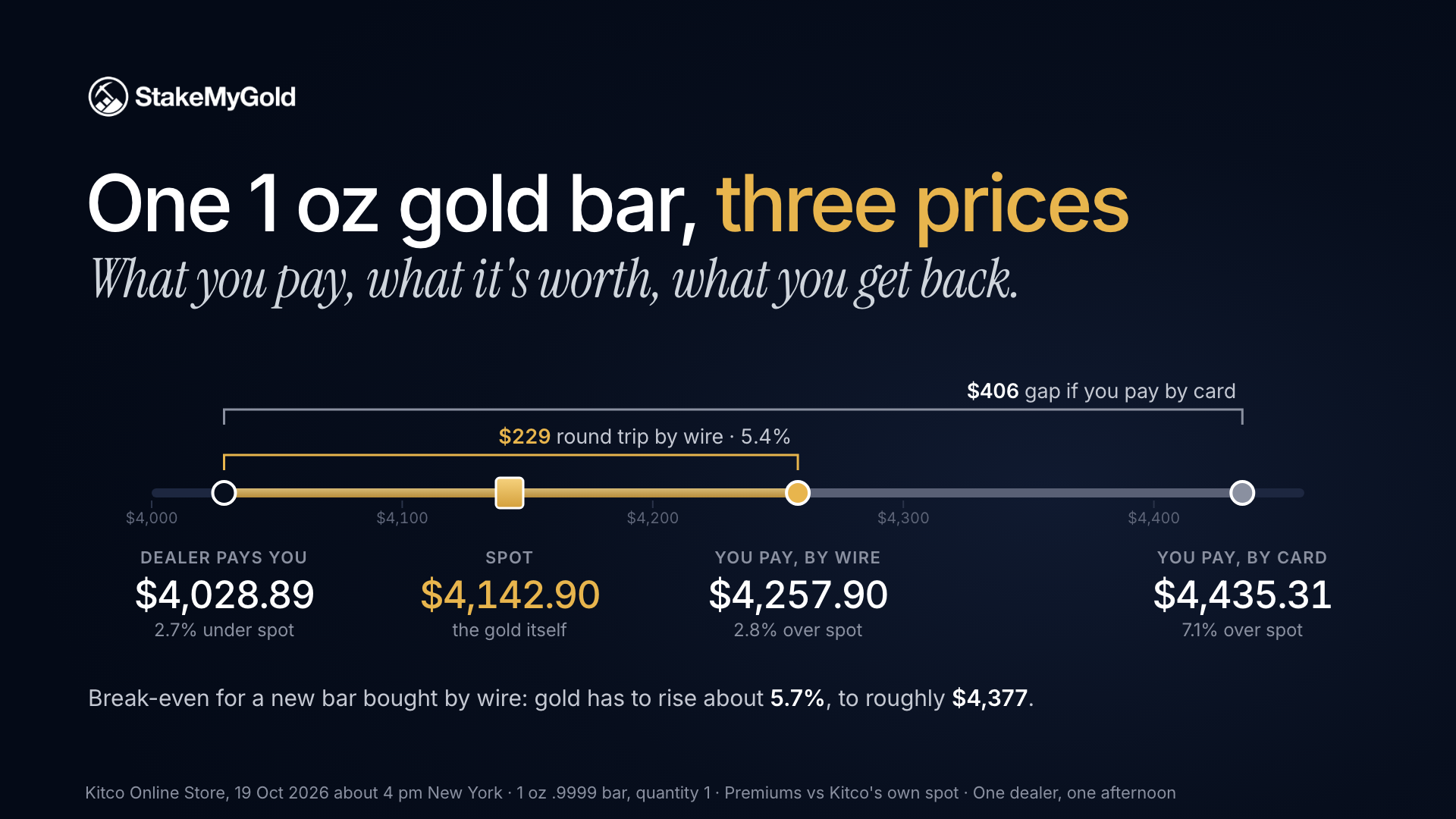
So on the same afternoon, from the same dealer, a 1 oz bar cost $4,257.90 and was worth $4,028.89 if sold back. The difference, $229, is 5.4% of the purchase price. Paying by card raised the premium from 2.8% to 7.1%, which widens the gap from $229 to $406.
Spreads vary by dealer, by day and by how much you trade, so treat this as one real example rather than a market average. For how to get the best bid when you sell, see how to sell gold.
Small bars cost much more per ounce than large ones, because making, packaging and shipping a 1 gram bar costs nearly as much as making a 1 oz bar. That fixed cost is spread over less gold.
On 19 October, SD Bullion listed a 1 gram gold bar at $173.68 for one to nine bars paid by check or wire. The gold in it was worth about $135. That is a premium of about 29%, against roughly 2-3% for the 1 oz, 100 g, 10 oz and kilo bars above.
Put another way, $4,200 spent on 1 gram bars bought about 24 grams of gold. The same money spent on a 1 oz bar bought about 31 grams. Small bars can make sense as gifts or for buying in tiny amounts, but they are a poor way to hold gold for its value. Our guide to gold coins vs bars explains where the premium goes and why it varies by product.
Say you bought the 1 oz bar above on 19 October for $4,257.90, paid by wire. How far does gold have to rise before you could sell it back without a loss?
| Bar size | Grams | Troy ounces | Pounds | Gold value at $4,181.10/oz |
|---|
| 1 gram | 1 | 0.032 | 0.002 | $134 |
| 5 grams | 5 | 0.161 | 0.011 | $672 |
| 10 grams | 10 | 0.322 | 0.022 | $1,344 |
| 1 troy ounce | 31.1 | 1 | 0.069 | $4,181 |
| 50 grams | 50 | 1.608 | 0.110 | $6,721 |
| 100 grams | 100 | 3.215 | 0.220 | $13,443 |
| 5 troy ounces | 155.5 | 5 | 0.343 | $20,906 |
| 10 troy ounces | 311.0 | 10 | 0.686 | $41,811 |
| 1 kilogram (kilobar) | 1,000 | 32.151 | 2.205 | $134,425 |
| 100 troy ounces | 3,110 | 100 | 6.857 | $418,110 |
| 400 troy ounces (London Good Delivery) | 12,441 | 400 | 27.43 | $1,672,440 |
| Product | Dealer asks (wire, qty 1) | Premium over spot | Dealer pays back |
|---|
| 1 oz gold bar .9999 | $4,257.90 | 2.8% | $4,028.89 (2.7% under spot) |
| 1 oz gold bar, paid by card | $4,435.31 | 7.1% | n/a |
| 100 g Valcambi bar | $13,688.67 | 2.8% | not listed |
| 10 oz gold bar .9999 | $42,203.99 | 1.9% | not listed |
| 1 kg Royal Canadian Mint bar | $136,936.67 | 2.8% | not listed |
If you had paid by card at $4,435.31, the break-even rises to about $4,560 an ounce, a 10% rise. Gold has moved further than that in weeks this year: COMEX closes show it up 23% in January and down 18% between 2 and 26 March. Still, the point stands: a bar bought today starts a few percent in the red.
The same arithmetic works for any bar. Divide what you paid by what the dealer would pay you now, and the result minus one is the rise you need.
A Fort Knox gold bar is worth less than a modern 400 oz bar of the same weight, because US government gold is, on average, only about 90% pure. In testimony to Congress in 2011, the Treasury's Inspector General said the Mint's three storage sites held 699,515 bars with an average fineness of 0.9006, with individual bars ranging from 47% to 99.99% gold. Fort Knox held 60% of the fine ounces in that deep-storage reserve.
As an illustration, a bar with a gross weight of 400 troy ounces at that average fineness would hold about 360 ounces of fine gold, worth about $1.51 million at the 16 October price, against $1.67 million for a 400 oz bar of pure gold. The bars are not for sale, and the Treasury's gold reserve report carries them at a statutory book value of $42.22 an ounce rather than the market price. We cover the vault, its audits and its bars in how much gold is in Fort Knox.
The gold price sets the floor, but several things change what a particular bar will fetch:
What does not change the value of a standard bullion bar is rarity or design. A collectible or numismatic bar is a different product and is priced like a collectible.
The values here are snapshots. Gold's closing price moved by more than $1,000 an ounce in 2026, so check the spot price on the day you buy or sell, and re-run the table with it. Our dealer data is one dealer on one afternoon, plus one price from a second dealer; other dealers, local shops and pawnbrokers can pay much less. We could not find a published buyback price for 10 oz, kilo or 400 oz bars, so we do not show one.
We also do not cover taxes or the cost of storage and insurance, which come off any return. And none of this says whether gold will rise or fall from here.
StakeMyGold does not sell gold bars and does not buy them back. It is a platform where holders of GGBR, a gold-backed token, can stake it to earn a return paid in gold. The site's FAQ states a target return that is not guaranteed and can change, and lists the risks, including smart contract and counterparty risk.
GGBR is not a claim on a bar in a vault. It is backed by certificates for gold still in the ground, which we explain in what actually backs your token. That is a different risk from holding a physical bar, not a smaller one. If you want metal you can hold, a bar is the simpler product. If you are weighing physical bars against other forms of gold, our guide on how to invest in gold compares them.
How much is a 1 oz gold bar worth today? Its gold is worth the spot price per ounce, which was $4,181.10 at the COMEX close on 16 October 2026. On 19 October, one large dealer sold 1 oz bars for about 3% more by wire and bought them back for about 3% less.
How much is a 400 oz gold bar worth? About $1.67 million at the 16 October price. Because London Good Delivery bars hold 350 to 430 fine ounces, a single bar's value ranged from about $1.46 million to $1.80 million at that price.
How much does a standard gold bar weigh? A 400 oz London Good Delivery bar weighs about 12.4 kilograms or 27.4 pounds. The New York Fed describes its bars as weighing approximately 27 pounds each.
How much is a 20 lb bar of gold worth? Twenty everyday pounds is about 291.7 troy ounces, worth about $1.22 million at the 16 October price. There is no standard 20 lb bar, though; the nearest standard size is the 400 oz bar, at about 27.4 pounds.
Are gold bars hard to sell? Standard bars from known refiners can be sold to most bullion dealers; on 19 October one large dealer bought 1 oz bars back at 2.7% under spot. Bars from unknown refiners or out of their packaging may need testing and can fetch less.
Is a gold bar worth more than its gold? To buy, yes: you pay a premium over the metal. To sell, usually no: dealers buy standard bars below spot. Only collectible bars are worth more than their gold, and that depends on demand for the collectible.
A gold bar is worth its fine gold times the spot price. At the 16 October close, that was about $4,181 for a 1 oz bar, $134,400 for a kilobar and $1.67 million for a typical 400 oz London bar.
What you pay and what you get back sit on either side of that number. On 19 October the gap for a 1 oz bar was about 5.4% at one large dealer, and the premium alone on a 1 gram bar was about 29%. Before you buy or sell, check three things: today's spot price, the dealer's premium for your payment method, and the price the same dealer would pay you back.
This article is for informational purposes only and is not financial advice.
