How much gold is in Fort Knox? According to the US Treasury's own monthly report, dated 31 August 2026, the answer is 147,341,858.382 fine troy ounces. That is about 4,583 metric tonnes, and it is exactly the same figure the Treasury has reported every month since at least January 2012.
The question keeps coming back for a reason. In February 2025 Elon Musk asked online whether the gold was "still there", and President Trump said he would go and look. In May 2026 Trump raised it again, telling an interviewer he wondered whether the gold had been left in the vault. As of this writing, no visit by either man has taken place and no new audit law has passed.
Here is the short answer. At roughly $4,140 an ounce, the Fort Knox gold is worth about $610 billion. On the government's books it is carried at $6.2 billion, because the law values it at $42.22 an ounce. It is 56% of all the gold the US Treasury owns. Below are the full numbers by vault, how the gold has been audited since 1974, and what happened to the 2025 audit push.
Fort Knox holds 147,341,858.382 fine troy ounces of gold, equal to about 4,582.8 metric tonnes. The figure comes from the Treasury's monthly "Status Report of U.S. Government Gold Reserve", published on the Treasury's Fiscal Data site.
The vault itself is the United States Bullion Depository, a Treasury building on the Army post at Fort Knox, Kentucky, operated and guarded by the US Mint. It was built in 1936, and the first gold arrived in January 1937.
Two terms matter here:
That second point is less trivial than it sounds. Many websites say Fort Knox holds "about 368,000 bars", which assumes every bar is a pure 400-ounce bar. It is not. In testimony to Congress in 2011, the Treasury's Inspector General said the three Mint storage sites held 699,515 bars with an average fineness of 0.9006. Most of the reserve is old "coin gold" (90% gold, the alloy used in pre-1933 US coins) that was melted into bars, not the 99.99% pure bars that trade in London today. The number of bars inside Fort Knox alone is not published.
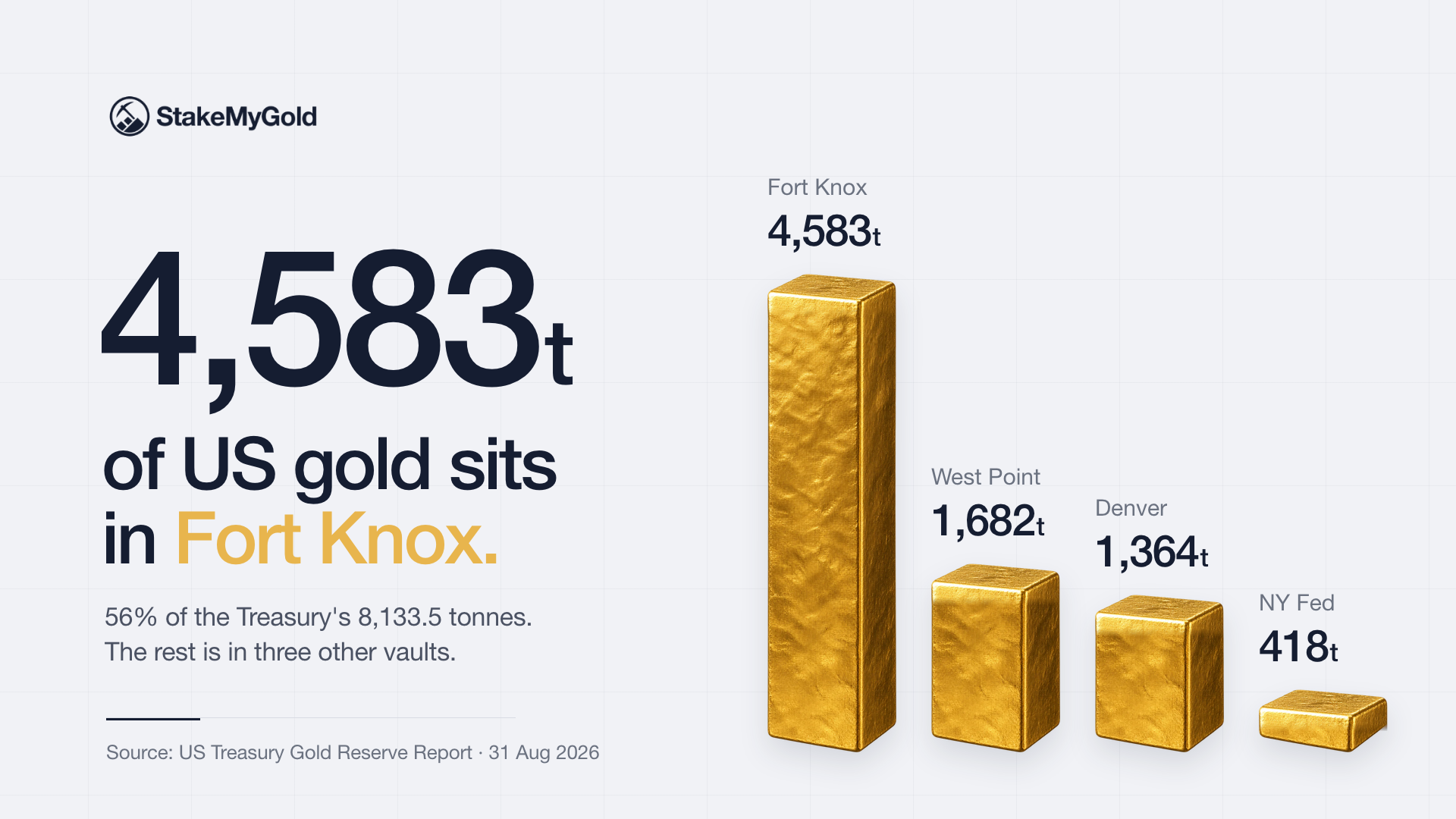
The US Treasury owns 261,498,926 fine troy ounces of gold, about 8,133.5 tonnes, spread across five lines of the Treasury's report. Fort Knox is the largest single location.
Source: US Treasury, Status Report of U.S. Government Gold Reserve, 31 August 2026 (Fiscal Data API). Tonnes and shares calculated at 31.1034768 grams per troy ounce.
"Deep storage" is the Mint's term for gold sealed in vault compartments and not used for coin production. The Treasury's Inspector General confirmed that the Mint did not use any deep-storage gold to make coins in fiscal years 2024 or 2025.
The Fort Knox, West Point and Denver figures have not changed in any monthly report since January 2012, the start of the dataset. For context on how this compares with other countries, the World Gold Council lists Germany second at 3,350.3 tonnes, so the US holds about 2.4 times as much as the next nation. For the global picture of where bullion is kept, see our map of where the world's gold is stored.
At $4,140 per ounce (2 October 2026), the gold in Fort Knox is worth about $610 billion. The formula is simple: fine troy ounces × gold price.
| Location | Type | Fine troy ounces | Tonnes | Share of US gold |
|---|
| Fort Knox, KY | Mint deep storage, bullion | 147,341,858.382 | 4,582.8 | 56.3% |
| West Point, NY | Mint deep storage, bullion | 54,067,331.379 | 1,681.7 | 20.7% |
| Denver, CO | Mint deep storage, bullion | 43,853,707.279 | 1,364.0 | 16.8% |
| Federal Reserve Bank of New York | Treasury gold held at the Fed (bullion, coins, display) | 13,452,810.545 | 418.4 | 5.1% |
| All Mint locations | Working stock (coins, blanks, misc.) | 2,783,218.656 | 86.6 | 1.1% |
| Total | 261,498,926.241 | 8,133.5 | 100% |
| Holding | Fine troy ounces | Value at $4,140/oz | Book value at $42.22/oz |
|---|
| Fort Knox | 147.34 million | ~$610.0 billion | $6.22 billion |
| All US Treasury gold | 261.50 million | ~$1.083 trillion | $11.04 billion |
Because the ounce count does not change, the value moves only with the price. Every $100 change in the gold price moves the value of Fort Knox by about $14.7 billion, and the value of all US gold by about $26.1 billion.
| Gold price | Date or scenario | Fort Knox value |
|---|---|---|
| $3,825.30 | LBMA PM price, 30 Sep 2025 (used in the Treasury IG audit) | ~$563.6 billion |
| $4,000 | Round number | ~$589.4 billion |
| $4,140 | Close, 2 Oct 2026 | ~$610.0 billion |
| $5,595.47 | Intraday record, 29 Jan 2026 | ~$824.4 billion |
So in the eight months from the January 2026 record to early October, the paper value of Fort Knox fell by roughly $214 billion without a single bar moving.
The Treasury values its gold at $42.2222 per fine troy ounce because federal law sets that rate. Under 31 U.S.C. §5117(b), gold certificates issued against the Treasury's gold may not exceed the value of that gold at "42 and two-ninths dollars a fine troy ounce". The rate was set in 1973 and has not changed since.
The mechanics work like this. Decades ago the Treasury issued gold certificates (claims on its gold) to the Federal Reserve, and the Fed credited the Treasury with dollars in return. The Fed's weekly balance sheet (H.4.1, 1 October 2026) still shows a "gold stock" of $11,041 million and a gold certificate account of $11,037 million. Those numbers are the statutory value, not the market value, and they match the Treasury's own book value of about $11.04 billion.
Gold revaluation means changing the $42.22 rate to something near the market price so the Treasury can book the difference. At $4,140, revaluing all US gold would create an accounting gain of about $1.07 trillion. In principle, the Treasury could then issue new gold certificates to the Fed and receive that amount as a cash deposit, without selling any gold.
The arguments for it: it would recognize an asset the government already owns, and some supporters see it as a way to fund spending or a sovereign wealth fund without new borrowing.
The arguments against it: no new wealth is created; it is a one-off accounting transfer. Critics say it amounts to the central bank creating money for the Treasury, which raises questions about inflation and Fed independence. It would also probably need Congress to amend §5117.
What has actually happened: in February 2025 Treasury Secretary Scott Bessent said he had no plans to revalue the gold, after his comments about putting the government's balance sheet to work had set off speculation that he would. We found no proposal to revalue the gold that has advanced in Congress since then.
The Fort Knox gold has been audited many times, mostly by Treasury bodies rather than independent outsiders. The record, from the Treasury Inspector General's 2011 testimony to Congress and its later audit reports, looks like this:
| Year | What happened |
|---|---|
| 1974 (23 Sep) | Members of Congress and journalists toured the vault at the invitation of Treasury Secretary William Simon, led by Mint Director Mary Brooks. The same autumn, GAO and Treasury auditors audited about 21% of the bars at Fort Knox and found they matched the records. The next day Rep. John Rousselot told the House: "It is there." |
| 1975–1986 | A "Committee for Continuing Audit of U.S. Government-owned Gold", made up of Treasury and Mint internal auditors plus New York Fed auditors, audited the gold each year. By 1986, 97% of the Mint's deep-storage gold had been audited and sealed. |
| 1986–1992 | The Mint ran its own annual inventories of compartments not yet sealed. |
| 1993 onward | The Treasury Office of Inspector General (OIG) audits the Mint's deep-storage gold every year. |
| By end of FY2008 | All 42 compartments at Fort Knox, West Point and Denver had been audited and placed under Official Joint Seal. The IG said no inventoried gold had moved since. |
| 2017 (21 Aug) | Treasury Secretary Steven Mnuchin visited the vault with Senate Majority Leader Mitch McConnell, Kentucky Governor Matt Bevin and Rep. Brett Guthrie. |
| 2025 (12 Dec) | OIG-26-002: clean audit opinion on the deep-storage gold as of 30 September 2025, with no material weaknesses. |
According to the Inspector General's description to Congress, the work has two parts:
One result gives a sense of scale. In the fiscal 2008 audit, the difference between the independent assays and the Mint's records came to $3,819.84 on a sample representing $75 million of gold, or 0.005%.
For the Treasury gold held at the New York Fed, the IG relies on a signed confirmation from the Fed rather than a physical count.
The most recent completed audit is Treasury OIG report OIG-26-002, issued 12 December 2025, covering the gold as of 30 September 2025. The next annual report, covering 30 September 2026, would normally appear around December 2026. The last publicized visit by elected officials was the 2017 Mnuchin trip, and the only time Congress and the press went in together was 1974.
The audit push produced statements, two bills and no new audit. Here is the dated sequence:
The Senate bill would require the Government Accountability Office to hire an independent auditor to assay and inventory all US gold within nine months, repeat it every five years, account for any leases, swaps or sales over the past 50 years, and publish the results. It would also require the Treasury to upgrade the reserve to current "good delivery" bar standards within five years. When we checked congress.gov on 4 October 2026, neither bill had moved past committee referral.
Every official record says yes, and no evidence has been produced that it is missing. The ounce count has not changed in over 14 years of monthly reports, the Inspector General told Congress in 2011 that its audits had found no noteworthy exceptions, and the latest report is a clean opinion, and the Fed's balance sheet carries the matching gold certificates.
Skeptics make a narrower point, and it is fair to state it. The annual audits are done by a Treasury office auditing a Treasury bureau. Once every compartment had been counted by 2008, the IG told Congress, its 2009 and 2010 audits mainly checked that the seals were intact. A sealed compartment is not recounted bar by bar each year. No full, outside, public audit of every bar has ever been carried out. That is the gap the 2025 bills are trying to close. Whether it is worth the cost is a political question; the existing evidence does not suggest the gold is gone.
The gold in Fort Knox is owned by the US Treasury; the Mint only guards it. The Treasury IG's audit notes state that the custodial reserves "are not assets of the Mint, but are assets of Treasury."
The New York Fed vault is a different place with a different owner mix. It sits 80 feet below Manhattan and held about 507,000 bars, or 6,331 tonnes, as of 2024. The New York Fed says none of that gold belongs to the Fed itself. Account holders include foreign governments, other central banks, international organizations and the US government. The Treasury's share there is about 418 tonnes, roughly 7% of the vault, so most of the gold under Manhattan belongs to other countries. That is why the New York Fed vault can hold more gold than Fort Knox while the US still keeps most of its own gold in Kentucky. Our vault map covers London, New York and Switzerland in more detail.
Fort Knox is a useful test case for any gold product, including the ones we work with. The question people ask about the US reserve is the right one to ask anywhere: who checked the gold, how, when, and can I read the document?
Here is how that applies to us. StakeMyGold is a non-custodial staking platform for GGBR, a gold token issued by a separate company. GGBR is not backed by bars in a vault. It is backed by in-situ gold (gold assessed to exist in the ground, not yet mined), held as certificates issued by I-ON Digital Corp. That is a different kind of claim from a sealed bar at Fort Knox, with its own risks, which we set out in vaulted gold vs in-ground gold.
On verification: token supply can be checked on-chain by anyone, at any time. The backing cannot, because it sits off-chain, so it depends on documents such as technical reports and attestations, and their dates. Our smart-contract audit with CertiK is listed as in progress on our security page, and a smart-contract audit says nothing about metal in any case. Our monthly transparency reports cover staking metrics, not a reserve audit. If you want a gold product whose backing is closest to Fort Knox in form, an allocated, vaulted token is the more conservative choice. Our 7 checks to run before depositing list the documents to ask for, from us or anyone else, and Is Gold Staking Safe? sets out the counterparty risk in our own model.
How much gold is in Fort Knox right now? 147,341,858.382 fine troy ounces, about 4,582.8 metric tonnes, according to the Treasury's Status Report for 31 August 2026. The figure has not changed since at least January 2012.
How much is all the gold in Fort Knox worth today? About $610 billion at $4,140 per ounce, the price on 2 October 2026. The government's book value is $6.22 billion, because the law values gold at $42.2222 an ounce.
When was the gold in Fort Knox last audited? The Treasury Inspector General's latest annual audit, OIG-26-002, was issued on 12 December 2025 and covered the gold as of 30 September 2025. It found no material weaknesses. A full independent public audit of every bar has never been done.
Who owns most of the gold in Fort Knox? The US Treasury owns all of it; the US Mint operates the depository and guards it. Foreign governments' gold in the US is held at the Federal Reserve Bank of New York, not at Fort Knox.
Where is the largest stockpile of gold in the world? Counted by country, the United States: 8,133.5 tonnes across five Treasury locations, about 2.4 times Germany, the next largest. By single vault, the New York Fed (about 6,331 tonnes) holds more than Fort Knox, but most of its gold belongs to other countries.
Did Trump or Musk ever visit Fort Knox? No visit by either had been reported as of 4 October 2026. Treasury Secretary Bessent said in July 2026 that Treasurer Brandon Beach had visited and that the gold was accounted for.
Fort Knox holds 147.3 million fine ounces of gold, worth about $610 billion at early-October 2026 prices and carried on the books at $6.2 billion. The Treasury audits it every year and has reported the same figure for more than a decade. What does not exist is a full independent public audit, and the two bills that would require one have not left committee. When you read anything about Fort Knox, check whether it cites the Treasury report or the audit reports themselves. Most claims online do neither.
This article is for information only and is not financial, legal or tax advice. Gold prices change constantly; figures are dated where they appear. StakeMyGold is a staking platform and has an interest in gold-related products.
