On 30 October 2026, platinum futures closed at $1,438.00 an ounce, their lowest close of the year. Gold futures closed at $3,898.90 the same day. In the platinum vs gold contest, one ounce of gold now buys 2.7 ounces of platinum.
That surprises people, because platinum is the rarer metal. The world mined about 170 tonnes of it in 2025, against about 3,300 tonnes of gold. For most of the 2000s, platinum was also the more expensive metal, often twice the price of gold.
The short answer: no, platinum is not more expensive than gold today. On closing futures prices, it last finished a day above gold on 14 January 2015. It is rarer, but it is priced mostly by car makers and factories, while gold is priced by investors and central banks. Over the past 25 years that difference has made gold the far better holding, with lower swings.
Here is how the two metals compare on the numbers that matter to an investor, with the jewelry basics at the end.
Prices are COMEX/NYMEX front-month futures closes from Yahoo Finance, which can differ slightly from spot. Returns and risk are our calculations from daily closes (analysis.py).
Yes. Platinum is much rarer than gold by the amount dug out of the ground each year. The US Geological Survey estimates that world mines produced about 170 tonnes of platinum in 2025, compared with about 3,300 tonnes of gold. That is roughly 19 tonnes of new gold for every tonne of new platinum.
Supply is also far more concentrated. In the same USGS table, South Africa mined about 120 of the 170 tonnes, about 71%. Russia added about 20 tonnes and Zimbabwe about 18. Gold comes from dozens of countries, and the top five producers together account for only about 41% of output.
That concentration is a real risk for platinum buyers. The USGS says South African output of the platinum family of metals fell about 9% in 2025, citing higher costs of deep-level mining and ongoing disruptions to the supply of electricity. A strike, a power cut or a policy change in one country can move the whole market.
Rarity, though, is only half of price. The other half is who wants the metal and why.
Platinum is cheaper than gold because most of the people who buy it use it up, while most of the people who buy gold keep it. That one difference explains most of the gap.
The World Platinum Investment Council (WPIC), a body funded by South African producers, publishes the most detailed platinum balance. Its September 2026 report forecasts total platinum demand of 7,089,000 ounces in 2026. Of that, about 2.9 million ounces go into autocatalysts. An autocatalyst is the part of a car's exhaust system that turns toxic gases into less harmful ones, and platinum is one of the metals that makes the reaction work. Another 2.4 million ounces go to other industry, such as glass, chemicals, oil refining and medical devices. Jewelry takes about 1.9 million ounces.
So platinum behaves like an industrial metal. When car production slows, demand slows. WPIC now expects automotive demand to fall 4% in 2026, partly because light-vehicle production is projected to dip.
Gold's demand is led by jewelry, investment bars and coins, and central banks. The USGS puts central banks and other institutions at about 21% of physical gold consumption. No central bank holds platinum as a reserve. That matters because central banks and investors tend to buy gold in a crisis and hold it for decades, which keeps a floor under its price. For more on that, see why gold holds its value.
Gold also has a huge stock above the ground. The World Gold Council estimates that about 222,600 tonnes of gold have been mined in all of history, nearly all of it still around as bars, coins and jewelry. That stock makes gold easy to buy and sell in size. Platinum's market is much smaller and less liquid.
Platinum's slide against gold came in steps. In the 2008 financial crisis, car sales collapsed. On our data, platinum fell 65% between March and October 2008, while gold fell 30%.
Then came diesel. Diesel cars use more platinum in their exhaust systems than gasoline cars. After Volkswagen's emissions scandal in 2015, analysts expected diesel cars to lose market share and platinum prices to fall. From 2016 through 2024, platinum closed below $1,100 on about 94% of trading days.
For most of the early 2000s, platinum was the premium metal. Here is the average price of gold divided by the average price of platinum each year. A number below 1 means platinum cost more.
Our calculation from COMEX gold and NYMEX platinum front-month daily closes, Yahoo Finance. Full table in results.json.
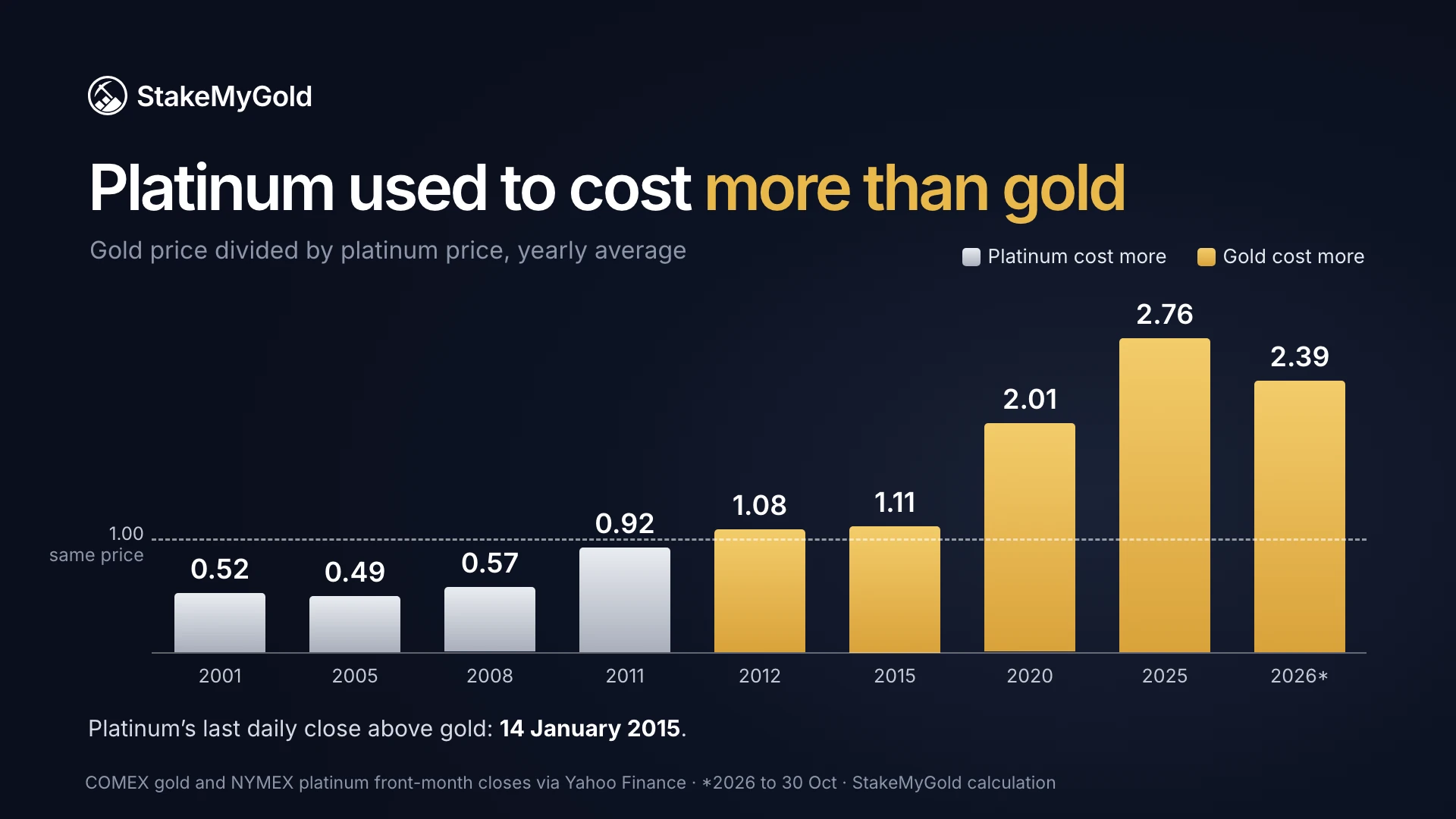
The two prices crossed back and forth between 2011 and 2014. On closing prices, platinum's last day above gold was 14 January 2015, when it settled at $1,238.40 against gold's $1,234.40. Since August 2000, platinum has closed above gold on about 44% of trading days, but not once since January 2015.
The widest gap came on 22 April 2025, when gold closed at 3.59 times the price of platinum. Then platinum rallied. From the end of 2024 to 30 October 2026, platinum is up about 61% and gold about 48%. So platinum has clawed back some ground, but it is still nowhere near parity.
Platinum can be a good trade, but over the long run it has been a worse investment than gold: lower returns and deeper falls. Here is what $10,000 in each metal would be worth on 30 October 2026, depending on when you started.
| Platinum | Gold |
|---|
| Price, 30 Oct 2026 (front-month futures close) | $1,438.00/oz | $3,898.90/oz |
| World mine output, 2025 (USGS estimate) | ~170 tonnes | ~3,300 tonnes |
| Top producer | South Africa, ~71% of output | China, ~12% of output |
| Biggest source of demand | Car exhaust catalysts, ~41% (2026 forecast) | Jewelry, then bars, coins and central banks |
| Annual return, Jan 2001 to Oct 2026 | ~3.4% | ~10.9% |
| Worst fall from a peak since 2001 | -73.5% | -44.4% |
| Typical yearly swing (volatility) since 2001 | ~28% | ~18% |
| US tax on gains (collectible) | Up to 28% | Up to 28% |
| Jewelry purity for an unqualified label | 950 parts per thousand | 24K for "gold"; karat stated otherwise |
| Year | Gold price divided by platinum price (yearly average) | Which cost more |
|---|
| 2001 | 0.52 | Platinum, about 1.9x gold |
| 2005 | 0.49 | Platinum, about 2x gold |
| 2008 | 0.57 | Platinum |
| 2011 | 0.92 | Platinum, narrowly |
| 2012 | 1.08 | Gold, first full year |
| 2015 | 1.11 | Gold, for good |
| 2020 | 2.01 | Gold, about 2x |
| 2025 | 2.76 | Gold, about 2.8x |
| 2026 (to 30 Oct) | 2.39 | Gold |
| Start date | Gold | Platinum | Gold per year | Platinum per year |
|---|
| 2 Jan 2001 | $145,260 | $23,580 | 10.9% | 3.4% |
| 3 Mar 2008 (platinum's 2008 peak month) | $39,720 | $6,490 | 7.7% | -2.3% |
| 3 Jan 2011 | $27,410 | $8,070 | 6.6% | -1.3% |
| 4 Jan 2016 | $36,270 | $16,280 | 12.6% | 4.6% |
Price change only, from futures closes; ignores storage, dealer spreads, fund fees and taxes.
From almost any start date in the past 25 years, gold is ahead today. The exception is a short window: buyers who started between late August 2024 and June 2025 have done better in platinum. Even someone who bought platinum near its January 2016 low has earned about a third of gold's annual return since then.
The risk side is just as clear. Since 2001, platinum's daily price moves have added up to a yearly volatility of about 28%, against about 18% for gold. Volatility is a measure of how much a price typically swings in a year; higher means a bumpier ride. Platinum's worst peak-to-low fall in that period was 73.5%, ending in March 2020. Gold's was 44.4%, ending in December 2015.
2026 is a fresh example. Platinum closed at a record $2,852.40 on 26 January, then fell 49.6% to 30 October. Gold's record close of $5,318.40 came on 29 January, and it is down 26.7% since. Both fell hard. Platinum fell nearly twice as far. WPIC blames investment outflows in the first half of 2026, mainly from exchange-traded funds, as investors priced in higher interest rates.
The bull case for platinum rests on supply. WPIC estimates the market ran a deficit of 1,440,000 ounces in 2025, its third year in a row of more demand than supply. Even with a small surplus forecast for 2026, it says above-ground stocks will cover only about 3.4 months of demand. WPIC also points to new demand from AI data-center hardware. These are reasons platinum could rally. They are not evidence that it will, and WPIC is funded by the companies that sell platinum.
For a ring, the comparison turns on purity and weight, not on the price per ounce. That is why a platinum ring can cost more than a gold one even though gold is the pricier metal.
Under the US Federal Trade Commission's Jewelry Guides, a piece can be called just "platinum" only if it is at least 950 parts per thousand pure platinum. Gold works differently: anything less than pure 24-karat gold must state its karat, and a 14-karat ring is 14/24, or about 58.3%, gold. Our guide to karats and fineness explains the system.
Platinum is also heavier. Its density is about 21.45 grams per cubic centimeter, against about 19.3 for pure gold, and a 14K alloy is lighter still. So the same ring design needs more grams of metal, and nearly all of it is platinum. Add the harder work of casting a metal that melts at a higher temperature, and a platinum band often ends up costing more.
Resale is a different matter. When you sell, a buyer pays for the metal content, minus a margin. With platinum now at a deep discount to gold, the metal in a platinum ring may be worth less than the metal in a heavier 18K gold ring.
You can own platinum in most of the same ways as gold, but the market is smaller and the products cost more to hold.
Taxes are the same for both metals in the US. The IRS treats bullion as a collectible and taxes long-term gains on collectibles at a maximum rate of 28%. Our guide on how gold is taxed covers the details, and they apply to platinum bullion too.
StakeMyGold does not offer platinum, and we do not plan to argue that you should swap one metal for the other. Our platform is built around gold tokens, digital tokens that each represent a claim on real gold, and lets holders earn a yield on tokenized gold by staking them.
If the data above makes you lean toward gold as your core precious metal, tokenized gold is one way to hold it without storing bars. It comes with its own risks, including smart-contract and custodian risk, which our guide to whether gold staking is safe sets out.
Is platinum more expensive than gold? No. On 30 October 2026, gold futures closed at $3,898.90 an ounce and platinum at $1,438.00, so gold cost about 2.7 times as much. Platinum last closed above gold on 14 January 2015.
Is platinum rarer than gold? Yes. The USGS estimates world mines produced about 170 tonnes of platinum in 2025 and about 3,300 tonnes of gold, so roughly 19 times more gold is mined each year. About 71% of platinum comes from South Africa.
Why is platinum cheaper than gold? Because most platinum is used up in car exhaust systems and industry, while gold is mostly held as jewelry, bars, coins and central bank reserves. Industrial demand rises and falls with the economy, and platinum has no central bank buyer.
Is platinum a better investment than gold? Not over the past 25 years. From January 2001 to October 2026, gold returned about 10.9% a year and platinum about 3.4%, with platinum's worst fall at 74% against gold's 44%. Platinum can outperform in short rallies, as it did in 2025, but it is the riskier metal.
Platinum vs gold is a story of rarity losing to demand. Platinum is about 19 times scarcer to mine, yet it trades at about 37% of gold's price because its buyers are mostly factories, not savers. Since 2001, gold has delivered roughly three times the annual return with smaller falls. Platinum can be a speculative side position for someone who wants exposure to car and industrial cycles. Gold is the metal that has done the job of storing value.
This article is for informational purposes only and is not financial or tax advice.
