On 9 October 2026 gold traded around $4,180 an ounce, about a quarter below its January record. Yet in the second quarter of 2026, while the price was falling, central banks bought another 289 tonnes. So why is gold valuable enough that governments keep buying it during a slump, when it pays no interest and most of it just sits in vaults and jewelry boxes?
The short answer: gold is valuable because it is the one element that does everything money needs a material to do. It does not rust or decay, it is rare but not too rare, it is easy to melt and shape, and the supply grows only about 1.6% a year. On top of that physical base sit 2,500 years of use as money, steady demand from jewelry buyers, investors and central banks, and one feature no bank deposit or bond has: no counterparty risk.
There is also an honest case against gold, and this guide gives it a full section. Gold produces no income, and part of its value rests on a shared agreement that it is valuable. Both things are true at once.
Gold is valuable because it combines physical properties no other element matches with a supply that grows slowly and a long history of people trusting it as money. Five reasons do most of the work:
The rest of this guide takes each reason in turn, then gives the strongest arguments against it.
Of the 118 elements, gold is the one that survives every test a material for money has to pass. NPR's Planet Money asked Columbia University chemical engineer Sanat Kumar to cross off every element that could not work as money. The elimination went like this:
Source: NPR Planet Money interview with Sanat Kumar, Columbia University.
What is left is gold. Kumar's own conclusion was that, on Earth, gold is "the sweet spot."
The properties behind that result are well documented:
Silver passes most of the same tests and has been used as money for just as long. Two things separate them. Silver tarnishes, so it does not keep its look the way gold does. And silver is much more plentiful: the US Geological Survey estimates world mines produced about 26,000 tonnes of silver in 2025, against about 3,300 tonnes of gold on the same survey's method, roughly eight times as much. That keeps silver's price per ounce far lower. Our gold-silver ratio explainer covers how the two prices relate.
Platinum is rare and does not corrode, and at times it has traded above gold. But ancient metalworkers could not melt it, so it never built gold's monetary history. That history is a large part of why gold, not platinum, is the metal central banks hold today.
Gold is scarce in a specific way: almost all the gold ever mined still exists, and new mining adds only about 1.6% a year to it. That makes gold different from oil, wheat or copper, which get used up.
The World Gold Council (WGC, the gold mining industry's market-research body) estimates that about 222,600 tonnes of gold had been mined in all of history by the end of June 2026. Mines produced 3,671.6 tonnes in 2025, and another 1,404 tonnes came from recycling.
Analysts describe this with a ratio called stock-to-flow. Stock-to-flow is the existing supply (the stock) divided by new production each year (the flow). The higher it is, the less one year of new supply can change the total.
Stock-to-flow and growth rate are our calculations from the WGC figures above.
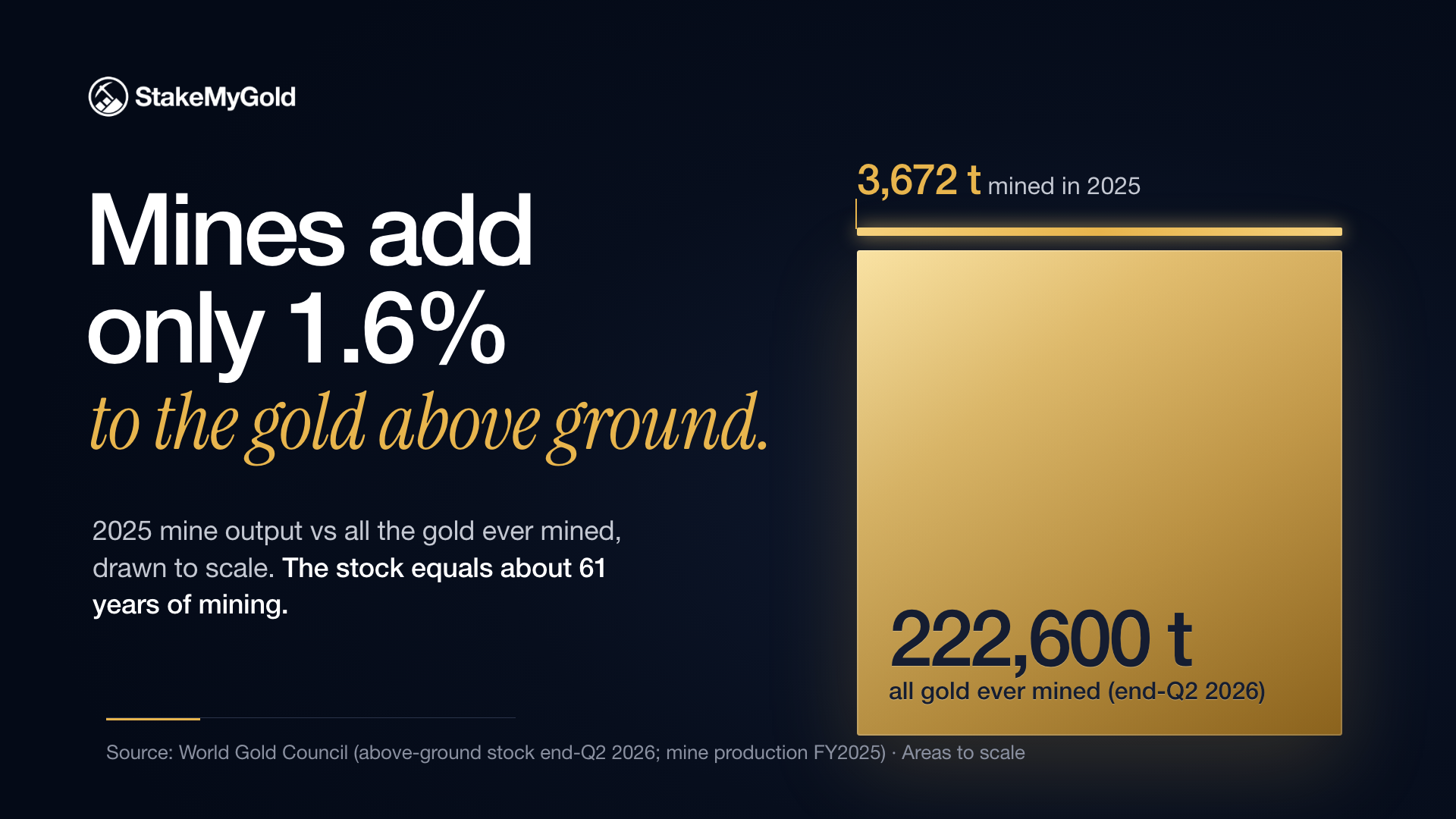
In plain words: even if mines had a record year, it would barely change how much gold exists. A sudden discovery cannot double the supply the way a new oil field or a new factory can for other goods. For the full count of who holds those 222,600 tonnes and how much is left to mine, see how much gold there is in the world.
Scarcity alone does not make something valuable. Plenty of rare things are worth little. Scarcity matters for gold because it comes on top of the other reasons.
Gold became valuable as money long before modern finance, and that record is part of why people still trust it. The London Bullion Market Association (LBMA, the trade body for the wholesale gold market) describes the Croesus stater, struck in Lydia (modern-day Turkey) in the middle of the sixth century BCE, as the world's first minted gold coin.
Gold kept a formal role in money into living memory. Under the postwar Bretton Woods system, US dollars were convertible to gold at a fixed $35 an ounce. On 15 August 1971, President Nixon closed that "gold window," and the link between the dollar and gold ended.
Since then, no major currency has been backed by gold. Gold stopped being money in daily life but kept its role as a store of wealth. That is the bridge between the history and today's demand.
Gold is valuable partly because many different buyers want it for different reasons, so demand does not depend on any one group. WGC data for full-year 2025:
| Step | What gets crossed off | Why |
|---|
| 1 | Noble gases (the far-right column) | Stable, but gases: open the jar and your money is gone |
| 2 | Lithium and 38 other reactive elements | They burn, corrode or fall apart |
| 3 | The radioactive rows at the bottom | They are dangerous to hold |
| 4 | Common elements near the top of the table | Too plentiful to be precious |
| 5 | Osmium | Too rare to make enough money |
| 6 | Rhodium and palladium | Not discovered until the early 1800s |
| 7 | Silver | It tarnishes |
| 8 | Platinum | Melts at over 3,000 °F, out of reach for ancient furnaces |
| Measure | Figure | Source |
|---|
| Above-ground stock (end-Q2 2026) | ~222,600 t | WGC |
| Mine production (2025) | 3,671.6 t | WGC |
| Stock-to-flow | ~61 years of mine output | 222,600 ÷ 3,671.6 |
| Annual growth of the stock from mining | ~1.6% | 3,671.6 ÷ 222,600 |
| Known reserves still in the ground | ~61,000 t | WGC |
| Buyer | Tonnes (2025) | Share of demand |
|---|
| Investment (bars, coins, ETFs, meaning exchange-traded funds that hold gold) | 2,175.3 | ~44% |
| Jewelry fabrication | 1,638.0 | ~33% |
| Central banks and other institutions | 863.3 | ~17% |
| Technology (electronics, dental, other) | 322.8 | ~6% |
| Total | 4,999.4 | 100% |
Source: WGC Gold Demand Trends Full Year 2025. Shares are our calculation.
Total demand was worth about $555 billion in 2025. Technology is the smallest slice, but it is real: gold conducts electricity well and does not corrode, which is why it is used to coat electrical connectors and as thin wires inside computer chips.
Central banks are the buyer to watch. In the WGC's 2026 survey of reserve managers, 89% expected global central bank gold holdings to keep rising over the next 12 months, and 90% cited gold's performance during times of crisis as a reason to hold it. We cover this in more depth in central banks have bought gold at a record pace, and the jewelry and Asian investment side in who actually buys gold.
Physical gold is valuable to many holders because it is not anyone's promise to pay. Counterparty risk is the risk that the other side of a financial contract does not pay you. A bank deposit depends on the bank, a bond depends on the borrower, and a currency depends on the government and central bank that issue it.
A gold bar in your hands, or in a vault under your name, does not depend on anyone else staying solvent. That is one reason central banks hold it next to foreign government bonds: if a country's bonds are frozen or defaulted on, the gold is still there.
The protection is only as good as the way you hold gold, though:
One year of mine output is worth less than 2% of all the gold that already exists. Here is the math at the 9 October 2026 price of about $4,180 an ounce. One tonne is 32,150.75 troy ounces (the unit gold is priced in).
Compare that with a currency. The US M2 money supply, a broad measure of dollars, grew by about 25% between December 2019 and December 2020, from $15.35 trillion to $19.12 trillion. Gold's supply cannot be expanded that way, which is the core of the "store of value" argument.
The strongest arguments against gold are that it produces nothing, that much of its value is social agreement, and that its price can fall hard. Each deserves a straight answer.
It produces no cash flow. A farm grows crops, a company earns profits, a bond pays interest. Gold does none of these. Warren Buffett made this case in 2012, writing that the world's gold would remain "incapable of producing anything" no matter how long you held it. Because gold pays nothing, holding it costs you the interest you could earn elsewhere, which is why gold often struggles when interest rates rise.
Its value is partly a convention. Only about 6% of 2025 demand was for technology. Most gold is bought because other people will value it later, as jewelry, savings or reserves. That is a shared belief, sustained by history. Even central banks cite tradition less: in the WGC's 2026 survey, the share naming "historical legacy" as a reason fell to 46%, from 62% in 2025. A skeptic would say the belief could weaken. A defender would answer that the same is true of any currency.
Its price is volatile. Gold fell about a quarter from its January 2026 record within months. Over the long run it has tracked inflation unevenly, as our look at gold as an inflation hedge since 1971 shows. The reasons for this year's fall are in why gold is falling in 2026.
The fair conclusion: gold is not valuable because it earns anything. It is valuable because it keeps its substance, its supply is hard to expand, and enough people across countries and centuries have agreed to treat it as wealth.
StakeMyGold lets holders of gold-backed tokens stake them for a return paid in gold. The live token today is GGBR, which is backed by certified in-ground gold reserves, not vaulted bars. PAXG and XAUT, both backed by vaulted bars, are listed as coming soon.
Be clear about the trade-off. A token is a claim on gold held by someone else, so it does not give you the "no counterparty risk" feature of a bar in your own safe. It adds issuer, custody and smart contract risk in exchange for easier transfer and, with staking, a return. If counterparty-free ownership is the reason you want gold, physical bullion does that more directly. If you do use staking, read the risks most platforms leave out first, and check current terms on the staking page.
Why is gold so valuable compared to other metals? In a chemist's elimination of the periodic table, gold is the only element that is durable, rare but not too rare, easy to work and safe to hold all at once. Silver tarnishes and is mined in roughly eight times the quantity; platinum was too hard for early civilizations to melt, so it never became money.
When did gold become valuable? People prized gold for ornaments long before coins, and the first minted gold coins appeared in Lydia (modern-day Turkey) in the sixth century BCE. Gold backed the US dollar at $35 an ounce until 1971.
Why is gold valuable when it has no use? It does have uses: about 6% of 2025 demand was for technology such as electronics. But most of its value comes from its role as a store of wealth, which rests on durability, slow supply growth and long-standing trust.
Why is gold more valuable than money? Gold is not more valuable than money in daily life, since you cannot easily spend it. Holders value it because its supply grows only about 1.6% a year and it carries no counterparty risk, while currencies can be printed and bank deposits depend on the bank.
Will gold ever lose all its value? No one can rule it out, but it would require jewelry buyers, investors and central banks across the world to stop wanting it at the same time. Its price can still fall sharply, as it did by about a quarter in 2026.
Is gold a good investment because it is valuable? Not necessarily. Being valuable explains why gold has a price; it does not tell you whether today's price is a good entry point. Gold pays no income and can be volatile.
Why is gold valuable? Because chemistry, scarcity and history all point the same way. It does not corrode, it is easy to work, its supply grows about 1.6% a year, and people have treated it as wealth for 2,500 years. Central banks still buy it because it is no one's liability. The counter-case is also real: gold pays nothing, its value is partly a shared belief, and its price can drop by a quarter in a few months. Both sides are worth knowing before you own any.
This article is for informational purposes only and is not financial advice. StakeMyGold operates in the tokenized-gold market.
