On 18 August 2026 the World Gold Council (WGC, the gold mining industry's market-research body) updated its answer to a question thousands of people search every month: how much gold is there in the world? The answer: about 222,600 tonnes of gold had been mined in all of history by the end of June 2026. Melted into one block, that is a cube roughly 22.6 metres (74 feet) on each side. At the spot price of $4,140 per ounce on 2 October 2026, it is worth about $29.6 trillion.
If you have searched this before, you have probably seen other numbers: 190,040 tonnes, 201,296 tonnes, 216,000 tonnes, even 244,000 tonnes. Most of them are not wrong. They are older snapshots of a total that grows every year, or they count something slightly different. This guide lines them up, shows who holds the gold, works through the cube and swimming-pool math step by step, and puts the "how much is left" and ocean-gold claims in proportion.
There are about 222,600 tonnes of gold above ground in the world, according to the World Gold Council's end-Q2 2026 estimate. That is the total ever mined. Gold barely corrodes and is almost always recycled, so the WGC treats nearly all of it as still existing in some form.
Two definitions matter here:
One tonne is 32,150.75 troy ounces (the unit gold is priced in), so 222,600 tonnes is about 7.16 billion troy ounces.
About 222,600 tonnes of gold has been mined through mid-2026; the other figures you see online are mostly older editions of the same series or count reserves as well. The total rises by roughly 3,600 to 3,700 tonnes a year, so a page that has not been updated since 2020 will be about 20,000 tonnes behind.
The USGS figure is the one that confuses people most. It is larger because it adds gold still in the ground to gold already mined. It is not a rival estimate of the above-ground stock.
Nobody weighed most of the gold mined before the 20th century. The WGC's total is built from data compiled by two consultancies, Metals Focus and Refinitiv GFMS. Modern production, which makes up about two-thirds of the total since 1950, is well recorded. Earlier centuries are reconstructed from historical studies.
That reconstruction has been challenged. In 2012, GoldMoney founder James Turk argued that the official estimate at the time (171,300 tonnes at end-2011) was about 16,000 tonnes too high, mainly because of assumptions about pre-modern production. The WGC has not adopted that view, and no published estimate is free of guesswork for ancient output. A fair reading: the modern figures are solid, and the total could plausibly be off by a few percent in either direction.
Private owners hold most of the world's gold, mainly as jewelry; central banks hold about 18%. The WGC's end-Q2 2026 breakdown:
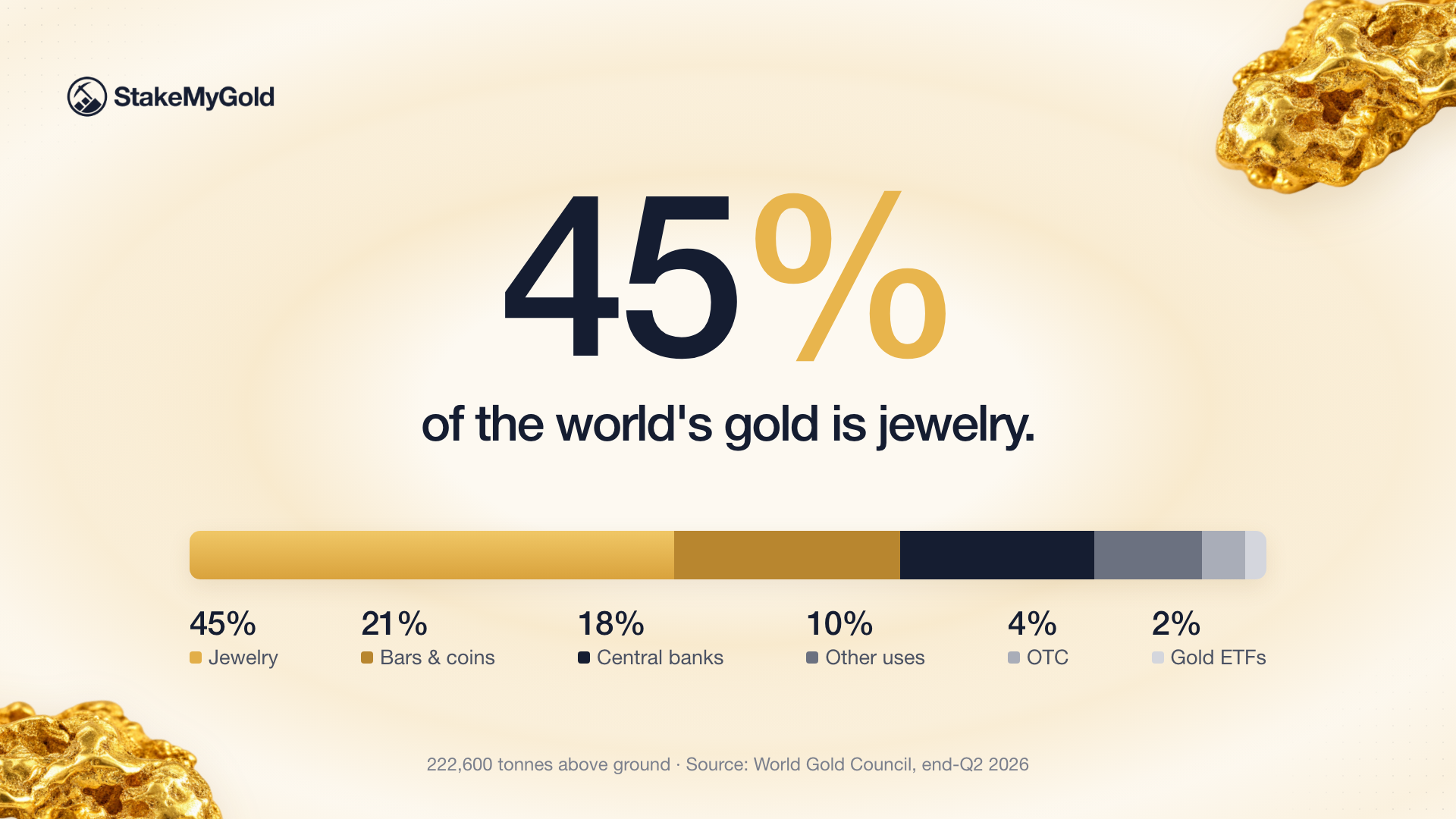
The WGC values these at the LBMA Gold Price on the last day of the quarter. Adding central banks, bars, coins, ETFs and OTC holdings gives about 100,800 tonnes of "investment" gold, almost the same weight as all the world's jewelry.
Among countries, the United States reports the largest official holding, about 8,133 tonnes. The USGS lists Treasury stocks at 8,130 tonnes in every year from 2021 to 2025. For what is actually stored at the Kentucky depository, see our piece on how much gold is in Fort Knox. For where the rest physically sits, from the Bank of England to Swiss refiners, see where the world's gold is stored. Central banks' share has been rising: they have been buying at a record pace since 2022.
All the gold ever mined would form a cube about 22.6 metres (74 feet) on each side. You can check this yourself with one physical constant: pure gold has a density of 19.32 grams per cubic centimetre.
One year of mine output (3,672 tonnes in 2025) adds about 190 m³, which stretches each side of the cube by only about 12 centimetres.
| Figure you will see | Source | As of | What it counts |
|---|
| 190,040 t | Quoted by BullionByPost (WGC series) | end-2017 | Above-ground stock, old edition |
| 201,296 t | Wikipedia, citing WGC | 2020 | Above-ground stock, old edition |
| ~216,000 t | Visual Capitalist, citing WGC | earlier WGC edition (date not shown) | Above-ground stock |
| 222,600 t | WGC Goldhub (updated 18 Aug 2026) | end-Q2 2026 | Above-ground stock, current |
| 244,000 t | USGS FAQ | mid-2010s data | "Discovered" gold: 187,000 t produced plus 57,000 t then in reserves |
| Holder | Tonnes | Share | Value (WGC, end-Q2 2026) |
|---|
| Jewelry | ~99,700 | 45% | US$13.0tn |
| Bars and coins | ~47,800 | 21% | US$6.0tn |
| Central banks | ~39,000 | 18% | US$5.0tn |
| Other (technology, dental, uses not allocated elsewhere) | ~22,100 | 10% | US$3.0tn |
| OTC (large investors' bars held off-exchange) | ~10,000 | 4% | US$1.5tn |
| Gold ETFs (exchange-traded funds holding bullion) | ~4,000 | 2% | US$0.5tn |
| Total | 222,600 | 100% | US$29.0tn |
No. It would fill about four and a half Olympic pools at the minimum depth, or about three at the deeper recommended depth. An Olympic competition pool is 50 m long and 25 m wide. World Aquatics sets a 2 m minimum depth and recommends 3 m.
The often-repeated claim that "all the gold fits in about three Olympic pools" is close only if you assume the deeper pool. With the 2,500 m³ figure most people use for an Olympic pool, the answer is closer to five.
At $4,140.06 per ounce (Reuters spot price, 2 October 2026), all the gold in the world is worth about $29.6 trillion. The WGC's own figure, valued at end-June prices, is $29.0 trillion.
Worked example:
At the January 2026 intraday record of $5,595.47, the same metal was worth roughly $40 trillion. The stock barely changed in nine months; the price did.
How that compares with other large pools of money:
| Asset | Value | Date | Source | Gold as % of it |
|---|---|---|---|---|
| All gold ever mined | ~$29.6tn | 2 Oct 2026 price | WGC tonnage × Reuters spot | n/a |
| Global equity market capitalization | $157.8tn | end-2025 | SIFMA Capital Markets Fact Book 2026 | ~19% |
| Global fixed income outstanding | $160.7tn | end-2025 | SIFMA Capital Markets Fact Book 2026 | ~18% |
| US M2 money supply | $23.3tn | Aug 2026 | Federal Reserve (FRED, M2SL) | ~127% |
The dates do not line up perfectly, so treat the percentages as orders of magnitude. The point stands: all the gold in the world is worth less than a fifth of listed stocks or of bonds, and somewhat more than the US money supply alone. Nearly half of that value is jewelry, which rarely trades at full metal value.
In 2025, total gold supply was a record 5,002 tonnes: 3,672 tonnes from mines and 1,404 tonnes from recycling, minus 74 tonnes of producer de-hedging (miners buying back earlier forward sales). Those are WGC figures from Gold Demand Trends Full Year 2025.
The latest quarter shows the same pattern. In Q2 2026, mine production hit 966 tonnes, the highest second quarter in the WGC's series back to 2000. Recycling fell 6% to 326 tonnes as prices dropped, and total supply was flat at 1,269 tonnes. First-half 2026 mine output was 1,867 tonnes, up 3%.
Three points help put the gold supply in perspective:
The USGS puts 2025 world mine production a little lower, at about 3,300 tonnes. Its leading producers, in order, were China, Russia, Australia, Canada and the United States. Different data methods explain the gap. Who buys that supply is its own story; see who actually buys gold.
Known gold reserves are about 61,000 tonnes (WGC) to 66,000 tonnes (USGS Mineral Commodity Summaries 2026), which is roughly 17 to 20 years of mining at today's rates. Beyond reserves, the WGC estimates about 114,400 tonnes of resources (gold that has been found but is less well drilled or not yet shown to be profitable).
The math:
Do not read that as "gold runs out in 2045." Reserves are an inventory, not a fixed endowment. They change when prices rise (more ore becomes worth mining), when companies drill, and when new deposits are found. The USGS FAQ, written years ago, cites 57,000 tonnes of reserves. The 2026 edition says 66,000 tonnes, even though more than 3,000 tonnes were mined every year in between.
What is real is that new discoveries are getting harder and slower to develop, and output has been flat for a decade. "Peak gold" is a debate about the production rate, not about gold disappearing. Gold already above ground does not get used up. That is also why tokens backed by gold still in the ground carry different risks from tokens backed by bars in a vault; see vaulted gold vs in-ground gold.
Counted by country, Australia (13,000 t) and Russia (12,000 t) report the largest reserves in the USGS table, followed by South Africa (5,000 t). The USGS notes that only 4,500 t of Australia's figure meets the stricter JORC reporting standard, a reminder that reserve totals mix different definitions.
The oceans do contain dissolved gold, but nobody can extract it at a profit, and popular estimates of the amount vary by more than a thousand times. Many articles repeat a figure of about 20 million tons. NOAA describes ocean gold differently: about one gram for every 100 million metric tons of seawater in the Atlantic and North Pacific, at concentrations "on the order of parts per trillion."
Run NOAA's ratio through NOAA's own ocean volume (1.335 billion cubic kilometres, about 1.37 quintillion tonnes of seawater) and you get roughly 14,000 tonnes. That is about 6% of the above-ground stock, not 90 times it. Measured concentrations differ by ocean and depth, so the true figure is uncertain. Either way, it is spread through the whole ocean, and NOAA says there is no cost-effective way to recover it.
Asteroids are a similar story. Headlines have valued the metal asteroid 16 Psyche at "$10,000 quadrillion," a number reached by multiplying its estimated mass by metal prices. NASA's Psyche spacecraft launched on 13 October 2023 and is due to start its main mission in August 2029. It is a science mission to study what may be the iron-nickel core of an early planet. It is not a mining project, and nothing about it changes the gold supply in any foreseeable time frame.
About 44 tonnes of vaulted gold backs today's gold tokens, roughly 0.02% of all the gold in the world. On 4 October 2026, CoinGecko's tokenized-gold category listed about $6.1 billion of tokens. Tether Gold (XAUT, $3.35bn) and PAX Gold (PAXG, $1.81bn) made up most of it.
To convert that to tonnes, we removed a bridged copy of XAUT (to avoid counting the same gold twice) and tokens backed by in-ground reserves, including our own GGBR. That left about $5.9 billion. At roughly $4,145 per ounce, that is about 1.42 million ounces, or 44 tonnes. It is an estimate based on market value, not an audited tonnage. For growth and usage data, see the tokenized gold market in 2026.
For comparison, gold ETFs hold about 4,000 tonnes, about 90 times as much.
A fixed, slow-growing stock does not tell you where the price goes next. The amount of gold barely changed between January and June 2026, yet the price fell about a quarter from its record. Prices are set by flows: who wants to buy or sell at the margin, interest rates, the dollar, central bank decisions. A 22.6 m cube is a good fact for a dinner party. It is not an investment thesis. For the forces that actually moved gold this year, see why gold is falling in 2026.
StakeMyGold lets holders of gold-backed tokens stake them for a yield. Today the live token is GGBR (Goldfish), which is backed by certified in-ground reserves, not vaulted bars. We excluded it from the "vaulted tokenized gold" figure above for that reason. PAXG and XAUT, both backed by vaulted bars, are listed as coming soon. If you want direct exposure to the gold already in vaults, those tokens, ETFs or physical bullion do that more directly than an in-ground-backed token. Before using any staking product, read the risks most platforms leave out.
How much gold is in the world in total? About 222,600 tonnes have been mined in all of history, as of the end of June 2026, according to the World Gold Council. Almost all of it still exists, mostly as jewelry and investment bars and coins.
Who owns most of the gold in the world? Private individuals, mainly through jewelry (45%) and bars and coins (21%). Central banks hold about 39,000 tonnes, or 18%. The United States has the largest official holding, about 8,133 tonnes.
How much gold is left to mine? About 61,000 to 66,000 tonnes are classed as reserves (WGC and USGS), or roughly 17 to 20 years of current production. Reserves are regularly replaced, so this is not a countdown to zero.
Would all the gold in the world fit in an Olympic swimming pool? No. At 11,522 cubic metres, it would fill about 4.6 Olympic pools at the 2 m minimum depth, or about 3.1 pools at the recommended 3 m depth.
How much is all the gold in the world worth? About $29.6 trillion at the 2 October 2026 spot price of $4,140 per ounce. That is less than a fifth of global stock market value.
Why do websites give different numbers for the world's gold? Most quote older editions of the WGC estimate (190,040 t, 201,296 t, 216,000 t). The total grows by about 3,600 to 3,700 tonnes a year. The USGS's 244,000 tonnes adds gold still in the ground.
All the gold in the world, about 222,600 tonnes, fits in a 22.6 m cube and is worth about $29.6 trillion at early-October 2026 prices. Most of it is jewelry and private investment, not central bank vaults. Mines add only about 1.6% a year, and there are 17 to 20 years of known reserves at current rates. That number keeps moving. The physical stock is well understood; the price is not set by it.
This article is for information only and is not financial or investment advice. Gold prices and the figures above change; check the linked sources for the latest data. StakeMyGold operates in the tokenized-gold market.
