On 23 October 2026, COMEX gold futures closed at $4,007.90 an ounce, about 25% below their record close of $5,318.40 in January. That weekend, one large dealer, Kitco, was selling a 1 oz gold bar for $4,111.90 by wire and offering $3,886.25 to buy one back. The same day, the SPDR Gold Trust (GLD) showed a 30-day median bid/ask spread of 0.01%.
That gap is the heart of the gold ETF vs physical gold question. A bar costs you up front, on the way in and the way out. A fund costs you a little every year, for as long as you own it. Which one is cheaper depends mostly on how long you hold.
The short answer: for a US investor holding $50,000 of gold for ten years at a flat gold price, the cheapest gold ETF (GLDM, 0.10% a year) costs about $500, GLD about $2,000, and 1 oz bars kept at home about $2,700, mostly from the dealer's markup and buyback discount. Both are taxed the same way, at up to 28%. The ETF wins on cost, liquidity and paperwork. Physical gold wins on one thing: nobody stands between you and the metal.
A gold ETF (exchange-traded fund) is a fund whose shares trade on a stock exchange and that holds gold bars on your behalf. Physical gold here means bars or bullion coins that you buy from a dealer and own outright. Both track the gold price. They differ in what you pay, what you own and who you depend on.
Dealer prices: Kitco, accessed 24 October 2026. ETF fees and spreads: issuer pages, 23 October 2026. Vault rate: BullionVault published tariff.
Fees at brokers come from Fidelity, which lists $0 commissions for online US stock and ETF trades. Check your own broker's price list before you buy.
On $50,000 held for ten years, with the gold price held flat so every lost dollar is a cost, GLDM is the cheapest option and 1 oz bars in a vault are the most expensive. Holding the price flat isolates fees from price moves. It is not a forecast.
Calculated with cost_calc.py from the prices and fees listed under Assumptions. Gold price flat at Kitco's 24 October 2026 quote.
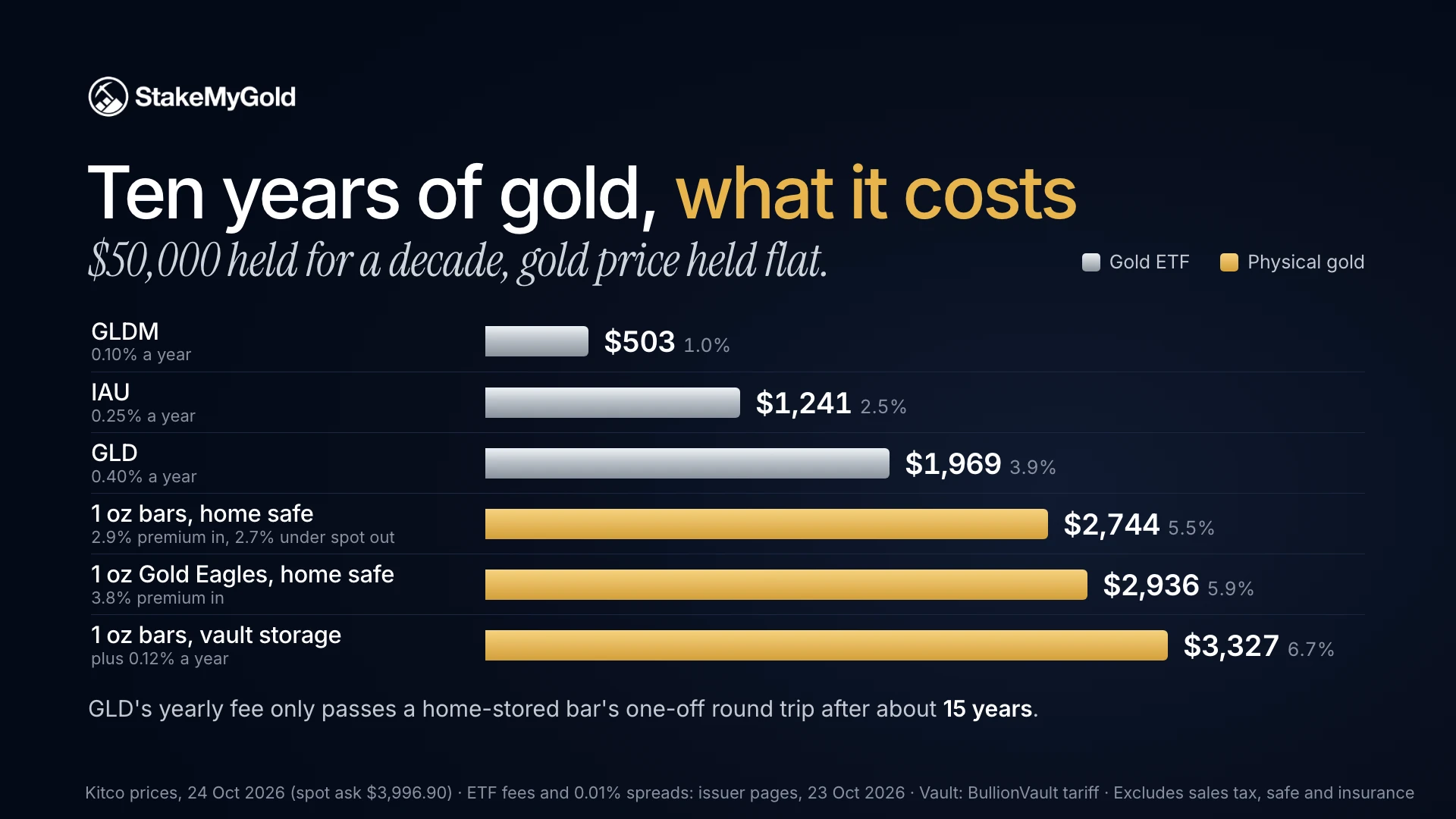
The round trip is what you lose by buying and selling back right away. For the 1 oz bar above it is 5.5% of what you paid. An ETF's fee builds up year by year, so there is a point where its total fee passes the bar's one-off cost.
| Gold ETF (GLD, IAU, GLDM) | Physical gold (bars, coins) |
|---|
| What you own | Shares in a trust that owns gold | The metal itself |
| Cost to buy | $0 commission at major brokers, spread ~0.01% | Dealer premium, ~2.9% for a 1 oz bar, ~3.8% for a 1 oz Eagle |
| Yearly cost | Expense ratio: 0.10% to 0.40% | Zero at home; ~0.12% a year in a vault |
| Cost to sell | Spread ~0.01% | Dealer buys back ~2-3% under spot |
| US tax on long-term gains | Ordinary rate, capped at 28% | Ordinary rate, capped at 28% |
| Who you depend on | Sponsor, trustee, custodians | Yourself, or your vault |
| Time to cash | Next business day | Days to weeks if you ship it |
| In a regular IRA | Yes | Only through a custodian, with rules |
| Can you take delivery | No, not as a retail holder | Yes, it is already yours |
| Option | Value when sold | Total cost | Cost as % |
|---|
| GLDM (0.10% a year) | $49,497 | $503 | 1.0% |
| IAU (0.25% a year) | $48,759 | $1,241 | 2.5% |
| GLD (0.40% a year) | $48,031 | $1,969 | 3.9% |
| 1 oz bars, home safe | $47,256 | $2,744 | 5.5% |
| 1 oz American Gold Eagles, home safe | $47,064 | $2,936 | 5.9% |
| 1 oz bars, vault storage at 0.12% a year | $46,673 | $3,327 | 6.7% |
| Years held | GLDM | IAU | GLD | 1 oz bar at home | 1 oz bar in a vault |
|---|---|---|---|---|---|
| 1 | 0.1% | 0.3% | 0.4% | 5.5% | 5.6% |
| 3 | 0.3% | 0.8% | 1.2% | 5.5% | 5.8% |
| 5 | 0.5% | 1.3% | 2.0% | 5.5% | 6.1% |
| 10 | 1.0% | 2.5% | 3.9% | 5.5% | 6.7% |
| 20 | 2.0% | 4.9% | 7.7% | 5.5% | 7.8% |
Total cost as a share of $50,000, gold price flat. Same inputs as the table above.
With these prices, GLD's fee passes a home-stored bar's round trip after about 15 years and IAU's after about 23. GLDM would take around 57 years. Put plainly: for most holding periods, a cheap ETF is the lower-cost route, and bars only win on cost if you hold for decades and store them for free.
Our earlier comparison of gold ETFs vs tokenized gold found the same pattern inside the ETF world: over ten years, the cheaper funds beat GLD by several percentage points, because they hold the same metal for a lower fee.
Yes. GLD, IAU and GLDM hold physical gold bars, not futures contracts. For GLD, the trust's annual report says that at the end of each business day only gold bars, and no gold in an unallocated form, are held in its accounts, and that the gold is held in London, New York or Zurich. That makes it allocated gold: specific, numbered bars that belong to the trust, as opposed to a general claim on a bank's metal. Our guide to allocated vs unallocated gold explains why that difference matters.
What "backed" means in practice, from GLD's own filings:
Two limits are easy to miss. First, retail shareholders cannot swap shares for metal. Shares are created and redeemed in baskets of 100,000 shares, only by large dealers called Authorized Participants; the 10-K says other shareholders "will only be able to redeem their Shares through an Authorized Participant". At the 23 October close of $366.61, one basket was worth about $36.7 million.
Second, the gold behind each share shrinks. The trust sells a little gold to pay its fee. A GLD share started out tied to about one-tenth of an ounce in 2004, and its annual report still charts it against the price of 1/10 of an ounce; in June 2026, redemptions averaged 0.0918 ounces per share. That is the 0.40% fee showing up in metal.
If you have read that "paper gold" outnumbers real gold 100 to 1, that ratio mostly concerns futures trading, not funds like GLD. We unpack it in what the 100-to-1 paper gold claim actually measures.
In the US, a physically backed gold ETF and a gold bar are taxed the same way. The IRS says net capital gains from collectibles are taxed at a maximum 28% rate, and its Schedule D instructions list gold, silver and platinum bullion as collectibles. Gains on assets held one year or less are short-term and taxed as ordinary income.
ETFs do not escape this. GLD, IAU and GLDM are grantor trusts, trusts whose income and gains flow through to their owners as if they held the metal directly. GLD's 10-K says gain on selling shares of a trust that holds collectibles "is treated as gain recognized on the sale of collectibles". The GLDM annual report and the IAU prospectus say the same for those funds.
Three practical differences remain:
For the full rules, including gold mining stocks, futures and gold tokens, see how gold is taxed. For how holding gold inside a retirement account changes this, see gold IRA vs physical gold.
Counterparty risk is the risk that someone you depend on fails to do what they promised. With a gold ETF, that is a chain of firms. With physical gold, it is mostly you.
GLD depends on a sponsor, a trustee (BNY Mellon) and two custodians, JPMorgan and HSBC, which may use subcustodians. The 10-K is direct about the gaps: "The Trust does not insure its gold." The custodians carry their own business insurance, which "does not cover the full amount of gold held by them", and the trust is not a beneficiary of it. The trustee also has no right to visit a subcustodian's premises. The allocated structure helps here: the bars are listed as the trust's property, not the bank's.
Bars at home remove every middleman, and add theft, fire and loss. Insurance is the weak point. The standard homeowners form published by the Insurance Information Institute sets a special limit of $200 per loss for money, bullion, gold and coins. Policies vary, and you can usually buy a rider, but check your own policy before you keep real money in a drawer. A professional vault solves this for a fee, which is the 0.12% line in our table. Our map of where the world's gold is stored shows how the big vaults work.
A gold ETF turns into cash faster and more cheaply than bars. GLD trades all day on NYSE Arca with a 0.01% median spread, and since May 2024 most US securities trades settle one business day after the trade.
Physical gold is easy to sell but slower. You get a quote, ship or carry the metal to the dealer, wait for inspection and then for payment, and you sell at the dealer's bid, about 2-3% below spot in our example. Our guide to how to sell gold compares dealers, pawn shops and online buyers, and what a gold bar is worth walks through the spread by bar size.
Neither is better for everyone. The right one depends on why you own gold.
A gold ETF suits you if:
Physical gold suits you if:
You can also split it: an ETF for most of the position and a few coins as a backstop. If you go the physical route, buy larger bars or common coins, since small pieces carry far higher premiums; our guide to gold coins vs bars explains why. How much gold to own at all is a separate question, covered in how much gold you should own.
Our cost table uses one dealer's prices on one weekend. Premiums rise when demand spikes and fall when it cools, and other dealers, local shops and pawnbrokers can pay you much less. Buying larger bars, such as a kilo bar, usually lowers the premium; Kitco listed one at about 2.9% over spot, but showed no buyback price for it.
We held the gold price flat. If gold rises, an ETF's fee grows in dollars along with your holding, while a bar's premium was fixed on the day you bought. We left out state sales tax on bullion, the cost of a safe, insurance riders, shipping, and ETF tracking error. ETF fees can also change. None of this says whether gold will rise or fall, or how much of it you should own.
StakeMyGold is neither of these options. It is a platform for staking gold-backed tokens, mainly GGBR, a token that the StakeMyGold FAQ says represents audited, unmined gold reserves. That is in-ground gold, not vaulted bars like GLD's, and the FAQ does not describe redeeming GGBR for physical metal. Our article on vaulted gold vs in-ground gold explains the difference.
The other difference is yield. ETFs and bars pay nothing. StakeMyGold's yield strategy page says rewards come mainly from lending against gold reserves, that returns are not guaranteed, and that a borrower's or partner's failure can affect returns and recovery of assets. That is a counterparty risk an allocated ETF or a bar in your safe does not carry. If you want the simplest, cheapest gold exposure, an ETF or a bar is the closer fit. We cover the trade-offs in is gold staking safe.
Is a gold ETF better than physical gold? For cost and liquidity, usually yes. In our $50,000 example, a 0.10% ETF cost about $500 over ten years against about $2,700 for 1 oz bars kept at home. Physical gold is better if you want no financial middleman at all.
Which gold ETF is 100% backed by physical gold? GLD, IAU and GLDM all hold allocated physical gold bars rather than futures. GLD's filings say its accounts hold only gold bars at the end of each day, and it publishes daily bar lists from its custodians, HSBC and JPMorgan.
Is a gold ETF taxed like physical gold? Yes, for physically backed ETFs that are grantor trusts, such as GLD, IAU and GLDM. Long-term gains are taxed as collectibles at your ordinary rate, capped at 28%, the same as bars and bullion coins.
Can I convert GLD shares into physical gold? Not as a retail investor. Only Authorized Participants can redeem shares, in baskets of 100,000 shares worth about $36.7 million at the 23 October 2026 close.
How much does it cost to store physical gold? At home it can cost nothing beyond a safe, but a standard homeowners form may cover only $200 of bullion. A professional vault charges a yearly fee; BullionVault, for example, publishes 0.12% a year for gold, with a $4 monthly minimum, insurance included.
Why does GLD hold less gold per share every year? Because the trust sells a small amount of gold to pay its 0.40% fee. Each share began tied to one-tenth of an ounce in 2004; by June 2026 it was about 0.0918 ounces.
Gold ETF vs physical gold comes down to time and trust. Over most holding periods, a low-fee ETF is the cheapest, most liquid way to own gold, and the IRS taxes it exactly like a bar. Physical gold costs more up front, wins on cost only over very long holds with free storage, and is the only option that leaves no one between you and the metal.
Before you choose, check three numbers: the fund's expense ratio, the dealer's premium, and the price the same dealer would pay you back today.
This article is for informational purposes only and is not financial or tax advice.
