On 16 October 2026, COMEX gold futures closed at $4,181.10 an ounce. That is 21% below the record close of $5,318.40 set on 29 January, and only a little above the 16 July close of $3,992.10, which ended a 25% fall from that record. If you own coins, bars, old jewelry, ETF shares or gold tokens, a year like this raises two questions: how to sell gold without giving away more than you have to, and whether to sell at all.
The short answer: work out what your gold is worth before anyone makes you an offer, get at least two written quotes, and sell through the channel that matches what you own. Bullion goes to a bullion dealer, jewelry to a refiner or jeweler, ETF shares through your brokerage, tokens through an exchange or the issuer.
This guide covers the payout math, compares eight places to sell, explains when a buyer has to report your sale to the IRS, and sets out a neutral way to decide whether selling makes sense right now. To build it, we went to the primary documents: the IRS Form 1099-B instructions, the COMEX gold futures rulebook, the FTC's record on mail-in gold buyers, and dealers' published sell-back terms. StakeMyGold does not buy gold, so we have no bid of our own to protect.
To sell gold, follow these five steps:
You will get the melt value of your gold minus the buyer's margin. The formula is:
Payout = weight in grams x purity x (spot price / 31.1035) x the buyer's percentage
The first three parts are facts you can check. The buyer's percentage is where offers differ, and it depends on what you are selling and who is buying.
The spot price of gold is the market price for one troy ounce of pure gold for immediate delivery. It is a wholesale reference, not a price anyone pays a retail seller. Dealers quote two numbers: the ask (what they sell at) and the bid (what they buy at). The gap is the spread, and it is how they earn a living. Benchmarks such as the LBMA Gold Price, set in twice-daily auctions at 10:30 and 15:00 London time, and COMEX futures anchor the spot price that dealers quote. For more on how that number is formed, see how the gold price is set.
When you sell, the only number that matters is the bid, expressed either in dollars or as a percentage of spot or melt value. Ask for it in that form.
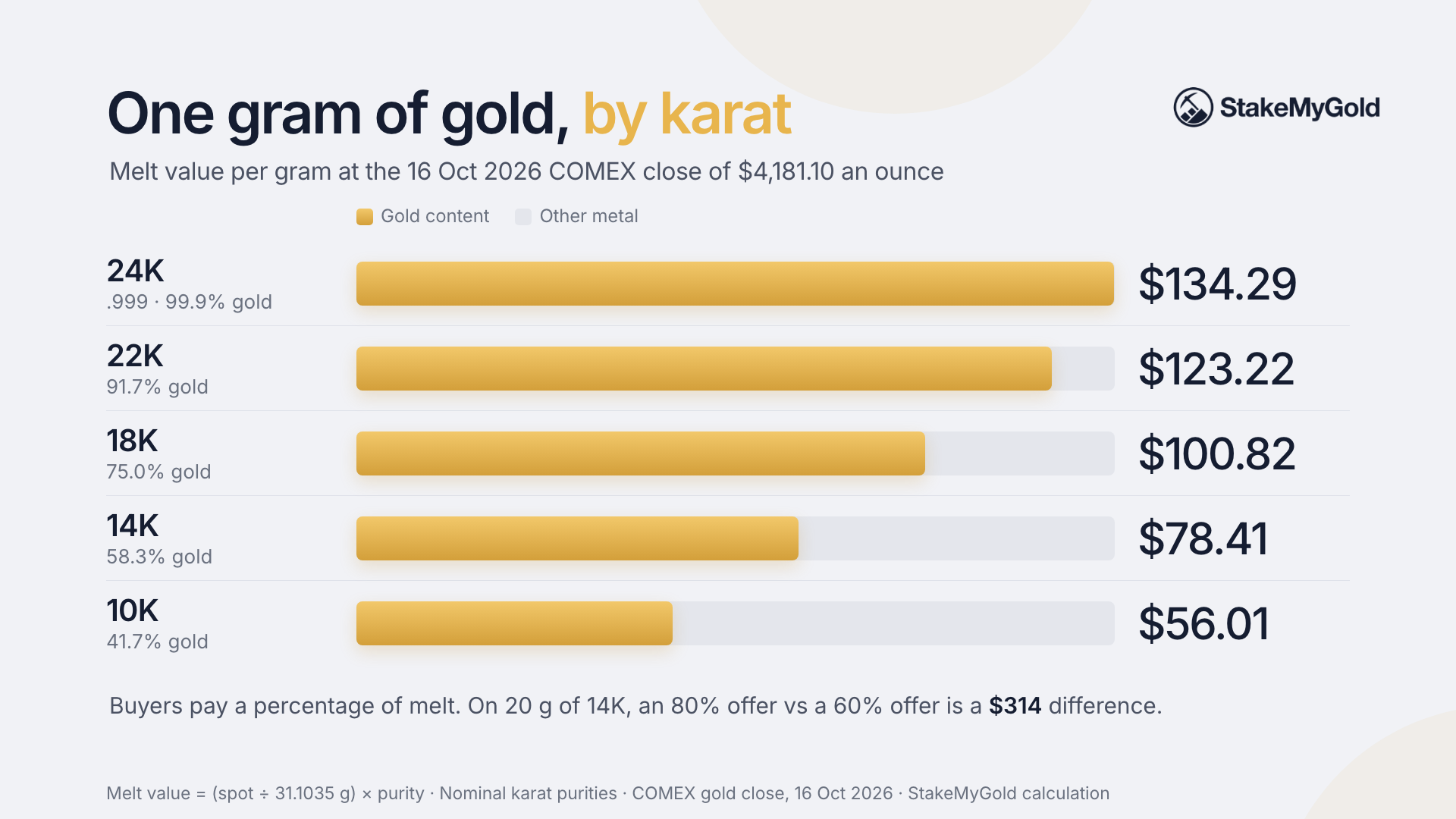
Melt value is the market value of the pure gold in an item, ignoring design, brand or collector value. It is the number scrap buyers start from. Karat measures purity in 24 parts. The Federal Trade Commission explains that 18K gold is 18 parts gold and 6 parts other metal, and 14K is 14 parts gold and 10 parts other metal. For a deeper explanation, see how karats and fineness work.
Melt value = (spot / 31.1035 g) x purity, using the COMEX gold close of 16 October 2026. Karat purities are the nominal 22/24, 18/24 and so on.

Stones, clasps made of other metals and hollow pieces all reduce the weight that counts. A buyer pays only for the gold.
Say you hold one 1 oz gold bullion coin and a 20-gram bag of broken 14K chains, and you sell with gold at the 16 October 2026 close of $4,181.10.
| Stamp | Gold content | Melt value per gram at $4,181.10/oz |
|---|
| 24K / .999 | 99.9% | $134.29 |
| 22K | 91.7% | $123.22 |
| 18K | 75.0% | $100.82 |
| 14K | 58.3% | $78.41 |
| 10K | 41.7% | $56.01 |
| Item | Pure gold | Melt value | If the buyer pays 98% | If the buyer pays 80% | If the buyer pays 60% |
|---|
| 1 oz bullion coin | 1.000 oz | $4,181 | $4,097 | n.a. | n.a. |
| 20 g of 14K jewelry | 11.67 g (0.375 oz) | $1,568 | n.a. | $1,255 | $941 |
The percentages are illustrations, not quotes from any dealer.
They show why the buyer's percentage matters more than anything else on scrap: on the same 20 grams, the gap between an 80% offer and a 60% offer is $314. On a bullion coin, each percentage point is worth about $42.
The other cost people miss is the round trip. If you bought that coin at a premium over spot (the extra dealers charge above spot to cover minting, shipping and margin) and sell it at a bid below spot, the price has to rise by the premium plus the spread before you break even. Our guide to coin and bar premiums covers why some products carry larger premiums than others.
The best place to sell gold is the buyer that specializes in your type of gold. A bullion dealer is usually best for standard coins and bars. A refiner or reputable scrap buyer is usually best for broken jewelry. A jeweler or auction can beat melt value only for branded, antique or designer pieces. Your brokerage is the place for ETF shares, and a regulated exchange or the token issuer is the place for gold tokens.
| Where to sell | Best for | How the price is set | Speed | Watch out for |
|---|---|---|---|---|
| Local coin shop or bullion dealer | Bullion coins and bars | Posted bid vs. spot | Same day | Ask for the bid as % of spot; compare two shops |
| Online bullion dealer | Bullion, larger amounts | Price locked online or by phone, paid after inspection | Days to weeks (shipping, inspection, payment) | Minimums, payment timing, insured shipping |
| Refiner or mail-in gold buyer | Scrap jewelry, dental gold | % of melt value after assay | Days to weeks | Offer only after melting; get the return policy in writing |
| Jeweler | Branded or antique pieces | Resale value or melt | Same day | Many jewelers only pay scrap rates |
| Pawn shop | Fast cash, small items | Negotiated; includes the shop's resale margin | Minutes | Selling vs. pawning (a loan) are different deals |
| Private sale or auction | Collectible coins, designer pieces | What a buyer will pay | Weeks | Fraud, fees, payment risk |
| Brokerage (ETF shares) | GLD, IAU and other gold ETFs | Market price during trading hours | Seconds; settles next business day | Reported on Form 1099-B; collectibles tax rate can apply |
| Exchange or issuer (tokens) | PAXG, XAUT | Market price or issuer redemption | Minutes to days | Exchange fees; token may trade above or below spot; Form 1099-DA |
Online dealers publish their own terms, and they change. When we checked JM Bullion's sell-back page on 19 October 2026, it set a $1,000 minimum and said payment was being issued 10+ business days after it received your metal, longer than the 3 to 7 business days stated elsewhere on the same page. Read the current terms before you ship.
Standard bullion (American Gold Eagles, Canadian Maple Leafs, Krugerrands, bars from recognized refiners) is the easiest gold to sell because every dealer knows what it is. Expect the buyer to check weight, dimensions and sometimes run a non-destructive test. Keep coins in original packaging or assay cards where you have them; some dealers pay less for damaged or cleaned pieces.
Rare or graded coins are a different market. A coin valued above its gold content should go to a numismatic dealer or auction, not a scrap buyer, or you will be paid only for the metal.
Most jewelry sells as scrap, priced on melt value. Separate pieces by karat before you go, so a buyer cannot lump 18K in with 10K and pay the lower rate. Ask to have stones removed and returned, or sell them separately.
ETF shares such as SPDR Gold Shares (GLD) sell like any stock through your brokerage, and since May 2024 most US securities trades settle one business day after the trade. There is no dealer spread beyond the market bid-ask, but there is a tax point: the trust's own FAQ says gains on shares held more than a year are taxed at up to 28%, the collectibles rate, because the trust holds bullion. For a cost comparison of holding ETFs vs. tokens, see GLD and IAU costs over ten years.
Gold tokens can be sold on a crypto exchange for dollars or swapped for a stablecoin. Paxos also lets PAXG holders redeem for US dollars at market prices, or for LBMA Good Delivery gold bars. Token prices can drift away from spot on exchanges, so compare the token's price to spot before you sell; we explain why in why gold tokens trade above or below spot.
Swapping a token for a stablecoin is a sale for US tax purposes. The IRS lists exchanging one digital asset for another as a disposition that you must report.
The best way to sell gold for a fair price is to arrive knowing your melt value and to make buyers compete. A practical checklist:
The IRS learns about a gold sale in two ways: from a form the buyer files, or from your own tax return. Whether the buyer files depends on what you sell and how.
| How you sell | Does the buyer report to the IRS? | Form |
|---|---|---|
| Gold coins to a dealer (Eagles, Maples, Krugerrands, etc.) | Generally no under the IRS rule; some dealers still report 25 or more of certain coins | None, or Form 1099-B if the dealer reports |
| Gold bars meeting the COMEX futures contract (one 100 oz bar or three 1 kg bars, .995+ fine, approved brand), in a 24-hour period | Yes | Form 1099-B |
| Jewelry or scrap | No dealer 1099-B for jewelry | None |
| Gold ETF shares at a brokerage | Yes | Form 1099-B |
| Gold tokens through a crypto broker | Yes, gross proceeds for sales from 1 Jan 2025 | Form 1099-DA |
| Any sale | You report the gain or loss yourself | Form 8949 and Schedule D |
The rule behind the table. The IRS Form 1099-B instructions say a sale of gold, silver, platinum or palladium is not reportable if the quantity is below the minimum needed to satisfy a CFTC-approved futures contract, or if the metal is in a form the CFTC has not approved for futures trading. Sales to one customer within 24 hours are added together, and the exception does not apply if a broker knows a customer is splitting sales to avoid reporting. The COMEX gold contract calls for 100 troy ounces delivered as one 100 oz bar or three 1 kg bars of at least .995 fineness from an exchange-approved brand.
Why dealers disagree about coins. The instructions used to include an example saying a single gold coin was not reportable when gold coin contracts called for at least 25 coins. In early 2026 the IRS posted a correction removing that example from the 2025 and 2026 instructions. The National Coin & Bullion Association says the change was posted on 30 January 2026 and aligns the instructions with 2024 IRS Chief Counsel guidance. When we checked on 19 October 2026, the web version of the instructions still showed the old example, and JM Bullion still listed 25 or more 1 oz Maple Leafs, Krugerrands or Mexican Onzas, and bars totaling 1 kilo, as reportable. Ask the buyer before you sell.
Form 8300 is about cash the dealer receives, not cash it pays out. A business files it when it receives more than $10,000 in cash in one transaction or related transactions, which mostly applies when you buy gold with cash, not when you sell.
None of this changes what you owe. A sale that is not reported by the dealer is still taxable if you made a gain.
The IRS taxes long-term gains on collectibles at a maximum rate of 28%, rather than the lower rates on most long-term gains, and its Schedule D instructions list gold bullion and coins as collectibles. Gold held one year or less is taxed as ordinary income. Gold ETFs that hold bullion are generally treated the same way. We did not find IRS guidance specific to gold-backed tokens, so ask a tax professional how yours should be treated. Your cost basis (what you paid, including premium) decides the size of the gain, which is why the original receipt matters. For the full rules by vehicle, including ETFs, futures and gold tokens, see how gold is taxed.
Whether you should sell your gold depends on why you hold it and what you need the money for, not on the drop alone. A falling price is a reason to review the decision, not a decision in itself.
Reasons selling can make sense:
Reasons to pause:
If you are unsure, you do not have to sell everything on one day. Selling in stages spreads your exit across several prices, the mirror image of the buying approach in dollar-cost averaging gold.
If you only need cash for a short time, there is a third route: borrow against your gold instead of selling it. That keeps the position but adds liquidation risk if gold falls further. If the question is really whether gold belongs in your savings at all, start with is gold a good investment and how much gold you should own. We cover the buy side separately in is now a good time to buy gold.
StakeMyGold does not buy physical gold, coins or jewelry, and it does not offer loans. If you are selling bullion or jewelry, you need one of the buyers above.
Where it is relevant: if you are thinking of selling because gold pays no income, StakeMyGold lets holders of GGBR, a gold-backed token, stake it for a yield. The StakeMyGold FAQ says the platform targets up to 15% APR, although another answer on the same page cites 12%, so check the current rate before you stake. That yield carries smart contract, counterparty and liquidity risks, and leaving an optional-lock stake early costs 30% of the interest earned in that period. PAXG and XAUT support is listed as coming soon. See is gold staking safe before deciding.
What is the best way to sell gold? Calculate its melt value first, then get written quotes on the same day from at least two buyers that specialize in your item type. Bullion dealers usually pay closest to spot for standard coins and bars.
How much will I get if I sell my gold? Multiply the weight in grams by the purity (14K = 14/24) and by the spot price divided by 31.1035, then by the buyer's percentage. At the 16 October 2026 close of $4,181.10 an ounce, 20 grams of 14K gold has a melt value of about $1,568.
How does the IRS know if you sell gold? Dealers file Form 1099-B only for reportable sales, mainly large bars that meet the COMEX contract. Brokerages report ETF sales on Form 1099-B and crypto brokers report token sales on Form 1099-DA. Either way, you must report any gain on your return.
Do I have to pay taxes when I sell gold? Yes, if you sell for more than your cost basis. Long-term gains on gold bullion and coins are taxed as collectibles at up to 28%. Short-term gains are taxed as ordinary income.
Is it better to sell gold to a pawn shop or a dealer? For bullion and scrap, a dealer or refiner usually pays more. A pawn shop is faster and can lend against an item instead of buying it, but its offer has to cover its own resale margin, so compare it with a dealer's quote first.
Should I sell my gold now? Only if it fits your plan: you need cash, you are rebalancing, or you want to clear unused items. Selling only because the price fell locks in the loss and the spread.
Knowing how to sell gold comes down to three numbers you can check yourself (weight, purity, spot) and one you negotiate (the buyer's percentage). Use a specialist buyer, get competing quotes the same day, keep your receipts, and decide whether to sell based on your plan rather than the latest move in the price.
This article is for informational purposes only and is not financial or tax advice.
