On 23 October 2026, COMEX gold futures closed at $4,007.90 an ounce, their lowest close since mid-July and about 25% below the record close of $5,318.40 set on 29 January. For anyone buying gold for retirement, a lower price raises the question of how to hold it. And anyone aged 73 or older who already takes required withdrawals from a traditional IRA has until 31 December to take this year's.
So if you want gold for the long run, should you hold it in a gold IRA or buy coins and bars yourself? Most of the pages that rank for the gold IRA vs physical gold question are written by companies that sell gold IRAs or metals. StakeMyGold does not sell IRAs, coins or bars, so this comparison has no product to push on either side.
The short answer: a gold IRA only beats owning physical gold when the account is large enough that the tax shelter outweighs flat fees of a few hundred dollars a year (about $265 to $325 at one custodian we checked), and when you are happy to leave the metal in a depository you cannot visit. For smaller amounts, or if you want the gold where you can reach it, owning coins or bars outright is usually cheaper and simpler, even though long-term gains face a collectibles tax of up to 28%.
A gold IRA is a self-directed retirement account that holds IRS-approved gold coins and bars in a depository through a custodian. Physical gold is metal you buy and store yourself. The IRA defers tax (traditional) or removes it (Roth), but it charges flat fees every year, about $265 to $325 at STRATA Trust, and the metal must stay with the custodian. Physical gold has no account fees, no contribution limit and no required withdrawals, but long-term gains are taxed at your ordinary rate up to a 28% cap when you sell. Because the IRA's fees are fixed dollars, size decides the winner. In our 10-year Roth example with a 60% gain, the gold IRA cost more than it saved below about $27,000 and came out ahead above it. A traditional gold IRA taxes every dollar withdrawn as ordinary income, at up to 37%.
Fee figures from STRATA Trust and Equity Trust fee pages, accessed 24 October 2026. Tax rules from IRS publications cited below.
A gold IRA is a normal traditional or Roth IRA with one difference: it is self-directed. A self-directed IRA is one where the custodian lets you choose assets outside the usual stocks and funds. The custodian is the firm that holds the account on paper. Under IRS rules it must be a bank, a federally insured credit union, a savings and loan, or an entity approved by the IRS. The metal itself sits in a depository, a commercial vault that stores it for the custodian. Whether your coins are kept apart or pooled with other clients' matters, as our guide to allocated vs unallocated gold explains.
The default rule is strict. Under section 408(m) of the tax code, when an IRA buys a collectible, the purchase is treated as a distribution from the account, so it is taxed as if you had withdrawn the money. The code lists "any metal or gem" and "any stamp or coin" as collectibles.
Gold IRAs exist because of an exception. The same section excludes certain US-minted gold, silver and platinum coins, coins issued by a state, and gold, silver, platinum or palladium bullion of at least the fineness a US futures exchange requires, but only if that bullion is in the physical possession of the IRA trustee. For gold, the COMEX futures contract requires bars that assay to a minimum of 995 fineness, meaning 99.5% pure. IRS Publication 590-A says your IRA can invest in one, one-half, one-quarter or one-tenth ounce US gold coins and certain bullion.
Can you hold physical gold in your IRA? Yes, through this route, within the yearly limit. For 2026, IRS Publication 590-A sets the IRA contribution limit at $7,500, or $8,600 if you are 50 or older. Larger amounts usually arrive by rolling over an old 401(k) or IRA.
No. You cannot keep gold owned by your IRA at home. Some sellers market "home storage" or "checkbook" gold IRAs, where the IRA owns a company and you keep the coins in your own safe. The statute and the courts say otherwise.
The IRS page on collectibles says the bullion exception applies only if a bank or approved non-bank trustee keeps physical possession of it. If an IRA buys a collectible that does not qualify, the IRS treats the cost as an immediate distribution, generally reported as ordinary income.
The leading case is McNulty v. Commissioner, 157 T.C. No. 10 (2021). Donna McNulty's self-directed IRA owned an LLC that bought American Eagle gold coins, and she kept them in a safe at home. The Tax Court held that her physical possession of the coins made them taxable IRA distributions, $374,000 in 2015 and $37,380 in 2016, and it upheld accuracy penalties. According to the Journal of Accountancy's summary of the ruling, the court rejected her argument that the trustee rule covered only bullion and not coins.
If you want gold in your own hands, that is a good reason to buy physical gold outside an IRA. It is not something an IRA can give you.
A gold IRA costs more each year. Physical gold costs about the same to buy and sell, and its holding costs are whatever you choose to spend on security. Here is what two named custodians publish, next to one dealer's prices on the same day.
STRATA Trust fee schedule, Equity Trust fee FAQ and Kitco online store, all accessed 24 October 2026. Kitco spot shown: $3,996.90 ask. Commingled or non-segregated storage pools your metal with other clients' identical items; segregated storage keeps your specific coins or bars apart.
STRATA Trust's fee schedule lists a $150 annual IRA fee for its precious metals tier, storage of $115 commingled or $175 segregated, and $40 per purchase, sale or exchange. Equity Trust's fee FAQ lists storage at $110 non-segregated and $160 segregated, with the annual account fee based on account value. Kitco's online store on 24 October asked $4,149.90 for a 1 oz American Gold Eagle paid by wire, and bid $3,906.18 to buy the same coin back. A generic 1 oz bar was cheaper: $4,111.90 to buy and $3,886.25 to sell.
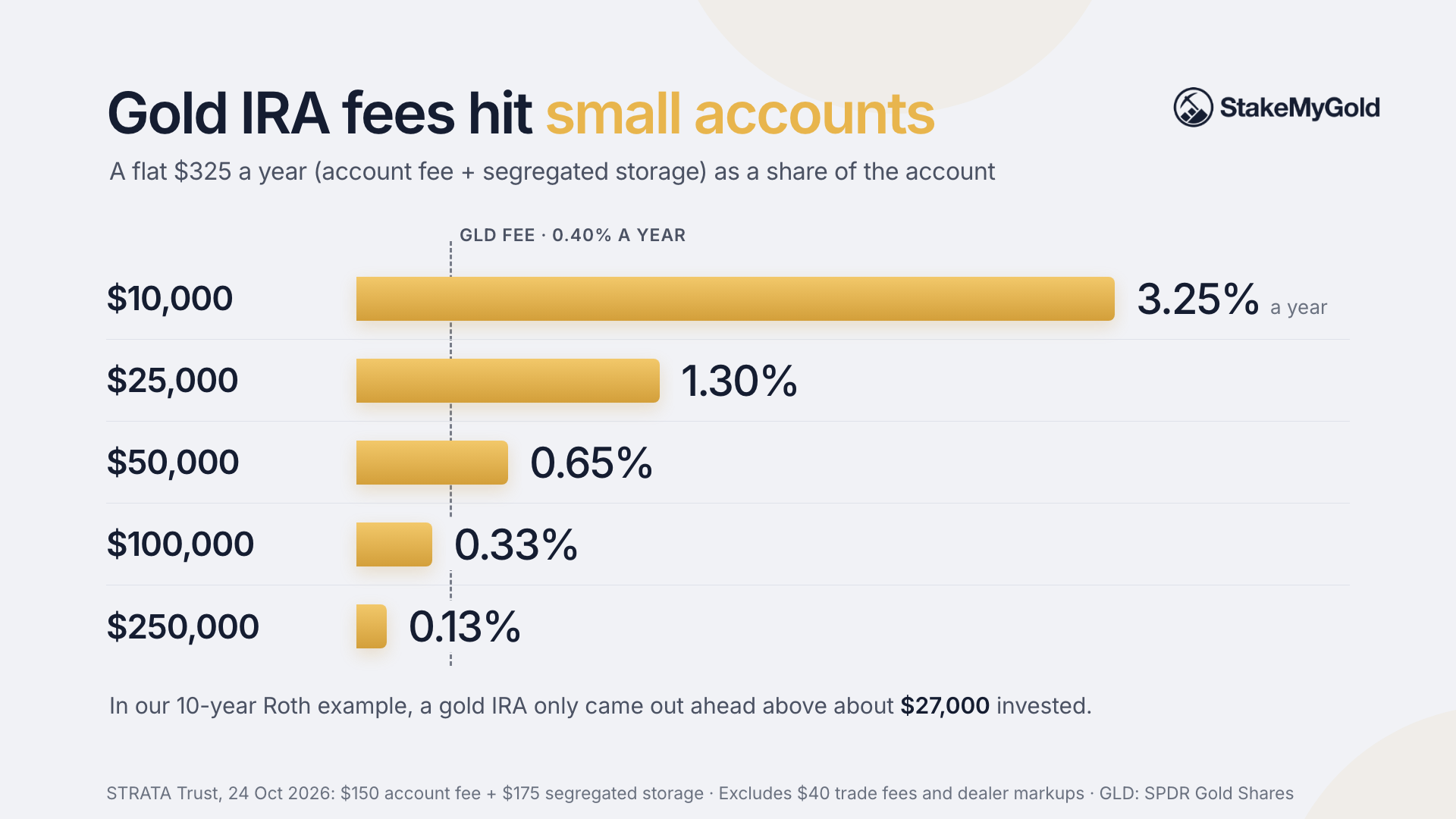
Because the IRA fees are flat dollars, their weight depends on the size of the account:
STRATA Trust precious metals tier: $150 account fee plus storage. Excludes trading fees and dealer markups.
For comparison, the SPDR Gold Trust (GLD), which holds gold bars, lists an expense ratio of 0.40% and can be held in an ordinary IRA at most brokers. Below about $80,000, a flat $325 a year is a higher percentage than that. Our comparison of gold ETFs vs tokenized gold shows what those fees add up to over ten years.
The bigger risk is the dealer, not the custodian. Gold IRA firms often bundle the metal sale with the account, and the markup is where abuse happens. In a 2023 enforcement action, the CFTC alleged that one dealer, Red Rock Secured, charged markups of roughly 100% to 130% on coins sold largely to retirement savers, while telling them markups would be far lower. A CFTC advisory describes a customer who rolled over a $300,000 account and was charged nearly $150,000 in commissions and fees. Before buying through any IRA company, compare its price with a large dealer's published ask for the same coin on the same day.
The tax difference depends on which kind of IRA you use and on your income. A Roth gold IRA can beat physical gold by a wide margin. A traditional gold IRA can be worse.
Gains inside the account are not taxed each year. When you take money or metal out, IRS Publication 590-B says distributions from a traditional IRA are taxed as ordinary income, at your regular rate, which in 2026 runs from 10% up to 37%. All of it is taxed, not only the gain, unless you made nondeductible contributions. The upside is that you may have deducted the contributions, and the withdrawals are excluded from the 3.8% Net Investment Income Tax.
Contributions are not deductible, but qualified distributions are tax-free. Under IRS Publication 590-B, a qualified distribution comes after a 5-year period that starts with your first Roth contribution, and on or after age 59½ (or on disability or death). For someone who expects gold to rise a lot, this is the strongest case for a gold IRA.
| Gold IRA | Physical gold you own |
|---|
| Who holds the metal | A custodian, in an approved depository | You, at home, in a bank box or a private vault |
| Yearly account costs | Custodian fee plus storage: $265-$325 a year at STRATA Trust, plus trading fees | None, but you pay for a safe, a box or insurance |
| Tax on gains | Traditional: ordinary income on withdrawal. Roth: tax-free if qualified | Up to 28% on long-term gains, plus 3.8% NIIT for high earners |
| How much you can put in each year | $7,500 in 2026 ($8,600 if 50 or older), plus rollovers | No limit |
| Required withdrawals | From age 73 in a traditional IRA. None for a Roth owner | None |
| Getting cash out | Through the custodian; 10% extra tax before 59½ in most cases | Sell to a dealer the same day |
| Eligible products | Only certain coins and bars | Anything you like |
| Cost | Gold IRA | Physical gold at home |
|---|
| Account setup | $50 at STRATA Trust (waived if opened online) | None |
| Yearly account fee | $150 at STRATA's precious metals tier; at Equity Trust it depends on account type and value | None |
| Yearly storage | STRATA: $115 commingled, $175 segregated. Equity Trust: $110 non-segregated, $160 segregated | Your own safe, bank box or insurance |
| Per trade | $40 per purchase or sale at STRATA | None |
| Closing the account | $250 at both STRATA and Equity Trust | None |
| Buying a 1 oz American Gold Eagle | Same dealer markup, chosen through the custodian | $4,149.90 at Kitco by wire, 3.8% over spot |
| Selling it back | Through the custodian | $3,906.18 Kitco bid, $243.72 (5.9%) less than the purchase price |
| Account size | Yearly fees at $325 (segregated) | Yearly fees at $265 (commingled) |
|---|
| $10,000 | 3.25% | 2.65% |
| $25,000 | 1.30% | 1.06% |
| $50,000 | 0.65% | 0.53% |
| $100,000 | 0.33% | 0.27% |
| $250,000 | 0.13% | 0.11% |
You buy with after-tax money and pay nothing until you sell. The IRS says net capital gains from selling collectibles such as coins are taxed at a maximum 28% rate. The 28% is a cap: if your ordinary rate is lower, you pay that lower rate, but you never get the 0% or 15% rates that stocks can get. Higher earners may also owe the 3.8% NIIT. Only the gain is taxed, and only when you sell. Our guide to how gold is taxed covers brackets, cost basis and losses.
So, for a high earner who will still be in a high bracket in retirement, a traditional gold IRA can turn a gain capped at 28% into a full withdrawal taxed at up to 37%.
From age 73, traditional IRA owners must take a yearly withdrawal, and gold makes this awkward. The IRS says you generally must start required minimum distributions when you reach age 73. The amount is the account's value on 31 December of the prior year divided by a life expectancy factor. Missing it can cost an excise tax of 25%, or 10% if corrected within two years.
A stock fund pays dividends you can use for this. A gold IRA usually holds no cash, so each year you either sell some metal through the custodian, paying trade fees, or take coins out in kind. Taking the coins is still a distribution, taxed as ordinary income on their value. The same FAQ says RMD rules do not apply to Roth IRAs while the owner is alive. Physical gold you own has no such rule.
Physical gold is faster to turn into cash. You can sell a standard coin or bar to a dealer the same day at their bid price. Our guide to how to sell gold covers where you get the best price.
With a gold IRA, the custodian must instruct the depository, the metal is sold or shipped, and fees apply at each step. If you are under 59½, the IRS adds a 10% early withdrawal tax unless an exception applies, on top of income tax for a traditional IRA. Gold in an IRA is retirement money. It is not an emergency fund.
Here is a simple illustration, not a forecast. Take a Roth gold IRA, because that is the best tax case for the IRA, and compare it with buying the same coins outside any account.
Assumptions: you buy 1 oz American Gold Eagles at Kitco's 24 October prices either way. Gold rises 60% over 10 years, and dealer prices move with it. You sell at the end. Outside the IRA you are in the 24% bracket, so the 28% cap does not bite. Inside the IRA you pay STRATA's $150 account fee plus $175 segregated storage each year, and $40 to buy and $40 to sell: $3,330 over 10 years. Home storage costs are not counted.
| Amount invested | Value after selling | Gain | Tax on coins (24%) | Gold IRA fees, 10 years | Gold IRA ahead or behind |
|---|---|---|---|---|---|
| $7,500 | $11,295 | $3,795 | $911 | $3,330 | Behind by $2,419 |
| $50,000 | $75,302 | $25,302 | $6,072 | $3,330 | Ahead by $2,742 |
Value after selling = amount x 1.6 x (Kitco Eagle bid / ask on 24 Oct 2026, 0.9413). Illustration only.
With $7,500, the most a person under 50 can put into an IRA in 2026, the fees cost more than three times the tax saved. The coins would need to gain about $13,900, close to tripling in value, before the tax saved matched the fees. With $50,000, the same flat fees are small enough that the Roth wins. On these assumptions, the break-even is about $27,000 invested. A $50,000 Roth gold IRA usually takes several years of contributions or a rollover from a Roth 401(k).
The lesson is not that gold IRAs are always bad. Size matters more than most sellers say, and a higher dealer markup inside the IRA would push the break-even further out.
A gold token is a digital token on a blockchain that represents a claim on gold held by an issuer, such as PAX Gold (PAXG) or Tether Gold (XAUT). You can buy small amounts, hold them in your own wallet and sell at any hour. Our guide to tokenized gold explains how they are backed.
Tokens get no IRA tax treatment when you hold them in your own wallet. The IRS says digital assets are treated as property, so every sale or swap is taxable. Whether a gold token's long-term gain gets the 28% collectibles cap is unsettled. In Notice 2023-27, about NFTs, the IRS said it intends to use a look-through analysis, treating a token as a collectible if the asset behind it is one. The same notice says that when an IRA acquires a collectible, the cost is treated as a distribution. No guidance yet says how that applies to a gold-backed token held inside an IRA, so treat any "gold token IRA" pitch with care.
Tokens also carry risks a coin in your safe does not: the issuer, the custodian of the bars and the smart contract. Our comparison of gold ETFs vs tokenized gold sets those costs against GLD and IAU.
Is a gold IRA a good idea? For some people, yes. Here are the trade-offs in one place.
Gold IRA pros:
Gold IRA cons:
A gold IRA tends to suit someone with a large balance to roll over, who wants gold as long-term retirement money, prefers a Roth, and has checked the dealer's price against the open market.
Physical gold tends to suit someone investing smaller amounts, who wants the metal within reach, may need to sell before retirement, or wants no account rules. Our guide to gold coins vs bars covers what the premium buys you.
The fee table uses two custodians and one dealer on one day. Other custodians charge more or less, depository fees can be billed separately, and IRA dealers often charge more than Kitco. The worked example assumes a 60% rise, a 24% bracket and a Roth, and ignores state tax, home storage costs and inflation. It cannot tell you where gold goes next.
Tax rules change, and your own bracket in retirement is a guess. If you are moving a large balance, an hour with a CPA or fee-only adviser who does not sell metals is cheap insurance.
StakeMyGold is not an IRA custodian, a dealer or a substitute for either. It offers staking of GGBR, a gold-backed token on Ethereum that its FAQ describes as representing audited, unmined gold reserves, not vaulted bars. It gets none of the IRA tax treatment discussed above.
The FAQ mentions a target of up to 15% APR in one place and 12% in another, and says yields are not guaranteed and depend on market conditions. The yield strategy page explains that rewards come mainly from lending against gold reserves through a partner, which adds counterparty risk. Under IRS Revenue Ruling 2023-14, staking rewards are taxed as ordinary income when you gain control of them. If you want gold for retirement with a tax shelter, a gold IRA or a gold ETF inside an IRA is the relevant choice. If you want gold that earns a yield and you accept token and partner risk, our explainer on gold staking covers where that kind of yield comes from.
What is the downside of a gold IRA? Flat yearly fees, usually a few hundred dollars, that weigh heavily on small accounts. You also cannot hold the metal, traditional withdrawals are taxed as ordinary income, and RMDs from age 73 force sales or taxable withdrawals of coins.
Is it better to have physical gold or a gold IRA? It depends on the amount. In our 10-year Roth example with a 60% gain, the gold IRA only came out ahead above about $27,000, because its fees are flat. For larger balances, especially in a Roth, the IRA's tax shelter can outweigh the fees. Check the dealer markup either way.
Can I convert my IRA to physical gold? You can roll or transfer an existing IRA or 401(k) into a self-directed IRA that buys approved coins and bars. The metal must stay with the custodian's depository. Taking it home counts as a distribution.
Can I keep gold from my IRA at home? No. The tax code requires IRA bullion to be in the physical possession of a trustee, and the Tax Court ruled in McNulty v. Commissioner that coins an IRA owner kept at home were taxable distributions.
Is it better to hold physical gold or a gold ETF? An ETF such as GLD is cheaper to buy and sell and can sit in an ordinary IRA, but you own shares, not metal. Physical gold has no yearly fee but wider dealer spreads. Both are taxed as collectibles outside an IRA.
How is gold in an IRA taxed? In a traditional IRA, withdrawals are taxed as ordinary income at your regular rate. In a Roth IRA, qualified withdrawals are tax-free. Outside an IRA, long-term gains on gold are taxed at up to 28%.
The gold IRA vs physical gold choice is about the wrapper. A Roth gold IRA with a large balance can save real tax. A small gold IRA mostly pays fees, and a traditional gold IRA can leave a high earner paying more tax than coins would. If you go the IRA route, keep the metal in an approved depository, ignore home storage pitches, and compare the dealer's price with a large dealer's published ask before you sign.
This article is for informational purposes only and is not financial or tax advice.
