On 16 October 2026, COMEX gold futures closed at $4,181.10 an ounce, about 21% below their record close of $5,318.40 on 29 January. Many people who bought gold in the past few years are sitting on large gains, and anyone who bought near the top has a loss. Early in 2027, crypto holders also get the first tax forms that show cost basis, because US brokers must now report basis on certain digital asset sales from 1 January 2026.
So how is gold taxed? In the US, physical gold and funds that hold physical gold are collectibles. A collectible is a category of asset, set by the tax code, whose long-term gains get a special maximum rate. Profits on collectibles held more than a year are taxed at your ordinary income rate, capped at 28%, plus a possible 3.8% surtax. Gold mining stocks get normal capital gains rates. Gold futures get a 60/40 blend. Gold tokens such as PAXG are taxed as property, and whether the 28% cap applies to them is still unsettled.
Below is each vehicle, the rule behind it, and a worked example of what the same $10,000 profit costs you in each. If you are still deciding whether to own gold at all, start with whether gold is a good investment. How we checked: every rate and threshold here was read from the statute, IRS rulings and fund documents listed under Sources, last on 19 October 2026.
Gold is taxed in the US when you sell it, swap it or otherwise dispose of it at a profit. Owning it is not a taxable event, and there is no federal annual tax on gold you hold. The rate you pay depends on two things: what form the gold takes and how long you held it.
On top of any of these, higher earners may owe the 3.8% Net Investment Income Tax, and many states tax capital gains too.
Gold is taxed at up to 28% because the tax code lists any metal or gem as a collectible in section 408(m)(2) of the Internal Revenue Code, next to art, rugs, antiques, stamps, coins and alcoholic beverages. Section 1(h)(5) borrows that definition to define "collectibles gain", and section 1(h)(4) puts that gain in a separate 28-percent rate gain bucket. The IRS instructions for Schedule D name gold, silver and platinum bullion as collectibles whose long-term gains count as "28% rate gain".
Two details trip people up:
You pay tax only on the gain: the sale price minus your cost basis. How much depends on your bracket, your holding period and your total income. These are the 2026 federal numbers from IRS Revenue Procedure 2025-32, the 2026 inflation adjustments.
Brackets and long-term rate thresholds are taxable income; the NIIT threshold is modified adjusted gross income and is set by statute, not indexed.
If you are still deciding where to sell, our guide on how to sell gold compares what dealers, pawn shops and online buyers actually pay.
The line is one year. The IRS says a gain on an asset held more than one year is long-term. Hold it one year or less and the gain is short-term, taxed as ordinary income at up to 37%. For collectibles, the gap between short and long term only matters if your ordinary rate is above 28%. In the 24% bracket, a short-term and a long-term bullion gain cost you the same.
The Net Investment Income Tax (NIIT) is a surtax on investment income. It adds 3.8% on the smaller of your net investment income or the amount your modified adjusted gross income exceeds $200,000 (single) or $250,000 (married filing jointly). Capital gains count. The IRS notes that these thresholds "are not indexed for inflation", so more people cross them every year. For a high earner, the real top federal rate on long-term gold gains is 31.8%, not 28%.
Your cost basis is the amount you subtract from the sale price. Under the IRS rules on basis, it is the price you paid, which for gold includes the dealer premium, plus purchase costs such as sales tax and freight. Selling costs, such as a sale commission, reduce your proceeds. Keep invoices. Without them, you may struggle to prove your basis if the IRS asks.
If you buy on a schedule, as with dollar-cost averaging into gold, each purchase is a separate lot with its own basis and its own one-year clock. Inherited gold generally gets a basis equal to its value on the date of death. Gifted gold generally keeps the giver's basis. Both rules come from the same IRS publication on basis.
A loss on gold offsets other capital gains. If losses exceed gains, you can deduct up to $3,000 a year ($1,500 if married filing separately) against ordinary income and carry the rest forward. With gold about 21% below its January record close, anyone who bought near the top may have a loss worth harvesting.
Sometimes. Under the IRS instructions for Form 1099-B, a dealer's purchase of precious metals from you is not reportable if the quantity is below the minimum for a regulated futures contract, or if the form of metal is not approved for futures trading. So many small coin and bar sales produce no form at all. The gain is taxable either way, and you report it on Form 8949 and Schedule D.
Physically backed gold ETFs pay the collectibles rate, not the stock rate. The SPDR Gold Trust (GLD) is a grantor trust, a trust whose income and gains flow through to its owners. The sponsor's January 2026 FAQ says gains on GLD shares held over a year are taxed at a maximum 28%, the same as bullion. The iShares Gold Trust (IAU) is also a grantor trust, and its prospectus says a sale of shares is treated as a sale of collectibles to the extent of the gold's gain.
One quirk: these trusts sell small amounts of gold to pay their fees. GLD's FAQ says these sales are "de minimis", that brokers are not required to report them on Form 1099-B, and that a worked example is posted on spdrgoldshares.com for shareholders who want to report them. The amounts are tiny, but they exist.
If the 28% rate bothers you, our comparison of gold ETFs vs tokenized gold covers the fee side of the same choice.
Shares in gold miners are ordinary stock. Long-term gains are taxed at 0%, 15% or 20%, and qualified dividends get the same rates. The same goes for funds that hold mining shares rather than metal, such as miner ETFs. You get stock-style tax treatment, but you also take on company risk (costs, debt, management, country risk) that a bar does not carry. A broad stock index fund gets the same stock rates; our gold vs the S&P 500 comparison covers the return side of that choice.
Regulated gold futures contracts are section 1256 contracts, a class of exchange-traded contracts with their own tax rules. Two rules apply:
You report these on Form 6781, for section 1256 contracts and straddles. For a trader in a high bracket, the blended rate usually lands below both the 28% collectibles cap and the short-term rate.
A gold IRA does not make gold tax-free. It moves the tax to a different point. Normally, the IRS treats buying a collectible inside an IRA as a distribution, which is taxable. Section 408(m)(3) carves out certain US-minted gold coins and bullion of a set fineness. For bullion, the carve-out applies only while a trustee has "physical possession" of it, so bullion stored in your home safe does not qualify.
Gold IRAs also carry custodian and storage fees. Compare them with the cost of simply holding a physically backed ETF inside an ordinary IRA, which gets the same tax shelter.
Yes. A gold token is a digital asset on a blockchain that represents a claim on gold held by an issuer, such as PAX Gold (PAXG) from Paxos or Tether Gold (XAUT). For US tax, gold tokens are digital assets, and the IRS says "digital assets are considered property, not currency." Every sale or swap is taxable. The open question is which rate applies to the gain.
Since Notice 2014-21, the IRS has applied general property rules to virtual currency. Buying a token with dollars is not taxable. Selling it for dollars, spending it, or swapping it for another token is a disposal that triggers a gain or loss. Swapping PAXG for XAUT, or PAXG for GGBR, is a sale of PAXG for tax purposes. Our guide to swapping PAXG or XAUT for GGBR covers the mechanics; the tax side is that each swap needs a line on Form 8949.
Nobody can say for certain. The IRS has not ruled on gold-backed tokens. The closest guidance is Notice 2023-27, about non-fungible tokens (NFTs). In it, the IRS says it intends to use a "look-through analysis": an NFT is a collectible if the asset behind it is one. Its example is an NFT that certifies ownership of a gem, which it calls a collectible.
According to its issuer, each PAXG token represents one fine troy ounce of a London Good Delivery gold bar. A look-through test would point to gold, and gold is a collectible. But the notice covers NFTs, not fungible tokens like PAXG, and it describes intended guidance, not final rules. The conservative position is to plan for the 28% cap on long-term token gains and treat anything lower as an upside, not a base case. Ask a tax professional before filing on a lower rate.
GGBR adds another wrinkle. It is backed by certificates for gold reserves still in the ground, not by refined bars (what actually backs GGBR). Whether an interest in unmined reserves counts as "metal" under section 408(m) has not been tested. We do not know the answer, and you should be wary of anyone who claims they do.
Custodial crypto platforms report your sales on Form 1099-DA, the IRS form for digital asset sales through a broker. Gross proceeds are reported for transactions from 1 January 2025. Basis is reported for sales from 1 January 2026, but the 2026 instructions limit it to digital assets acquired after 2025 in a custodial account at that broker. A separate rule that would have pulled DeFi front-ends into reporting was overturned by Congress in April 2025. So if you hold tokens in a self-custody wallet and use DeFi protocols, you may get no 1099-DA at all. You still owe the tax, and Form 1040 asks every filer whether they had digital asset transactions during the year.
Rewards you earn on gold tokens are generally ordinary income, taxed at your regular rate when you receive them. Revenue Ruling 2023-14 says staking rewards are gross income at fair market value "in the taxable year in which the taxpayer gains dominion and control" over them. On 4 June 2026 the Tax Court reached the same result without relying on the ruling: in Paschall v. Commissioner, it held that staking rewards were taxable income when they landed in the taxpayers' account. It is a memorandum opinion, so it does not bind other cases, but it points the same way.
Gold-token yield is usually not proof-of-stake validation. It often comes from lending or other strategies. The principle that receiving property you control is income still points the same way. Three practical points follow:
If you are weighing yield, how much you can earn staking gold shows the pre-tax side. A 24%-bracket holder keeps about $76 of every $100 of rewards after federal tax.
Same profit, very different tax bills. Assumptions: single filer, federal tax only, 2026 brackets, a $10,000 gain, no other gains or losses, no state tax. Profile A has $150,000 of other taxable income, which puts them in the 24% bracket, with modified adjusted gross income still under the $200,000 NIIT threshold. Profile B has $400,000 of taxable income, which puts them in the 35% bracket and above the NIIT threshold.
Profile B futures: 60% at 15% plus 40% at 35% = 23% before NIIT.
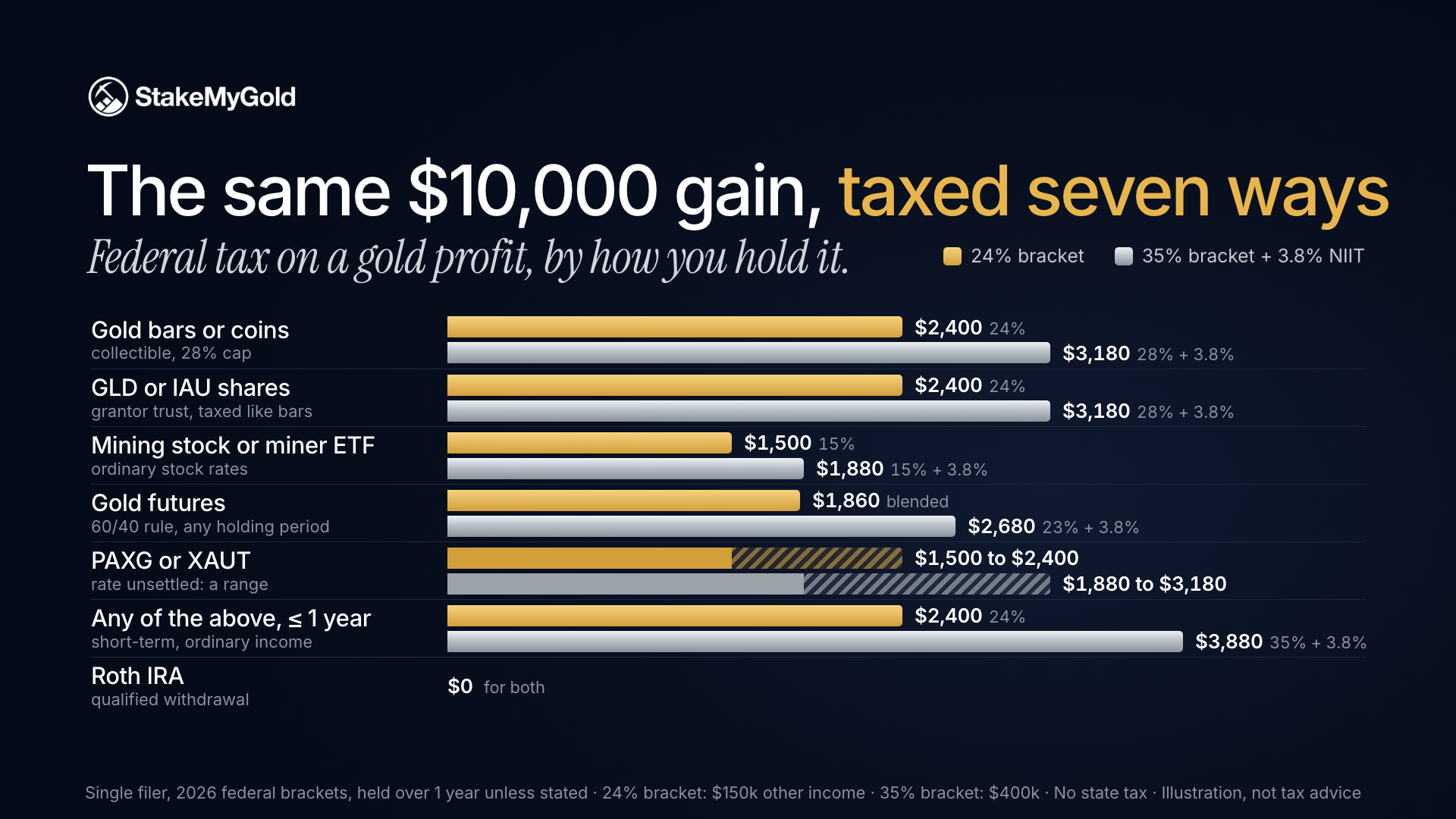

What the table shows:
Gold tax rules differ a lot by country. Three that come up most often:
| How you hold gold | Held 1 year or less | Held more than 1 year | Main rule |
|---|
| Bars, bullion coins, jewelry | Ordinary rate (10%–37%) | Ordinary rate, capped at 28% | Collectible, IRC 408(m) |
| Physically backed ETFs (GLD, IAU) | Ordinary rate | Ordinary rate, capped at 28% | Grantor trust: treated as owning the metal |
| Gold mining stocks, miner ETFs | Ordinary rate | 0%, 15% or 20% | Ordinary stock |
| Gold futures (regulated contracts) | 60% long-term / 40% short-term blend | Same blend | Section 1256 |
| Gold IRA (approved bullion) | No tax inside the account | No tax inside the account | Tax at withdrawal (traditional) or none (qualified Roth) |
| Gold tokens (PAXG, XAUT, GGBR) | Ordinary rate | 15%/20% or up to 28%: unsettled | Digital asset = property |
| 2026 federal figure | Single | Married filing jointly |
|---|
| 24% bracket starts above | $105,700 | $211,400 |
| 32% bracket starts above | $201,775 | $403,550 |
| 35% bracket starts above | $256,225 | $512,450 |
| 37% bracket starts above | $640,600 | $768,700 |
| 0% long-term rate (stocks) up to | $49,450 | $98,900 |
| 15% long-term rate (stocks) up to | $545,500 | $613,700 |
| NIIT threshold (MAGI) | $200,000 | $250,000 |
| Vehicle (held >1 year unless stated) | Profile A: federal tax | A: you keep | Profile B: federal tax | B: you keep |
|---|
| Gold bars or coins | $2,400 (24%) | $7,600 | $3,180 (28% + 3.8%) | $6,820 |
| GLD or IAU shares | $2,400 (24%) | $7,600 | $3,180 (28% + 3.8%) | $6,820 |
| Gold mining stock or miner ETF | $1,500 (15%) | $8,500 | $1,880 (15% + 3.8%) | $8,120 |
| Gold futures (any holding period) | $1,860 (60% at 15%, 40% at 24%) | $8,140 | $2,680 (23% + 3.8%) | $7,320 |
| PAXG or XAUT (unsettled) | $1,500 to $2,400 | $7,600 to $8,500 | $1,880 to $3,180 | $6,820 to $8,120 |
| Any of the above, held 1 year or less | $2,400 (24%) | $7,600 | $3,880 (35% + 3.8%) | $6,120 |
| Roth IRA, qualified withdrawal | $0 | $10,000 | $0 | $10,000 |
StakeMyGold lets you stake GGBR, a gold-backed token, through fixed-term staking or the stGGBR liquid staking vault. Our FAQ gives a target of 12% to 15% APR for GGBR stakers and says yields are not guaranteed; current rates per pool are on the staking page, and our own stGGBR post reports the measured exchange-rate growth. PAXG and XAUT staking are listed as coming soon.
On tax, be clear about what we do not do. Our FAQ does not describe any tax reporting, and we do not give tax advice. If you stake, you are responsible for recording each reward's value when you receive it, the cost basis of every token, and every swap. Export your wallet history at least once a year. And do not stake gold tokens just to change your tax rate. Staking adds income tax on the rewards; it does not remove tax on the gold.
Why is gold taxed at 28%? Because US tax law treats physical gold as a collectible under IRC section 408(m), and long-term collectibles gains have a 28% maximum rate under section 1(h). Stocks held over a year get lower maximum rates of 0%, 15% or 20%.
How much tax do I pay if I sell my gold? You pay tax on the gain, not the full sale price. For physical gold held over a year, the federal rate is your ordinary income rate up to 28%, plus 3.8% NIIT if your income is above $200,000 single or $250,000 joint. Held one year or less, the gain is taxed as ordinary income at up to 37%.
Are gold tokens like PAXG taxed? Yes. The IRS treats gold tokens as property, so selling, spending or swapping them triggers capital gain or loss. Whether long-term PAXG or XAUT gains get the 28% collectibles cap or the 15%/20% rates is unsettled; the IRS's look-through approach for NFTs in Notice 2023-27 suggests the collectibles rate could apply.
Are staking rewards on gold tokens taxable? Generally yes, as ordinary income at fair market value when you gain control of the rewards, under Rev. Rul. 2023-14 and the Tax Court's June 2026 Paschall decision. When you later sell the reward tokens, you have a separate capital gain or loss.
Can you sell gold tax-free in the US? Not outside a tax-advantaged account. A qualified Roth IRA withdrawal is tax-free, and a sale at a loss has no tax. Physical gold does not get the 0% long-term rate that stocks get, so even low earners pay their ordinary rate on bullion gains.
What if I invested $10,000 in gold 20 years ago? Gold averaged $587.43 an ounce in October 2006, according to the US Geological Survey. $10,000 would have bought about 17 ounces, worth about $71,200 at the 16 October 2026 COMEX close of $4,181.10. On a gain of about $61,200, the federal collectibles tax could reach about $17,100 at the 28% cap, before any NIIT or state tax.
Do I have to report selling gold to the IRS? Yes, if you have a gain. Report it on Form 8949 and Schedule D. Dealers file Form 1099-B only for some bullion sales, based on the type and quantity sold. Whether or not you receive a form, the gain is taxable.
How gold is taxed depends on the wrapper more than the metal. Bars, coins and physically backed ETFs face the collectibles cap of 28%, which only bites if your ordinary rate is higher. Miners get stock rates, futures get 60/40, and IRAs defer or remove the tax. Gold tokens are property, and the rate on their gains is an open question, so plan for 28% and keep careful records, especially if you stake. If your gain is large, a one-hour session with a CPA or enrolled agent will likely pay for itself.
This article is for informational purposes only and is not financial or tax advice.
