On Friday, 13 November 2026, COMEX silver futures closed at $49.03 an ounce, their lowest close in a year and 57% below January's record. On Monday the slide went on, with dealer screens showing spot silver near $47.90 by midday. If you are thinking about buying physical silver at these prices, one option keeps coming up: junk silver.
Junk silver is the dealer name for old US dimes, quarters and half dollars made of 90% silver, which are bought and sold for the metal inside them, not as collectibles. Every $1 of face value holds about 0.715 troy ounces of pure silver.
So is it worth buying? For someone who wants physical silver in small, recognizable pieces, it is often the cheapest way to get it. On 16 November, a $100 face value bag cost about 2% to 3% over the value of its silver at two large dealers, while a 1 oz Silver Eagle cost 13% to 28% over spot. The catch is that small lots cost more, resale prices are rarely published, and the silver is taxed like any other collectible.
Junk silver is circulated US coinage with no collector premium, valued only for its silver content. The word "junk" refers to the coins' condition and lack of rarity, not to the silver, which is the same 90% alloy the Mint used for more than a century. Some dealers call the same coins constitutional silver or simply 90% silver.
Two ideas explain how it is priced:
Junk silver coins have melt value only. A worn 1964 quarter is common enough that no collector pays extra for it, so it trades as a small, stamped piece of silver. That is the whole appeal: the coins are a known weight and purity, and anyone can identify them by the date.
One caution before you sell a jar of old coins as junk: check the dates first. A few, such as the 1916-D Mercury dime and the 1932-D and 1932-S Washington quarters, are scarce key dates that collectors pay more for, as one coin-collecting guide notes.
The core of junk silver is three coins: dimes, quarters and half dollars dated 1964 or earlier. All three were made of 90% silver and 10% copper, and their weights were set in proportion to face value, so any mix adding up to $1 contains the same silver.
Pure silver = weight x silver share / 31.1035 grams per troy ounce. Melt at the $47.91 spot price shown by BGASC at 12:46 pm ET on 16 November 2026. Our calculation, in analysis.py.
Three groups sit at the edges of the term:
The date is the test. Dimes and quarters are silver only if they are dated 1964 or earlier; Kennedy halves dated 1965 to 1970 are 40% silver; nickels are silver only if dated 1942 to 1945 with the large mint mark above the building. Everything newer in your change is copper and nickel.
US coins stopped being silver because the silver became worth more than the coins. The Coinage Act of 1965, signed on 23 July 1965, removed silver from dimes and quarters and cut the half dollar to 40% silver. Once the silver price rose above about $1.38 an ounce, the metal in a 90% coin was worth more than its face value, and people began hoarding them.
A 1970 law ended silver in the half dollar too. The old coins were hoarded and left circulation, and that hoard, passed through estates, coin shops and dealers, is today's supply. No more will be made.
To find the melt value of junk silver, multiply the face value by 0.715, then by the silver price per troy ounce.
Melt value = face value x 0.715 x silver spot price
At $47.91, $1 of face value holds $34.26 of silver, a $10 roll of quarters holds $342.56, and a $100 bag holds $3,425.56. A troy ounce, the unit silver is priced in, is 31.1 grams; our guide to troy ounces and fineness covers it in more detail.
As minted, $1 of 90% coins held 0.7234 troy ounces of silver. Decades in pockets and cash registers wore a little metal off, so the trade settled on a lower, conservative figure. Gainesville Coins explains that dealers assign 0.715 ounces per dollar so buyers get at least that much silver even after wear. Liberty Coin Service lists $1 face value at 0.715 troy ounces, and a $1,000 bag at 715 ounces. The gap is about 1%, so for a few coins it hardly matters. On a $1,000 bag it is about 8 ounces.
Dealers often quote junk silver as a multiple of face value. "35 times face" means $1 of coins costs $35. To check whether a quote is fair, divide it by 0.715 to get the price per ounce of silver, and compare that with spot. At 35 times face, you pay $48.95 an ounce, which was about 2% over the $47.91 spot price on 16 November.
Here is what $1 of face value is worth at different silver prices:
Melt value only, using 0.715 troy ounces per $1 face value. Our calculation.
In our snapshot, junk silver sold much closer to its melt value than newly minted bullion coins did. A premium is the amount a dealer charges above the value of the metal, to cover sourcing, handling and profit. Here is what three dealers charged on Monday, 16 November 2026.
Prices viewed between about 12:45 and 12:50 pm ET on 16 November 2026, while the market was open and falling. Card payments cost about 4% more. Melt uses 0.715 oz per $1 face (1.125 oz for $1 of war nickels). Our calculation, in analysis.py.
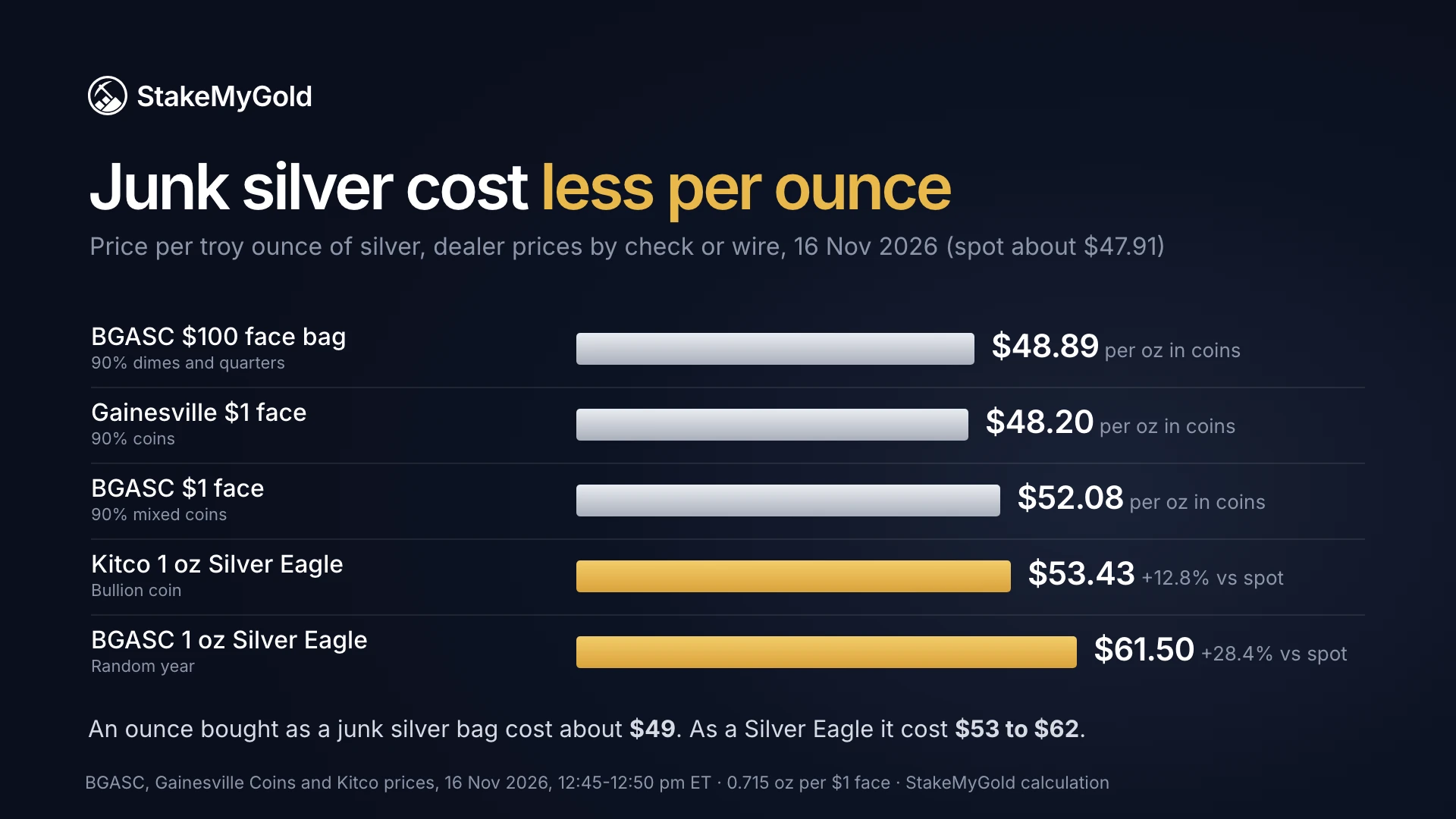
The BGASC listing shows the pattern clearly: the smaller the lot, the higher the premium. A single dollar of mixed coins cost 8.7% over melt, a roll 2.7% and a bag 2.0%. Dimes on their own cost 14.6% over melt, more than a mixed lot of the same face value. Kitco's $100 face bag, described as at least 71.5 troy ounces of .900 silver in circulated coins dated 1964 or earlier, came in at 3.3%. Gainesville Coins was the cheapest per dollar in our snapshot, at 1.5%.
Now compare a bullion coin. Around the same time, Kitco's 1 oz American Silver Eagle cost $53.43, 12.8% over its spot price, and BGASC's random-year Silver Eagle cost $61.50, 28.4% over. So an ounce of silver bought as a junk silver bag cost about $49, and an ounce bought as a Silver Eagle cost $53 to $62. We look at the same trade-off for gold in gold coins vs bars.
The other side matters too. BGASC published a buyback price of $45.66 for a Silver Eagle, 4.7% under spot. For 90% coins it showed "call us", and Kitco's sell page listed no junk silver price. You can sell junk silver easily, but you will not know the exact bid until you ask.
Say you have about $350 and want roughly 7 ounces of silver. Here is the math for a $10 face value roll of 90% quarters, using BGASC's price at 12:46 pm ET on 16 November.
| Coin | Years | Silver | Weight (grams) | Pure silver per coin (troy oz) | Silver per $1 face (as minted) | Melt per coin at $47.91 |
|---|
| Dime (Mercury, Roosevelt) | to 1964 | 90% | 2.50 | 0.0723 | 0.7234 oz | $3.47 |
| Quarter (Washington) | to 1964 | 90% | 6.25 | 0.1808 | 0.7234 oz | $8.66 |
| Half dollar (Walking Liberty, Franklin, 1964 Kennedy) | to 1964 | 90% | 12.50 | 0.3617 | 0.7234 oz | $17.33 |
| Morgan and Peace dollars | to 1935 | 90% | 26.73 | 0.7735 | 0.7735 oz | $37.06 |
| Kennedy half dollar | 1965-1970 | 40% | 11.50 | 0.1479 | 0.2958 oz | $7.09 |
| Jefferson war nickel | 1942-1945 | 35% | 5.00 | 0.0563 | 1.1253 oz | $2.70 |
| Silver spot price | Melt value of $1 face (90%) | Melt value of $10 roll | Melt value of $100 bag |
|---|
| $30 | $21.45 | $214.50 | $2,145 |
| $40 | $28.60 | $286.00 | $2,860 |
| $47.91 (16 Nov 2026) | $34.26 | $342.56 | $3,426 |
| $60 | $42.90 | $429.00 | $4,290 |
| $80 | $57.20 | $572.00 | $5,720 |
| $100 | $71.50 | $715.00 | $7,150 |
| Dealer | Product | Price (check/wire) | Spot shown | Melt value | Premium over melt | Times face |
|---|
| BGASC | 90% mixed coins, $1 face | $37.24 | $47.91 | $34.26 | 8.7% | 37.2x |
| BGASC | 90% Roosevelt dimes, $1 face | $39.25 | $47.91 | $34.26 | 14.6% | 39.2x |
| BGASC | 90% Washington quarters, $10 face | $351.71 | $47.91 | $342.56 | 2.7% | 35.2x |
| BGASC | 90% dimes and quarters, $100 face | $3,495.63 | $47.91 | $3,425.56 | 2.0% | 35.0x |
| BGASC | 35% war nickels, $1 face (20 coins) | $55.59 | $47.91 | $53.91 | 3.1% | 55.6x |
| Kitco | 90% coins, $100 face bag | $3,497.72 | $47.36 | $3,386.24 | 3.3% | 35.0x |
| Gainesville Coins | 90% coins, $1 face | $34.46 | $47.49 | $33.96 | 1.5% | 34.5x |
| $10 roll of 90% quarters (BGASC) | 7 Silver Eagles (Kitco) | 7 Silver Eagles (BGASC) | |
|---|---|---|---|
| Silver | 7.15 oz | 7.00 oz | 7.00 oz |
| Price | $351.71 | $374.01 | $430.50 |
| Cost per ounce of silver | $49.19 | $53.43 | $61.50 |
| Rise in silver needed to cover the premium | 2.7% | 12.8% | 28.4% |
Prices viewed 16 November 2026. Break-even compares cost with melt value only; it ignores what a dealer would actually pay back, shipping and tax.
On these prices, the roll gets you slightly more silver for $22 to $79 less. That gap is the main argument for junk silver. The Eagle's extra cost buys a newer coin of Mint-specified weight and purity, and at BGASC a published buyback price, which some buyers value more.
For the full picture on what you get back when you sell, see how much silver is worth, which tracks dealer bid and ask prices for coins and bars.
Pros
Cons
You can buy junk silver from online bullion dealers, local coin shops, coin shows and private sellers. Online dealers post prices that move with spot every few seconds, which makes comparison easy. Local shops let you see the coins and avoid shipping, but prices vary more.
Before you buy, check five things:
From private sellers, check every date. A lot can include clad coins dated 1965 or later, which hold no silver, or a scarce date that is worth more to a collector than its melt value.
Our guide to how to invest in silver compares junk silver with bars, ETFs, mining stocks and tokenized silver, if you are still choosing a route.
Junk silver is taxed as a collectible. The IRS counts any metal and any coin as a collectible, with limited exceptions, and says net capital gains from selling collectibles such as coins are taxed at a maximum 28% rate. That applies if you held the coins more than a year. Gains on coins held a year or less are taxed as ordinary income.
Two points cause confusion:
Our guide to how gold is taxed walks through the collectibles rate with examples; the same rules apply to silver. Ask a tax adviser about your own case.
Junk silver is worth buying if you want physical silver, plan to buy at least a roll at a time, and value small, recognizable pieces. In our 16 November snapshot it was among the cheapest ways to own silver ounces, at 2% to 3% over melt in rolls and bags.
It is a weaker choice if you want to buy one or two coins, need a published resale price, or want silver mainly for price exposure. For that last goal, a low-cost silver ETF avoids storage and coin-dealer premiums, though it is taxed as a collectible too.
Whether silver itself belongs in your portfolio is a separate question. Over the long run silver has been volatile and has trailed stocks; we ran 55 years of data in is silver a good investment, and covered this year's slump in why silver is falling.
The dealer prices are one snapshot, taken over a few minutes on a day when silver was falling, so each dealer's spot price differs slightly. Re-check prices on the day you buy.
We could not find published buyback prices for 90% coins at the dealers we checked, so we do not show a round-trip cost for junk silver. Local coin shops may pay noticeably less than online dealers. We also leave out state sales tax, which some states charge on bullion, and shipping. The coin specifications come from mint-derived references and dealer pages, because the US Mint's own site blocked our access. None of this says where the silver price goes next.
StakeMyGold does not offer a silver product. It does not sell or buy junk silver, coins or bars, and it has no silver token. If you want junk silver, you will need a bullion dealer or a coin shop.
StakeMyGold is a platform for gold. Holders of GGBR, a gold-backed token, can stake it to earn a return paid in GGBR. GGBR is backed by certificates for gold still in the ground, not bars in a vault, and the site's FAQ says the target return is not guaranteed and lists the risks, including smart contract and counterparty risk. That is a different trade-off from holding coins in a drawer. If you want to see how the gold side works, start at getting started.
What is junk silver? Junk silver is circulated US dimes, quarters and half dollars dated 1964 or earlier, made of 90% silver, that sell for their silver content rather than as collectibles. Dealers often include 1965-1970 Kennedy halves (40%) and 1942-1945 war nickels (35%).
How much silver is in $1 of junk silver? About 0.715 troy ounces. New coins held 0.7234 ounces per dollar of face value, and dealers use 0.715 to allow for wear.
How much is junk silver worth today? Multiply face value by 0.715 and by the spot price. At $47.91 on 16 November 2026, $1 of face value held $34.26 of silver, and dealers charged about $34.50 to $39.25 for it.
How much is a 1964 quarter worth in silver? A 1964 quarter holds 0.1808 troy ounces of silver, worth about $8.66 at $47.91 spot. A worn one is worth slightly less, which is why dealers price whole lots at 0.715 ounces per dollar.
How much is a $10 roll of silver quarters worth? A $10 roll of 40 pre-1965 quarters holds about 7.15 ounces of silver, $342.56 at $47.91. BGASC sold one for $351.71 on 16 November 2026.
Is junk silver a good investment? It is a low-premium way to own physical silver in bulk, but its value moves with the silver price, which fell 57% from January to mid-November 2026. It pays no income, and gains are taxed at up to 28% in the US.
Do I have to report junk silver sales to the IRS? You must report any gain on your tax return. Whether a dealer files a Form 1099-B is a separate question; the current IRS instructions do not list 90% silver coins as an example of a reportable sale.
Junk silver is old 90% silver US change, priced by weight: face value times 0.715 times the silver price. On 16 November 2026, with silver near $47.90, rolls and bags sold for about 2% to 3% over their silver value, cheaper per ounce than Silver Eagles at the same dealers.
That makes it a sensible way to buy physical silver in bulk, and a poor one for buying a single dollar's worth. Before you buy, convert the quote to a price per ounce, check the dates, and ask what the dealer would pay you back.
This article is for informational purposes only and is not financial or tax advice.
