On 23 October 2026, COMEX gold futures closed at $4,007.90 an ounce, their lowest close since mid-July. A few days earlier, the FDIC put the national average savings rate at 0.38% as of 19 October. For anyone shopping for a gold savings account, that is the problem in two numbers: one asset has been falling and pays nothing, and the other barely pays anything at all.
So it is natural to ask for both: a gold savings account that holds gold and pays interest like a bank account. The trouble is that three very different products use that name, and only one of them pays you anything in gold.
The short answer: a "gold savings account" is either (1) an ordinary bank account with "Gold" in its name, which is insured and pays dollar interest but has no gold in it, (2) a savings plan that buys gold for you each month, which holds real metal but pays no interest and charges storage, or (3) a product that pays you a yield in gold, which is never FDIC insured and gets its yield from lending your gold to someone else. You can have gold and a yield. You cannot have them with a bank's safety net.
A gold savings account is any account marketed as a way to save in, or around, gold. In practice the term covers three separate products: bank savings accounts that use "Gold" as a brand or tier name, plans that buy small amounts of physical gold for you on a schedule, and accounts or protocols that pay you a yield in gold.
Google's own AI summary for the term mixes all three, and so do most of the pages that rank for it. That matters, because each type answers a different question:
The rest of this guide takes them one at a time, then compares them side by side.
These are normal savings accounts. The word "Gold" is a brand, a tier or a membership level. Your money stays in dollars and earns dollar interest. There is no gold in the account and no link to the gold price.
One example ranks on the first page of Google for "gold savings account". Sun Canyon Bank's Gold Savings account showed a 4.00% APY on every balance tier as of 20 October 2026, with a $250 minimum to open and a $5 monthly fee if the balance falls below the bank's requirement. APY (annual percentage yield) is the yearly return including compounding. Bank rates like this are variable and can change without notice.
Robinhood Gold is another name people search for. It is a paid membership on Robinhood's brokerage app, and its high-yield cash program pays interest on uninvested cash. It is a cash product, not a gold product.
The main strength of Type 1 is insurance. The FDIC covers $250,000 per depositor, per insured bank, for each account ownership category. If what you want is safety plus interest, this is the product, and the "Gold" in the name is irrelevant.
A gold savings plan (also called a gold accumulation plan) takes a fixed amount from you every week or month and buys physical gold with it. The gold is usually stored in a vault in your name. You own metal, so your balance rises and falls with the gold price. You earn no interest.
What you pay instead is fees. Here is what three well-known providers listed on their own pages in October 2026:
Allocated means specific bars are set aside for you and are legally yours, so the provider's creditors cannot claim them if it fails. That is the main safety feature of a good savings plan. It is not deposit insurance: the FDIC list of products it does not insure includes stocks, bonds, annuities, the contents of safe deposit boxes and crypto assets, and it does not cover the gold price falling.
The honest way to think about Type 2 is as a disciplined way of buying gold in small regular amounts, not as savings. With no yield, every year of storage fees makes your ounce count slightly smaller.
India built the best-known government versions, and both have mostly closed to new money. Sovereign Gold Bonds paid 2.50% a year in cash on the initial investment, on top of the gold price, over an 8-year term. Reports say no new tranche has been issued since February 2024, though existing bonds still pay. The Gold Monetisation Scheme's government deposit components were discontinued from 26 March 2025, leaving short-term deposits to individual banks. Both were built for Indian residents, not US savers.
This is the only type that does what most searchers hope for: your gold earns more gold. To judge it, you need to know where the yield comes from, because gold itself produces nothing. A bar in a vault does not pay a dividend.
Every yield on gold comes from someone who borrows the gold and pays for it. The oldest version is gold leasing: jewelers, refiners and mints borrow metal for their inventory and pay a fee in gold, because owing ounces instead of dollars removes their price risk. We explain the mechanics in how gold lease rates work.
One retail provider of this is Monetary Metals, which in June 2026 reported a weighted average yield of 3.96% a year, paid in gold, from leases to precious-metals businesses such as jewelry manufacturers and refiners. There is no public benchmark to check such rates against: the LBMA stopped publishing GOFO, the gold forward rate once used to estimate lease rates, after 30 January 2015.
The newer version is on-chain. You hold a gold token (a blockchain token that represents a claim on gold) and deposit it in a smart contract that pays rewards. Staking here means locking tokens with a platform so they can be put to work, usually as loan collateral, in exchange for a return. Our gold staking explainer covers the seven places that return can come from.
Whatever the wrapper, lending changes what you own. Lent gold is unallocated gold: you no longer own specific bars, you own a promise from the borrower to give metal back. Your risk is no longer only the gold price. It is also whether the borrower pays.
Crypto "interest accounts" show how that can end. In February 2022 the SEC charged BlockFi over its interest accounts, and the company agreed to pay $50 million to the SEC and another $50 million to 32 states. In July 2023 the SEC charged Celsius, whose Earn program effectively halted on 12 June 2022. Neither was a gold product, but both lent out customers' assets to pay the yield, and the SEC said Celsius presented itself as safe.
None of these products are insured. The FDIC does not insure crypto assets, and SIPC, which covers brokerage accounts up to $500,000, does not protect commodity futures or crypto assets that are not securities. It also never covers a fall in value.
The table puts the three types on the same five questions. Fees and rates are as checked on the providers' pages in October 2026.
Examples: Sun Canyon Bank (Type 1); GoldRepublic, BullionVault, GoldCore (Type 2); Monetary Metals, on-chain staking (Type 3).
A realistic interest rate depends on which type you mean. In October 2026, bank savings accounts averaged 0.38% nationally, with some paying around 4% APY. Gold savings plans paid 0% and charged storage. Products paying yield in gold showed roughly 4% for physical leasing and higher targets for on-chain staking.
Higher numbers are possible, but someone has to pay them, and that usually means more risk somewhere in the chain. A simple test sorts most offers:
APR (annual percentage rate) is the simple yearly rate without compounding. Gold yield products usually quote APR, while banks quote APY, so a 10% APR and a 10% APY are not the same number. Also check what currency the yield is paid in. A yield paid in gold grows your ounces. A yield paid in dollars, or in a platform's own token, does not.
For a full walk-through of returns at different deposit sizes, see how much you can earn staking gold.
Here is an illustration, not a forecast. Say you put $10,000 into each type on 23 October 2026, with gold at $4,007.90, and cash out a year later. We test three outcomes: gold down 20%, flat, and up 20%.
The assumptions:
Illustration only. Ounces times the gold price, after the fees listed. Type 3 assumes the platform and its borrowers pay in full.
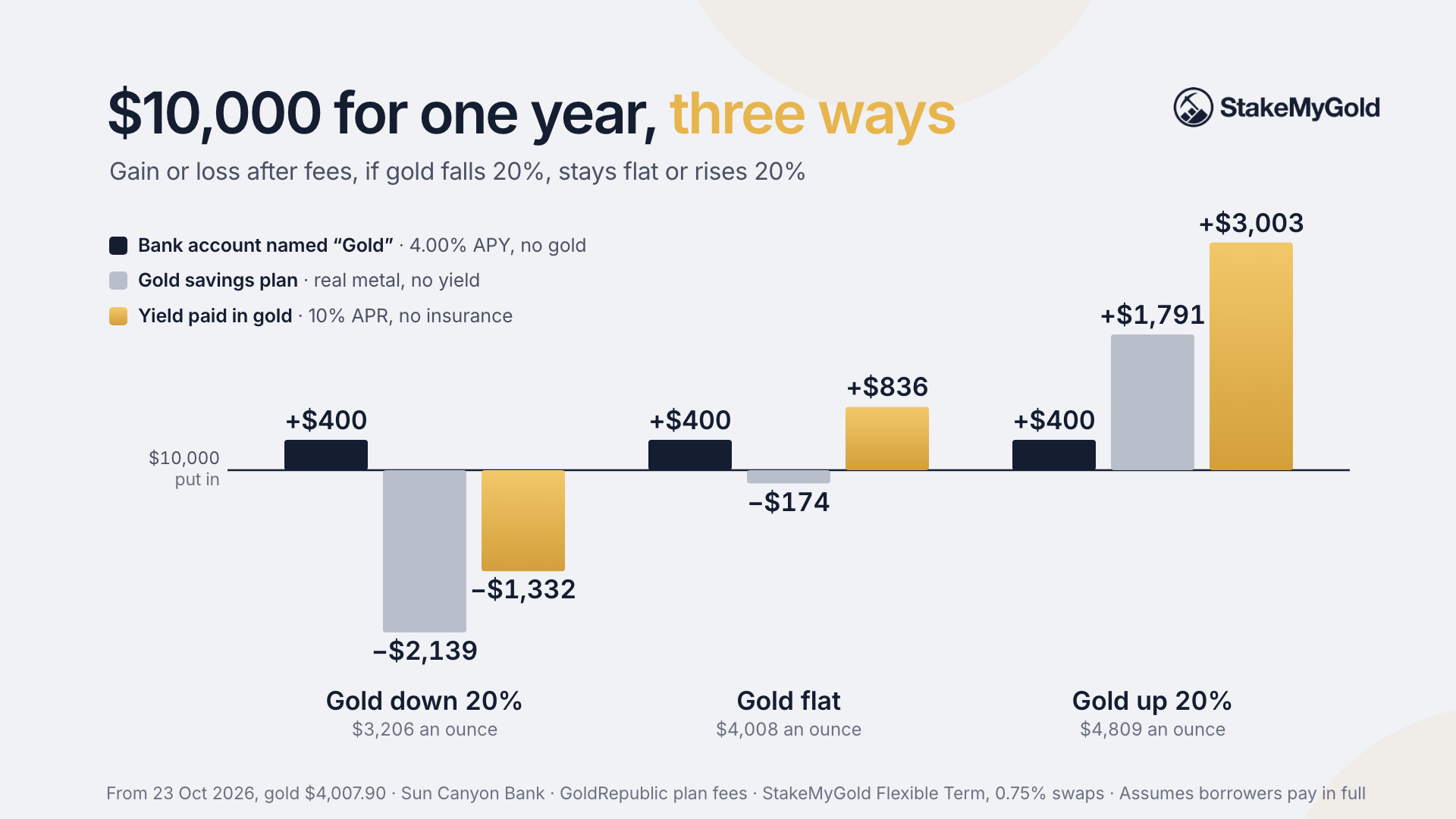
Three things stand out. The bank account wins whenever gold falls. The savings plan loses a little to fees even when gold is flat. The gold yield adds ounces but does not change direction: when gold falls 20%, you still lose money, just less of it.
And the Type 3 column assumes nothing goes wrong. If you need to leave early, the result changes too: on that Flexible Term, exiting after six months would cost 30% of the interest earned so far.
In the US, the three types are taxed differently. Bank interest is ordinary income in the year you earn it. Physical gold is a collectible, so a long-term gain is taxed at up to 28% when you sell. For crypto staking rewards, the IRS has ruled that their value counts as income when you gain control of them, which can mean tax each time rewards land, before you sell anything.
Whether a given gold-yield product fits that ruling is a question for a tax professional. Our guide to how gold is taxed covers bars, ETFs and tokens in detail.
The best gold savings account is the one that matches what you want, so start with the type. Then ask:
| Type 1: bank account named "Gold" | Type 2: gold savings plan | Type 3: yield paid in gold |
|---|
| Insured? | Yes, FDIC up to $250,000 | No deposit insurance; allocated metal is yours if the provider fails | No FDIC or SIPC cover |
| Gold exposure? | None | Full, in physical metal | Full, through a claim on lent gold or a token |
| Yield source | Bank interest in dollars | None | Borrowers paying to use the gold |
| Typical fees | Monthly fee if under minimum | Buy/sell spread or commission, 0.12% to 1% a year storage or management | Platform fee on yield, swap and network fees |
| Main risk | Inflation and rate cuts | Gold price, plus fees eating ounces | Gold price, borrower default, platform and smart-contract failure |
| Gold price after one year | Type 1: bank account | Type 2: savings plan | Type 3: 10% APR paid in gold |
|---|
| Down 20% ($3,206) | $10,400 | $7,861 | $8,668 |
| Flat ($4,008) | $10,400 | $9,826 | $10,836 |
| Up 20% ($4,809) | $10,400 | $11,791 | $13,003 |
For on-chain products, our risk checklist for gold staking goes deeper.
This guide cannot tell you which way gold goes next, and that will move your result more than any yield or fee. A 20% swing in gold is bigger than several years of any rate in the table.
It also checks a small sample of providers. Many banks, plans and platforms exist, their fees change often, and some are not open to US residents. The rates here were correct when we checked them in October 2026. Check them again on the day you open an account, and that includes ours.
Finally, a Type 2 plan with allocated metal and a Type 3 product that lends your gold carry different kinds of risk. A table can line them up, but it cannot make them equal.
StakeMyGold is a Type 3 product. It is not a bank, it is not FDIC or SIPC insured, and it is not a savings account.
You stake GGBR, a token where each unit represents 1/1000 of a troy ounce, and rewards are paid in GGBR. GGBR is backed by in-ground gold certificates issued by I-ON Digital, not by vaulted bars. I-ON's annual report says its digitization is currently limited to unextracted in-ground gold reserves. We explain what that means for your risk in vaulted gold vs in-ground gold.
As of 24 October 2026, our staking page lists:
Our own pages do not all agree. The homepage shows 12%, 10% and 8% for the Flexible Term and leads with "up to 15%", and the FAQ says we target 12.0% APR. The staking page figures above are the lowest of the three, so they are the ones we quote here.
Where the yield comes from matters most. Our yield strategy page says the only active source today is lending backed by gold, and that returns are not guaranteed. Most staked tokens are held by an institutional partner and used as loan collateral, so a failure at that partner could affect what you get back, as our security page states. Smart contracts have been audited by CertiK and Cyfrin. An audit lowers code risk. It does not insure you.
If you want an insured place for cash, use a bank. If you want allocated bars you can visit, use a bullion plan or buy gold bars directly. StakeMyGold is for people who already want gold exposure, accept lending and platform risk, and want that gold to earn more gold.
Is there a savings account that pays interest in gold? Not in the banking sense. Products that pay a yield in gold exist, such as gold leasing programs and on-chain gold staking, but they are investments, not insured deposit accounts.
Is a gold savings account FDIC insured? Only if it is a regular bank account that uses "Gold" as a name. FDIC insurance covers deposits up to $250,000 per depositor, per bank, per ownership category. It does not cover gold, gold savings plans or crypto assets.
What is the best gold savings account? It depends on what you want. For insured interest, a high-yield bank account. For owning metal in small steps, a low-fee plan with allocated storage. For yield paid in gold, a provider that names its borrowers and shows proof of holdings.
Can you earn interest on gold? Yes, but only by lending it to someone who pays to use it, such as a refiner or a borrower on a lending platform. The yield comes with the risk that the borrower does not return the gold.
Is a gold savings account a good idea? A gold savings plan suits people who want to buy gold regularly and hold it for years. It does not suit money you may need soon, because gold fell by about a quarter between its January 2026 record and late June.
Can I open a gold savings account in the USA? Yes. US banks offer accounts with "Gold" in the name, several bullion companies run monthly gold plans for US customers, and on-chain gold staking is open to anyone with a crypto wallet, depending on local rules.
Which gold saving scheme is best? For US savers, compare fees and storage first: in October 2026 yearly storage or management fees ranged from 0.12% to 1% across the plans we checked. India's Sovereign Gold Bonds paid 2.5% a year, but no new bonds have been issued since February 2024.
"Gold savings account" is one search term for three products. A bank account with "Gold" in its name gives you insurance and interest but no gold. A gold savings plan gives you real metal but no interest, and charges you to hold it. A gold yield product gives you more ounces, but only by lending your gold to someone else, with no insurance underneath.
Decide which of those you want first. Then ask who pays the yield, why, and what you hold while they use your gold.
This article is for informational purposes only and is not financial or tax advice.
