On 23 October 2026, COMEX gold futures closed at $4,007.90 an ounce, the lowest close since mid-July and about 25% below the record close of $5,318.40 set on 29 January. If the drop has you thinking about buying physical gold, the next question is practical: how do you actually buy a gold bar without overpaying or getting caught out?
Most people meet the same surprises in the same order. The price on the screen is not the price you pay. Paying by card costs more. Some states charge sales tax. And a bar has to be stored somewhere.
The short answer: to buy gold bars, pick an established bullion dealer (online or local), choose a 1 oz bar or larger from a known refiner, pay by bank wire or check, check your state's sales tax, and decide on storage before the bar arrives. On 24 October, a 1 oz bar cost about 3% more than its gold when paid by wire, about 7% more by card, and the same dealer would have bought it back for about 5.5% less than you paid.
Here is the whole process, in the order you will meet each decision. The sections below take each step in turn, with prices and sources.
The best place to buy gold bars for most people is an established bullion dealer, either online or a local coin shop. Dealers carry the widest range of sizes and brands, publish their prices against the live spot price, and buy bars back. Costco is a reasonable option for single 1 oz bars. Banks, the US Mint and online marketplaces are, for different reasons, weaker choices.
Large online dealers such as Kitco, SD Bullion, APMEX and JM Bullion list prices that update with the spot price, the wholesale price of one troy ounce of gold for immediate delivery. Their premiums on standard bars are low, and they ship insured. SD Bullion, for example, offers free shipping on orders of $199 or more.
The downside is that you have to wait for delivery and sign for a package. Prices also differ between dealers more than people expect. On 24 October, a generic 1 oz bar was $4,076.87 at SD Bullion (1.7% over that site's spot price) and $4,111.90 at Kitco (2.9% over Kitco's spot), both paid by wire. Comparing two or three dealers on the same day is the cheapest step in this guide.
A local coin shop lets you see the bar before you pay and walk out with it. Premiums are often a little higher than online, since a shop carries rent and keeps less stock, but there is no shipping wait. Ask for the shop's buy price on the same bar before you buy. The gap between the two numbers tells you more about the shop than its sign does.
Costco sells 1 oz gold bars online to members. Its listing for the PAMP Suisse bar, checked on 24 October, sets a limit of one transaction per membership with a maximum of 4 units per 24 hours, says the item is non-refundable and not eligible for price adjustments, and does not deliver to Alaska, Nevada or Puerto Rico. The bar is .9999 fine, made by an LBMA Good Delivery refiner and sealed with an assay certificate.
Two things to know. Costco does not buy gold back, so you will sell through a dealer. And the price is shown only to members, so compare it with a dealer's wire price on the same day rather than assuming it is cheaper.
Rarely. We could not find a retail gold bar offering on the public websites of the largest US banks. A few smaller banks do sell gold. Leader Bank in Massachusetts, for example, lists bullion coins and small Lakshmi gold bars on its precious metals page. Private banks may arrange bullion for wealthy clients, but that is a relationship service, not a retail counter.
Banks are more useful for storage than for buying, and even there the protection is thinner than people assume (see Step 7).
The US Mint does not sell gold bars. It makes gold coins, and it sells its bullion coins, such as the American Gold Eagle, only to a network of authorized purchasers that resell them to dealers and the public. If you see a "US Mint bar" for sale, it is a private product, not a government one. For the coin-versus-bar decision itself, see our guide to gold coins vs bars.
General marketplaces make it hard to check who the seller is or where the bar came from, and counterfeit bars are a real problem. TV and phone sellers often push collectible products with high markups. If you buy from either, test the bar before you pay or before the return window closes.
Costco terms from its product page and dealer terms from their websites, accessed 24 October 2026.
For most buyers, the best size gold bar to buy is 1 oz or larger. Every bar has a premium, the amount a dealer charges above the value of its gold to cover refining, packaging, shipping and margin. Most of that cost is fixed per bar, so the premium as a percentage falls fast as the bar gets bigger, then levels off at about 3%.
Here is what each size cost on 24 October 2026, when markets were closed and dealer prices reflected Friday's close:
Quantity 1, accessed 24 October 2026. Premiums are measured against each dealer's own spot price at the time ($3,996.90 at Kitco, $4,006.88 at SD Bullion). Our calculation; the script is published with this article.
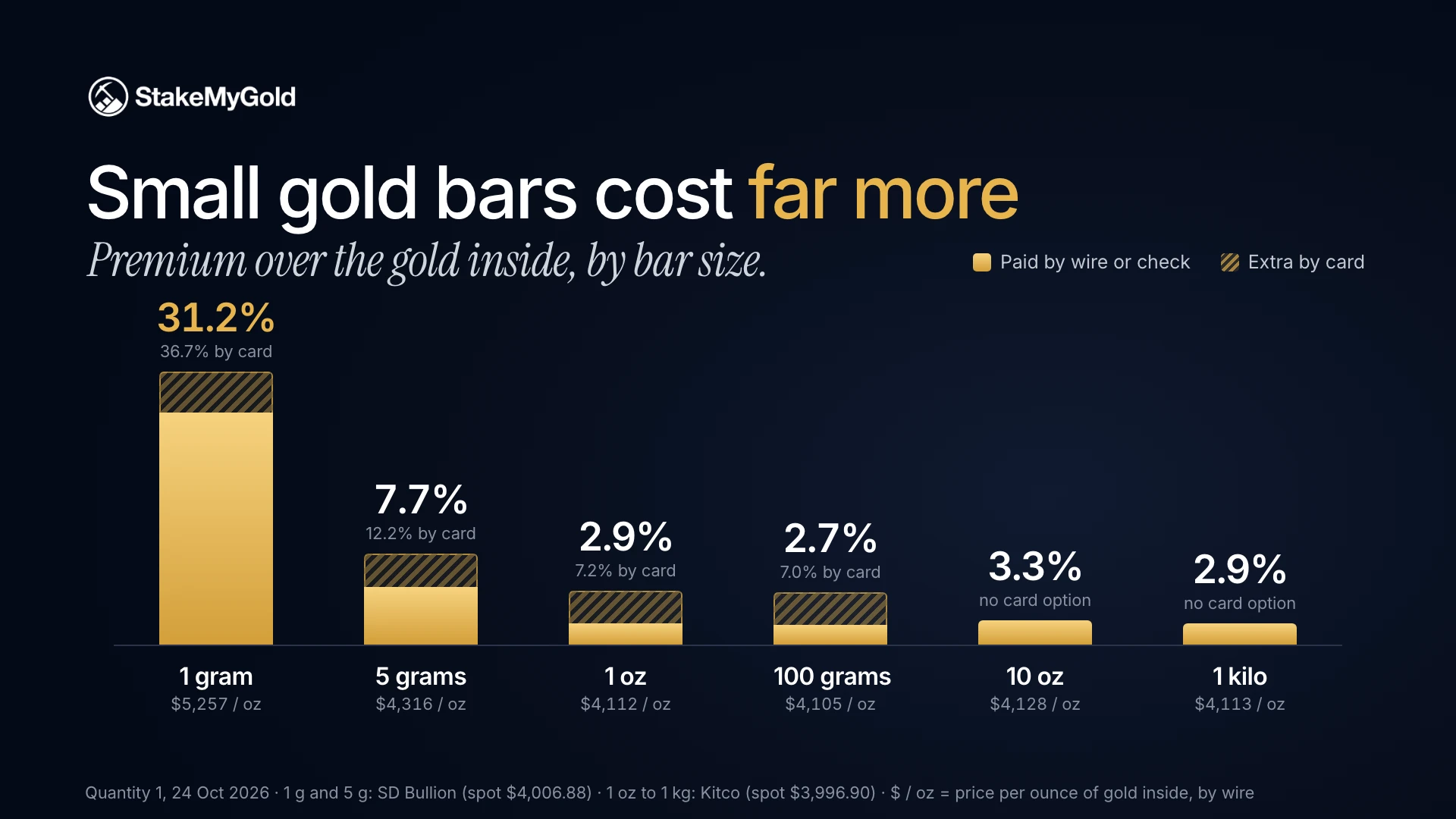
Three things stand out. First, a 1 gram bar costs about $5,257 per ounce of gold inside it, against about $4,110 for a 1 oz bar. Second, from 1 oz to 1 kg the premium barely changes at this dealer, so a kilobar is not much cheaper per ounce; it mainly concentrates a lot of money in one piece you cannot sell in parts. Third, Kitco did not offer card payment at all on its 10 oz and kilo bars.
A practical rule: buy the largest bar you would be happy to sell whole. If you might need to sell a quarter of your gold one day, four 1 oz bars beat one 4 oz bar. Our guide to how much a gold bar is worth gives the gold value of every common size, from 1 gram to the 400 oz bars central banks hold.
Buy bars made by refiners on the LBMA Good Delivery List. The London Bullion Market Association (LBMA) runs the main wholesale gold market and publishes the list of refiners whose large bars it accepts; its current gold list has 67 refiners, including Valcambi, Argor-Heraeus, MKS PAMP, the Royal Canadian Mint, the Perth Mint and Rand Refinery.
One nuance: the list approves the refiner, and its rules are written for large 400 oz bars. A 1 oz bar from a listed refiner is not itself a "Good Delivery bar". What the listing gives you is a brand that any dealer will recognize and buy back without fuss.
Small bars usually come sealed in an assay card: a tamper-evident card carrying the refiner's certificate of weight and purity, often with a serial number that matches the bar. Keep it sealed. A bar out of its card may need testing when you sell, and some buyers pay less for it. Larger cast bars usually carry a stamped serial number and come with a paper certificate; keep that too.
Check that the weight and fineness stamped on the bar match your invoice when it arrives. For how counterfeit bars are made and caught, including the tungsten-core problem, see our guide to .
| Where to buy | Typical bar sizes | Price check | Buys back? | Main catch |
|---|
| Online bullion dealer | 1 g to 1 kg and larger | Live price vs spot, card vs wire shown | Yes | Wait for insured delivery |
| Local coin shop | Mostly 1 g to 10 oz | Ask buy and sell price | Yes | Higher premium, smaller stock |
| Costco (members) | 1 oz | Visible only when signed in | No | 4 bars per 24 hours, no returns |
| Bank | Rare; small bars at a few banks | Varies | Rarely | Few banks sell at all |
| US Mint | No bars | n/a | n/a | Sells coins only, through dealers |
| Marketplace or TV seller | Varies | Hard to compare | No | Fakes and high markups |
| Bar size (brand) | Dealer | Price by wire or check | Premium over gold | Price by card | Price per ounce of gold |
|---|
| 1 gram (generic) | SD Bullion | $169.01 | 31.2% | $176.05 | $5,257 |
| 5 grams (generic) | SD Bullion | $693.89 | 7.7% | $722.80 | $4,316 |
| 1 oz (generic .9999) | Kitco | $4,111.90 | 2.9% | $4,283.23 | $4,112 |
| 100 grams (Valcambi) | Kitco | $13,199.27 | 2.7% | $13,749.24 | $4,105 |
| 10 oz (Valcambi) | Kitco | $41,279.00 | 3.3% | not offered | $4,128 |
| 1 kilogram (Royal Canadian Mint) | Kitco | $132,242.66 | 2.9% | not offered | $4,113 |
Paying by bank wire or check is usually about 4% cheaper than paying by credit card or PayPal. Card payments cost the dealer a processing fee, and dealers pass it on.
The numbers are on the dealers' own pages. On 24 October, Kitco's gold bars page priced a 1 oz .9999 bar at $4,111.90 by wire or check and $4,283.23 by card or PayPal, a difference of 4.2%. SD Bullion's payment page explains why: card payments "are not eligible for the 4% cash discount". On a $10,000 order, that is roughly $400 for the convenience of a card.
Dealers also set limits by payment method. SD Bullion, for example, accepts cards only up to $5,000, checks up to $20,000, and requires a bank wire for orders above $20,000. Its page also states that once you confirm and lock the price, you have entered a binding agreement that cannot be cancelled without penalty, and that wire payments must arrive within 3 business days. In practice: do not lock an order you have not funded, and do not cancel because the price moved.
Most US states exempt investment gold bullion from sales tax, but not all, and the rules change. Because sales tax is charged on the whole purchase price, a 6% to 10% tax can cost two or three times the dealer's premium.
Two examples show how much the rules differ:
Large online dealers generally collect your state's tax when they ship to you, so buying online does not avoid it. Before a large purchase, check your state's revenue department or the tax line at the dealer's checkout. The tax side of selling is a different set of rules, covered in how gold is taxed.
Usually not at the moment you buy. There is no IRS form for an ordinary purchase paid by wire, card or personal check. Reporting kicks in in two situations: large cash payments when you buy, and some larger sales when you sell.
Form 8300 when you pay with cash. A business must file Form 8300 when it receives more than $10,000 in cash in one transaction or in related transactions, within 15 days. Cash means currency, and in some sales it also includes cashier's checks and money orders of $10,000 or less; the IRS guide lists sales of collectibles among the transactions where those count. Personal checks and wire transfers from a bank do not count as cash. Payments from the same buyer within 24 hours are added together, and splitting payments to stay under $10,000 is exactly what the rule is built to catch. The dealer must also send you a written statement by 31 January of the following year.
ID checks. Under federal anti-money-laundering rules, a dealer in precious metals that buys and sells more than $50,000 a year must run an anti-money laundering program. That is why dealers may ask for ID, especially on large or cash orders.
Form 1099-B when you sell. The IRS instructions say a dealer's purchase of gold from you is not reportable if the quantity is below the minimum for a regulated futures contract. For gold, that generally means sales of 1 oz or 10 oz bars are not reported, while selling a 100 oz bar or three kilobars in one go can be. Either way, any gain is taxable and yours to report. Keep the dealer's invoice, which is your proof of what you paid. Our guide to how to sell gold covers the selling side in detail.
There are three common places to keep gold bars, and each leaves a different gap:
That minimum matters for small buyers. On a single 1 oz bar worth about $4,100, $9.99 a month is about $120 a year, or roughly 3% of the bar's value. On a kilobar worth about $132,000, the 0.29% rate works out to about $380 a year. Storage is cheap per dollar only once the holding is large.
If you use a depository, ask whether your bars are allocated: set aside and recorded in your name, as opposed to a claim on a shared pool of metal. We explain the difference in allocated vs unallocated gold, and where the big professional vaults are in where the world's gold is stored.
Say you bought the 1 oz .9999 bar above from Kitco on 24 October, paid by wire, in a state that does not tax bullion, and stored it at a depository with a $9.99 monthly minimum. Here is the full bill for one year, assuming the gold price does not move:
So gold would need to rise from about $3,997 to about $4,350 an ounce, roughly 9%, before this bar breaks even after a year in storage. Paid by card, the break-even rises to about $4,526, a 13% rise. Keep it at home with no storage bill and the break-even falls to about $4,227, a 6% rise, but then the insurance gap is yours.
Two lessons follow. A gold bar is a long-term holding; the round trip costs too much for short trades. And for small amounts, how you pay and where you store it decide more of your return than which dealer you pick.
At the 23 October close of $4,007.90 an ounce, $1,000 is worth about 7.8 grams of gold at spot. After premiums, you get less. At SD Bullion's 24 October wire prices, a 5 gram bar ($693.89) plus a 1 gram bar ($169.01) cost $862.90 for 6 grams, and five 1 gram bars cost $845.05 for 5 grams. A whole 1 oz bar needs about $4,100.
Under $2,000, small gram bars are the only physical option, and their premiums run from about 8% to over 30%. If your budget is in that range, also look at the other ways to own gold covered in how to invest in gold.
A gold token is a digital token on a blockchain where each token is a claim on gold held by a company. Some are backed by the same large bars that sit in London vaults. Paxos says each PAXG token represents one ounce of London Good Delivery gold held in LBMA vaults in London, that holders can look up the serial number of the bar behind their tokens, and that PAXG can be redeemed for physical bars.
Tokens solve some problems in this guide: no gram-bar premium, no storage minimum, no delivery. They add others: you rely on the issuer and custodian, a token can trade above or below the gold price, and redeeming for a physical bar has its own minimums and fees. If you want metal you can hold in your hand, a token is not that. We compare bars, coins, ETFs and tokens in the best gold to buy in 2026.
Our prices are a snapshot from two online dealers on one weekend day, when markets were closed. Premiums move with demand, and local shops can differ a lot from online prices. Costco's purchase limits and state tax rules also change: Washington's tax rule changed this year. Check each on the day you buy.
We also do not say whether now is a good time to buy gold, or how much of your savings belongs in it. Those are separate questions, and both depend on your situation.
StakeMyGold does not sell gold bars, does not store them and does not buy them back, so we have no premium of our own in this comparison. It is a platform where holders of GGBR, a gold-backed token, can stake it to earn a return paid in gold. Its FAQ describes GGBR as representing audited, unmined gold reserves, says yields are not guaranteed, and lists risks including smart contract and counterparty risk.
That makes GGBR a different product from a bar. It is not backed by bars in a vault, and you cannot exchange it for one on our platform; we explain the backing in vaulted gold vs in-ground gold. PAXG and XAUT are listed as coming soon. If what you want is a bar you can hold, buy a bar.
Can you buy a gold bar from a bank? Rarely in the US. We found no retail gold bar offering at the largest banks. A few smaller banks, such as Leader Bank in Massachusetts, sell small bars and coins, and private banks may arrange bullion for wealthy clients. Most people buy from a bullion dealer.
Does the IRS know if I buy gold? Not from an ordinary purchase paid by wire, card or personal check. A dealer files Form 8300 if it receives more than $10,000 in cash, which can include cashier's checks and money orders in some sales. When you sell, some larger sales are reported on Form 1099-B, and any gain is taxable either way.
How much gold can you buy for $1,000? About 7.8 grams at the 23 October 2026 spot price. After dealer premiums, roughly 5 to 6 grams: a 5 gram and a 1 gram bar cost $862.90 at one dealer on 24 October.
Can you buy gold bars at Costco? Yes, if you are a member. Costco sells 1 oz bars online, limited to 4 per membership every 24 hours. They are non-refundable, Costco does not buy them back, and they do not ship to Alaska, Nevada or Puerto Rico.
Is it better to buy gold bars online or in person? Online dealers usually have lower premiums and more sizes, and they ship insured. A local shop lets you inspect the bar and take it home the same day. Compare both on the same day, including the buy-back price.
What size gold bar should I buy first? For most first-time buyers, a 1 oz bar from a known refiner. On 24 October its premium was about 3% by wire, against 31% for a 1 gram bar, and it is easy to sell whole.
Buying a gold bar is simple; buying one without overpaying takes seven decisions. Use an established dealer or Costco, buy 1 oz or larger from a recognized refiner, pay by wire or check, check your state's sales tax, keep the invoice and assay card, and sort out storage before the bar arrives.
On 24 October, those choices were worth real money: about 4% for paying by wire instead of card, about 28 percentage points of premium for buying 1 oz instead of 1 gram, and about 3% a year for not storing one small bar under a monthly minimum. Check the spot price, the dealer's wire price and its buy-back price on the day you buy.
This article is for informational purposes only and is not financial or tax advice.
