
On 11 November 2026, COMEX silver futures closed at $51.88 an ounce, 55% below January's record and below every published forecast for next year. A week earlier, the World Bank's October outlook was reported to see silver averaging $62 an ounce in 2027. The research firm Metals Focus expects an average of $84.40. Any silver price prediction for 2027 has to start from that $22 gap.
This guide lists every 2027 forecast we could tie to a named firm and a date, says what kind of number each one is, and then builds three scenarios you can rerun yourself.
Short answer: the dated forecasts for the 2027 average run from $62 to $84.40, and the middle of the pack is about $67. Our base case is $57 to $66 an ounce, which assumes gold at $4,250 to $4,650 and a gold-silver ratio of 70 to 75. A bull case of $85 to $93 needs gold above $5,300. A bear case of $42 to $47 needs gold to stall near $4,000 while silver keeps lagging.
Silver is trading near $52 an ounce, about where it was a year ago, after a 2026 that took it to $115 and back. Here is the path, using COMEX futures closes:
The average close so far in 2026 is about $70, mostly because of the January spike. That is why most forecasts for the 2026 average sit near $70 even though silver now trades far lower. Our article on why silver has fallen this year covers the causes in detail.
The gold-silver ratio is the number of ounces of silver it takes to buy one ounce of gold. With COMEX gold at $4,000.50 on 11 November, the ratio is about 77. It was as low as 44 in late January and reached its 2026 high of 79.5 on 3 November. In plain terms, silver has done much worse than gold since January. Keep the number 77 in mind: it drives the scenarios below.
Ten named firms or surveys have a dated number for silver in 2027. They do not all measure the same thing. Some forecast the average for the whole year, some a price at the end of a quarter, and Citi a 6-to-12-month target. The table says which is which.
Each figure links to its source in the text below; all re-checked on 12 November 2026. Silver closed at $51.88 on 11 November.
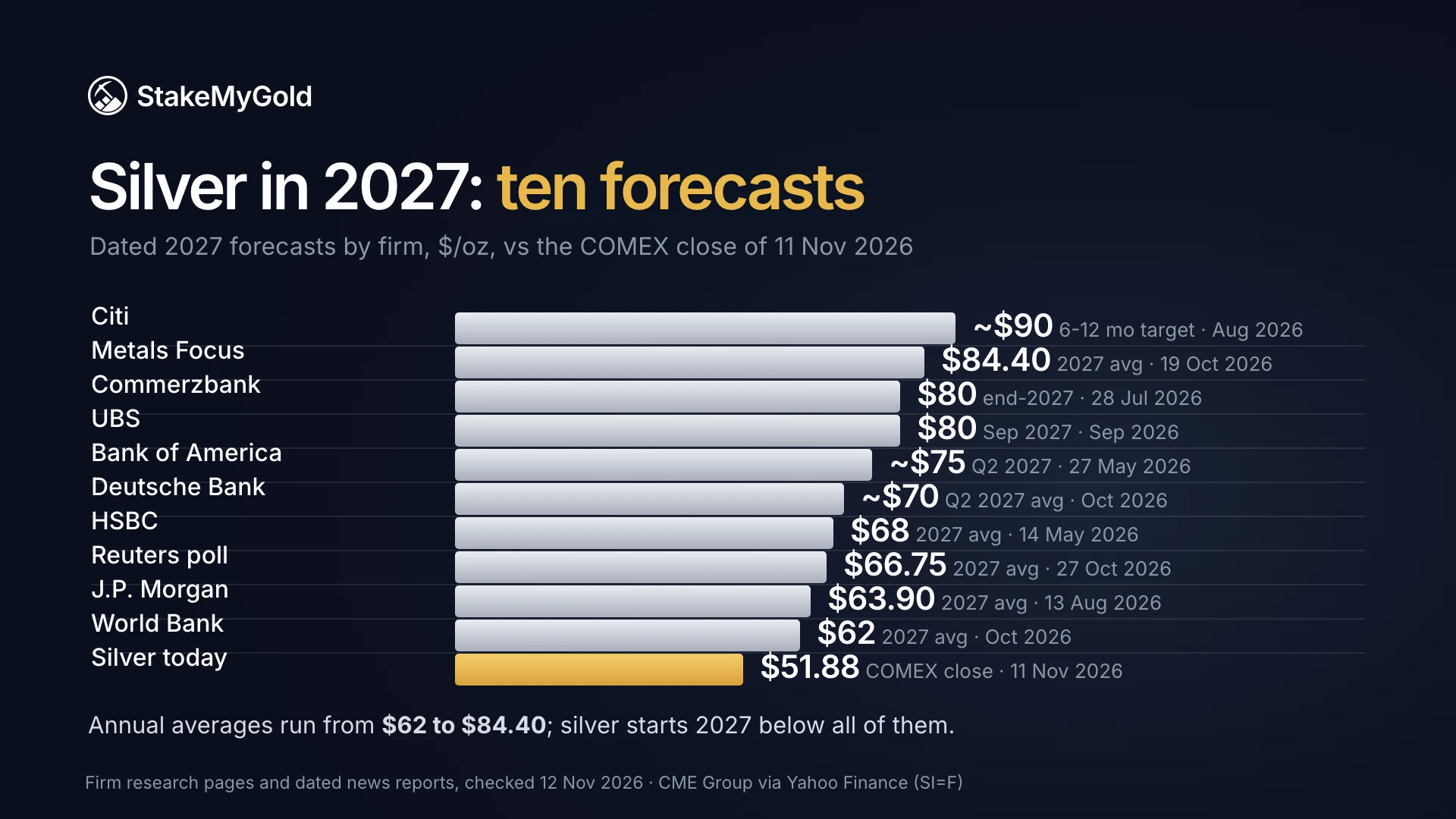
The most bullish forecasters first. Citi said in August that silver could rise to around $90 within six to 12 months, citing a less hawkish Fed. Metals Focus told Kitco on 19 October that it expects silver to average $84.40 in 2027 and rise above $90 in the fourth quarter. Commerzbank cut its end-2027 forecast to $80 from $90 in July. UBS set targets of $75 for March and June 2027 and $80 for September 2027, and its strategist called silver "a higher-beta version of gold."
The middle of the range is closer to today's price. Bank of America said in May that silver would trade around $75 by the second quarter of 2027. Deutsche Bank's Daniel Ghali expects silver to average around $70 in the second quarter of 2027. HSBC raised its 2027 average to $68 in May. A Reuters poll of 30 analysts and traders, published on 27 October, put the 2027 average at $66.75, down from $70.30 for 2026.
The lowest calls come from J.P. Morgan and the World Bank. J.P. Morgan cut its forecast in August to a 2027 average of $63.90, rising to $65 in the fourth quarter. The World Bank expects $62, down more than 11% from its 2026 estimate of $70.
Two things stand out. First, silver at $51.88 is $10 or more below every number in the table, so several of these calls are likely to be cut. Second, most of them were made in a different market. Only four were published in October or later, with silver near or below $60: Metals Focus, Deutsche Bank, the Reuters poll and the World Bank.
| Forecaster | Date of call | 2027 silver forecast | Type of number |
|---|
| Citi | Aug 2026 | about $90 | Target within 6 to 12 months |
| Metals Focus | 19 Oct 2026 | $84.40; above $90 in Q4 | 2027 average |
| Commerzbank | 28 Jul 2026 | $80 | End of 2027 |
| UBS | Sep 2026 | $75 (Mar, Jun), $80 (Sep) | Quarter-end targets |
| Bank of America | 27 May 2026 | about $75 | Q2 2027 |
| Deutsche Bank | Oct 2026 | about $70 | Q2 2027 average |
| HSBC | 14 May 2026 | $68 ($65 at year-end) | 2027 average |
| Reuters poll, 30 analysts | 27 Oct 2026 | $66.75 | 2027 average |
| J.P. Morgan | 13 Aug 2026 | $63.90 ($65 in Q4) | 2027 average |
| World Bank | Oct 2026 | $62 | 2027 average |
Forecasts for silver's 2027 average differ by $22 mainly because forecasters disagree on whether investors will come back, not on supply and demand, where they mostly agree.
Start with the physical market. A deficit means a year's demand (industry, jewelry, coins and bars) is larger than a year's supply (mine output plus recycling). A surplus is the opposite. The Silver Institute's World Silver Survey forecast a 2026 deficit of 46.3 million ounces in April. In its October interview, Metals Focus put this year's deficit at 35.4 million ounces and forecast a surplus of 37.3 million ounces in 2027, the first in years. Deutsche Bank has also said the market could flip to surplus in 2027.
The cause is mostly solar. Metals Focus expects industrial demand to fall from 640.2 million ounces in 2026 to 618.2 million in 2027, because panel makers keep cutting the silver in each cell faster than installations grow.
So why is Metals Focus also the most bullish? Its price case does not depend on a shortage. It depends on investment demand: more buying of exchange-traded products (ETPs), funds that hold physical silver for their shareholders, at the same time as gold rallies. Without a gold rally, Matthew Piggott of Metals Focus told Kitco, he does not expect a major silver move.
J.P. Morgan and the World Bank take the other side. J.P. Morgan says the tight physical market that drove 2025 is unwinding and that higher interest rates make metals that pay no interest less attractive. The Reuters poll quoted StoneX's Rhona O'Connell saying silver "is likely to underperform gold" and that the reversal in ETFs "leaves the market oversupplied."
Our scenarios use one formula:
Silver price = gold price ÷ gold-silver ratio
This is arithmetic, not a theory of value. It helps because both inputs have named forecasts behind them. Gold has its own 2027 outlooks, which we cover in our gold price prediction for 2027. The ratio tells you how silver performs against gold. Our guide to what the gold-silver ratio measures explains why it describes the relationship rather than predicting it.
| Case | Gold, 2027 average | Gold-silver ratio | Silver, 2027 average |
|---|---|---|---|
| Bear | $3,800 to $4,000 | 85 to 90 | $42 to $47 |
| Base | $4,250 to $4,650 | 70 to 75 | $57 to $66 |
| Bull | $5,330 to $5,600 | 60 to 63 | $85 to $93 |
StakeMyGold scenario math, not a forecast. Starting point: gold $4,000.50, silver $51.88, ratio 77.1 (COMEX closes, 11 November 2026).
This range sits just below the middle of the published forecasts, because most of them were set when silver was higher.
Say you put $10,000 into silver at the 11 November close of $51.88. That buys about 192.7 ounces. Ignoring dealer premiums and fees, here is what it would be worth at each end of each range:
| Case | Silver price | Value of 192.7 oz | Change |
|---|---|---|---|
| Bear, low end | $42 | $8,095 | -19% |
| Bear, high end | $47 | $9,059 | -9% |
| Base, low end | $57 | $10,987 | +10% |
| Base, high end | $66 | $12,721 | +27% |
| Bull, low end | $85 | $16,384 | +64% |
| Bull, high end | $93 | $17,926 | +79% |
Simple arithmetic at COMEX prices. Coins and bars cost more than spot to buy and fetch less to sell.
Now see how much the ratio matters. With gold at $4,500, a ratio of 77 gives silver at $58. A ratio of 65 gives $69. That $11 difference comes from the ratio alone, with the gold price unchanged.
Every 2027 forecast in the table is above today's $51.88, so most forecasters expect at least a partial recovery. Whether it comes depends on five things.
Higher interest rates hurt silver, because they raise the cost of holding a metal that pays nothing. The Fed raised rates by a quarter point on 16 September 2026 and on 28 October held its target range at 3.75% to 4%, with two officials voting for another hike. October consumer prices rose 0.4% in the month, more than expected, and after that report futures priced a December hike as close to certain. A pause early in 2027 is the bull case. Hikes through the year are the bear case. For how gold has behaved in past cycles, see what happens to gold when interest rates rise.
Silver rarely rises far without gold. Every forecaster we found links its silver call to gold, and the formula above shows why. The gold calls for 2027 are almost as spread out: the World Bank sees $4,250 and Metals Focus $5,330.
Thrifting means using less silver per unit of product. Solar panels are the clearest case. The World Silver Survey expects silver demand from solar to fall 19% in 2026, to about 151 million ounces, even as panel output grows. Deutsche Bank estimates silver use per solar cell falls 17% this year. Growth in electric vehicles, data centers and power grids offsets part of this, but Metals Focus does not expect it to offset all of it over the next 12 months.
This is the swing factor. Metals Focus reported on 29 October that silver ETPs had shed about 60 million ounces since January and that London vault stocks had risen to 932 million ounces, the highest in nearly four years. Metal leaving funds is metal available to buyers. If those flows reverse in 2027, the surplus could disappear quickly. If they do not, prices have little support.
About 70% of mined silver is a by-product of copper, lead and zinc mining, so mine output barely reacts to the silver price. Recycling does. It reached 197.6 million ounces in 2025, and the Silver Institute expects it to pass 200 million ounces in 2026, its highest since 2012. High prices pull old silver back into the market, which tends to limit rallies.
These are the dates when you can check which case is playing out.
| When | What | Why it matters |
|---|---|---|
| Mid-November 2026 | Silver Institute and Metals Focus interim review | First official update of the 2026 deficit and the 2027 outlook |
| 8-9 December 2026 | Fed meeting (FOMC) | The hike markets expect, plus new rate projections |
| 2027 Fed meetings | 26-27 Jan, 16-17 Mar, 27-28 Apr, 8-9 Jun, 27-28 Jul, 14-15 Sep, 26-27 Oct, 7-8 Dec | A pause supports the bull case; more hikes support the bear case |
| 31 March 2027 | UBS checkpoint | UBS targets $75 |
| April 2027 | World Silver Survey 2027 | Confirms or rejects the 2027 surplus |
| 30 June 2027 | UBS, BofA and Deutsche Bank checkpoints | Targets of $70 to $75 |
| 30 September 2027 | UBS checkpoint | UBS targets $80 |
| End of 2027 | Commerzbank and Metals Focus | $80 at year-end; above $90 in Q4 |
Fed dates from the Federal Reserve calendar, checked 12 November 2026; 2027 dates are tentative until confirmed. The 2026 World Silver Survey came out in April.
Two other numbers are worth tracking all year: the gold-silver ratio (is it moving toward 70 or toward 85?) and silver ETP holdings (are funds buying or selling?).
If you searched this topic, you may have seen 2027 figures far outside the table, from the low $20s to several hundred dollars. These come from algorithmic forecast pages, which project recent price moves forward automatically. They use no input on supply, demand, gold or rates, and they change sharply when the chart changes. Our silver price prediction for 2030 shows how one such model cut its 2030 number by about 98% in under nine months. Treat these pages as a picture of recent momentum, not as forecasts.
StakeMyGold is a gold platform, and it offers no silver product. If you want silver's upside in the bull case above, nothing on StakeMyGold gives you that, and a gold product is not a substitute.
What it does offer is gold staking. Holders of GGBR, a gold-backed token, can stake it to earn a return paid in gold. The site's FAQ states a target return that is not guaranteed and can change. GGBR is backed by certificates for gold still in the ground rather than vaulted bars, which we explain in what actually backs your token. Staking has its own risks, including smart contract risk and limits on how fast you can exit, covered in is gold staking safe. If you want to see how it works, the getting started guide walks through the steps.
What is the silver price prediction for 2027? Dated forecasts for the 2027 average range from $62 (World Bank) to $84.40 (Metals Focus), with a Reuters poll of 30 analysts at $66.75. Citi's 6-to-12-month target of about $90 is the highest call we found. Our base case is $57 to $66, assuming gold at $4,250 to $4,650 and a gold-silver ratio of 70 to 75.
Will silver go up in 2027? Every dated 2027 forecast we found is above the 11 November 2026 close of $51.88, so most forecasters expect some recovery. It depends on the Fed pausing its hikes, gold rising, and investors buying silver funds again. If none of those happens, our bear case is $42 to $47.
Can silver reach $100 in 2027? No named forecast we found has silver at $100 in 2027. The highest are Metals Focus, which sees prices above $90 in the fourth quarter, and Citi's target of about $90. With the ratio at 77, $100 silver would need gold near $7,700. With Metals Focus's $5,330 gold, it would need the ratio to fall to about 53.
What is J.P. Morgan's silver forecast for 2027? J.P. Morgan forecasts a 2027 average of $63.90 an ounce, with $63 in the first quarter rising to $65 in the fourth. It cut the forecast on 13 August 2026, citing an easing physical market, lower solar demand and higher interest rates.
Will the silver market be in surplus in 2027? Metals Focus forecasts a surplus of 37.3 million ounces in 2027, after a deficit of 35.4 million in 2026. Deutsche Bank also expects a surplus. The cause is mainly lower silver use in solar panels. The Silver Institute's World Silver Survey in April 2027 will give the official estimate.
Where will silver be at the end of 2027? Year-end calls are fewer: Commerzbank expects $80 and HSBC $65. UBS targets $80 by September 2027. Treat each as one firm's view on one date, made when silver traded higher than it does now.
The honest silver price prediction for 2027 is a range. Published forecasts for the year's average run from $62 to $84.40, and silver is starting below all of them at $51.88. Our base case is $57 to $66, with $42 and $93 as the outer bounds under stated assumptions. Whether silver reaches the upper half depends on three things: the Fed stopping its hikes, gold rising again, and investors returning to silver funds. Check the ratio and the quarter-end targets as 2027 goes on. For the longer view, see our silver price prediction for 2030.
This article is for informational purposes only and is not financial advice.
