Is the US dollar backed by gold? The clearest answer sits in a table the Federal Reserve published on 29 October 2026, in its weekly balance sheet. It lists what stands behind every Federal Reserve note in circulation. Of the $2.43 trillion in notes that needed collateral that Wednesday, $11.0 billion was gold certificates. That is 0.45%. Almost all the rest was US Treasury, agency and mortgage-backed securities.
The answer is no. You cannot swap a dollar for gold at the Fed or the Treasury, and the Fed says plainly that Federal Reserve notes are not redeemable in gold, silver, or any other commodity. Ordinary Americans lost the right to swap dollars for gold in 1933 and 1934. Foreign governments lost it on 15 August 1971.
The dollar is backed instead by four things you can check: the law that makes it legal tender and the currency of US taxes, the government debt the Fed holds against each note, the Fed's job of keeping inflation near 2%, and the rest of the world's demand for dollars. Gold still sits in the system, 261.5 million ounces of it, but on the books it is valued at $42.22 an ounce.
No. The US dollar is a fiat currency. It is not backed by gold or any other commodity, and no one can exchange dollars for a fixed amount of gold. Federal Reserve notes are legal obligations of the United States, and the law says they are redeemed in "lawful money", which in practice means other dollars.
Fiat currency is money whose value comes from government law and public acceptance rather than from a promise to swap it for a physical commodity. The word comes from Latin for "let it be done": the money is money because the state says so and people keep using it. The euro, the yen and the British pound are fiat currencies too.
The St. Louis Fed's explainer on why the US no longer follows a gold standard notes that tying a currency to the gold supply does not guarantee financial or economic stability. In the 1930s, countries that hoarded gold ran short of it and were forced off the standard anyway.
One quirk survives. The US Mint's 1 oz American Gold Eagle is legal tender with a $50 face value. On 30 October 2026, the gold in it was worth about $3,876. The coin is legal money, but the dollar is not defined by the gold inside it.
The US dollar is backed by US law, by the government securities the Fed holds against every note, by the Fed's mandate to keep prices stable, and by worldwide demand for dollars. None of these is a vault you can walk into, but each one can be measured.
Federal law says US coins and currency, including Federal Reserve notes, are legal tender for all debts, public charges, taxes, and dues. Legal tender means a creditor has to accept it to settle a debt owed in dollars.
The tax link matters more than it sounds. Every US household and business owes taxes in dollars, so every year hundreds of millions of people need dollars, whatever else they hold. The same section of the Federal Reserve Act that makes notes obligations of the United States also makes them receivable for all taxes, customs, and other public dues.
Congress requires each Federal Reserve Bank to pledge collateral at least equal to the notes it issues. The law lists what counts, from gold certificates and Special Drawing Right certificates to direct obligations of the United States or any agency thereof. The Fed's FAQ says this collateral is chiefly held in the form of U.S. Treasury, federal agency, and government-sponsored enterprise securities.
So the dollar bill in your wallet is, on the Fed's books, backed by US government debt. That debt is in turn backed by the government's power to tax. Gold is a footnote in this chain, as the table in the next section shows.
A fiat currency keeps its value only if its issuer does not print too much of it. The Federal Reserve's mandate is maximum employment and price stability, and the FOMC has said that inflation of 2 percent over the longer run is most consistent with that mandate.
The record shows what "stable" means in practice. The consumer price index averaged 40.5 in 1971 and stood at 336.940 in September 2026, so $1 from 1971 buys roughly what $8.32 buys today. The dollar has kept its role, but it has lost about 88% of its purchasing power since its last link to gold was cut. Gold went from $35 to $3,875.84 over the same span, which is why gold investors watch this number closely. Our piece on how gold has tracked inflation since 1971 covers that record in detail.
The dollar is also held up by how much of the world wants it. Two official data sets measure this:
That demand is not guaranteed. The IMF has tracked a slow decline in the dollar's reserve share since the early 2000s, and some central banks have been buying gold instead. We cover that shift in de-dollarization and gold.
On 28 October 2026, every $100 of Federal Reserve notes that needed collateral was backed by about $98.92 of Treasury, agency and mortgage-backed securities, $0.62 of SDR certificates and $0.45 of gold certificates. The figures come from table 7 of the Fed's H.4.1 release of 29 October 2026.
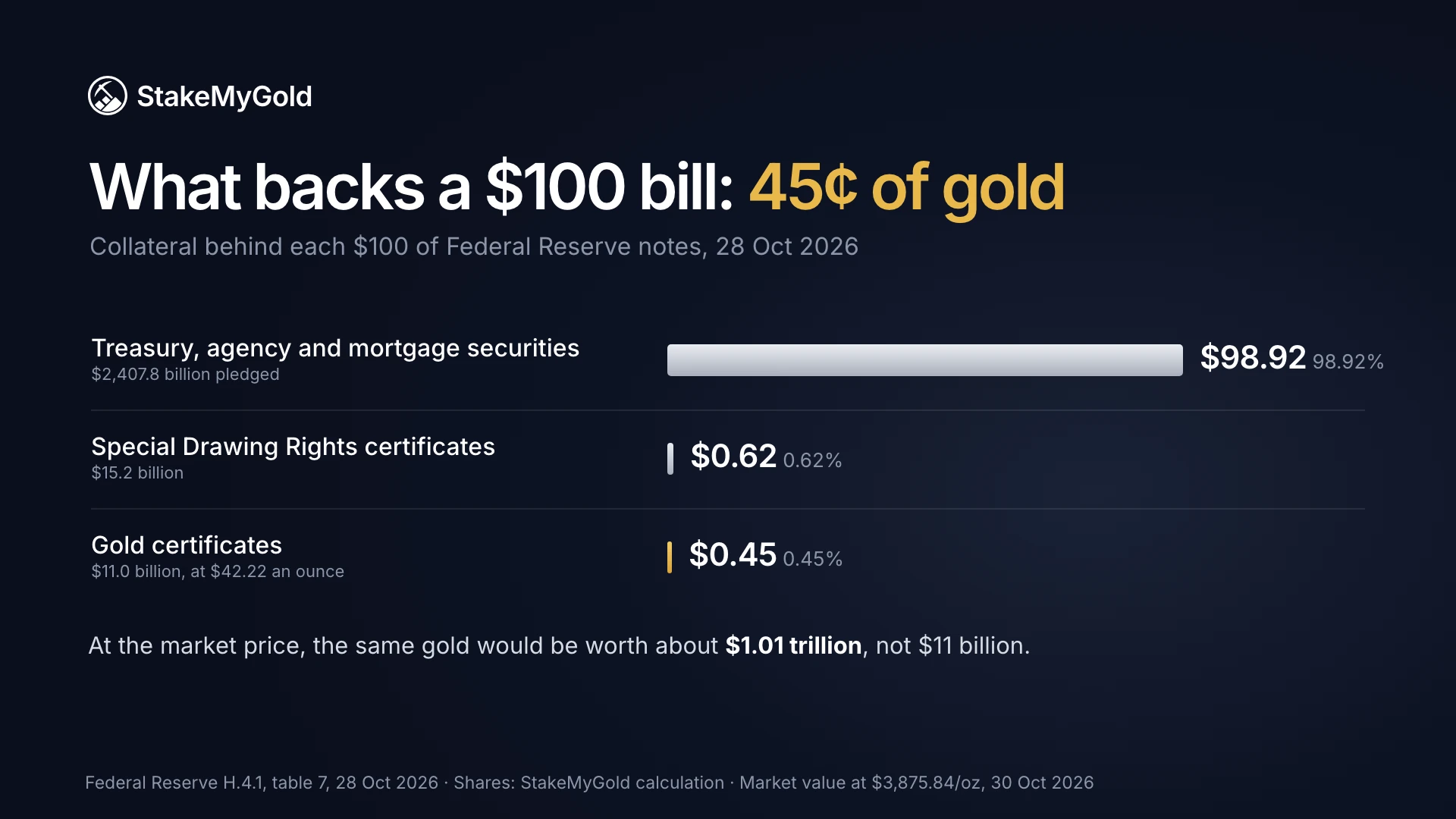
Two details stand out. First, the gold certificates are the same $11.0 billion every week, because they are carried at a fixed legal price, not at market. Second, the Fed had $6.08 trillion of securities eligible to be pledged, more than twice what it needed. The collateral rule is easy to meet, which is why it no longer limits how many dollars exist.
The US Treasury owns 261,498,926 fine troy ounces of gold, about 8,133 tonnes, according to its Status Report of US Government Gold Reserve for 30 September 2026. Most of it sits in Mint vaults at Fort Knox, Denver and West Point, with a smaller amount at the Federal Reserve Bank of New York. Our post on where the Treasury's gold sits breaks it down by vault.
| Line in the Fed's table | Amount (28 Oct 2026) | Share of collateral | Per $100 note |
|---|
| Federal Reserve notes outstanding | $2,838.1 billion | ||
| Less notes held inside Reserve Banks (no collateral needed) | $404.0 billion | ||
| Notes to be collateralized | $2,434.0 billion | 100% | $100.00 |
| Treasury, agency and mortgage-backed securities pledged | $2,407.8 billion | 98.92% | $98.92 |
| Special Drawing Rights certificate account | $15.2 billion | 0.62% | $0.62 |
| Gold certificate account | $11.0 billion | 0.45% | $0.45 |
| Source: Federal Reserve H.4.1, table 7, Wednesday 28 October 2026. Shares are our calculation. The gold line is valued at the statutory $42.22 per ounce, not the market price. |
| Measure | Value |
|---|
| Fine troy ounces (30 Sep 2026) | 261.5 million |
| Book value at $42.2222/oz | $11.04 billion |
| Market value at $3,875.84/oz (30 Oct 2026) | about $1.01 trillion |
| Market value as a share of currency in circulation ($2.48 trillion) | about 41% |
| Sources: US Treasury Fiscal Data; Trading Economics gold price, 30 October 2026; Fed H.4.1. Ratios are our calculation. |
The book value is low because federal law caps gold certificates at the value of the gold at 42 and two-ninths dollars a fine troy ounce, a rate set in 1973 and never changed. Decades ago the Treasury issued those certificates to the Fed in exchange for dollar credits. They are the $11.0 billion "gold certificate account" in the table above.
Gold closed at $3,875.84 an ounce on 30 October 2026, down 3.6% that day and about 31% below its January 2026 high. At that price the US gold reserve is worth roughly 92 times its book value. That gold belongs to the Treasury and backs nothing in particular. It is a reserve asset, not a promise to anyone holding dollars.
The US dollar stopped being backed by gold in stages: Americans lost the right to redeem dollars for gold in 1933-1934, the legal gold reserve behind notes was removed in 1968, and foreign governments lost redemption on 15 August 1971. After 1971 no one could exchange dollars for gold at a fixed price.
| Date | What changed |
|---|---|
| 1913 | The Fed is created. It must hold gold equal to 40% of the notes it issues and convert them at $20.67 an ounce. |
| 30 Jan 1934 | The Gold Reserve Act moves all monetary gold to the Treasury and resets gold at $35. Notes stop being redeemable in gold for Americans. |
| 3 Mar 1965 | Congress ends the gold reserve requirement on Federal Reserve Bank deposits. |
| 18 Mar 1968 | Congress removes the 25% gold reserve behind Federal Reserve notes. |
| 15 Aug 1971 | Nixon ends dollar convertibility into gold for foreign governments. |
| 1973 | The official price is set at $42.22, the book value still used today. |
| 31 Dec 1974 | Americans may legally own gold bullion again. |
| The 1965 and 1968 changes are recorded in the amendment notes to 12 U.S.C. §413. |
That is the short version. For how the system worked, why it broke and what economists think of bringing it back, read how the gold standard worked and why it ended.
To back only the physical cash in circulation with the Treasury's gold, gold would have to trade at about $9,500 an ounce, roughly 2.5 times its 30 October 2026 price. Currency in circulation was $2.48 trillion in the week to 28 October 2026, and the Treasury holds 261.5 million ounces.
Cash is only a small part of the money Americans hold. Bank deposits and money market funds are many times larger, so backing the broader money supply would need a far higher gold price. Our gold standard explainer runs that wider calculation. The point here is narrower: even the cash alone is not covered at today's gold price.
No major currency is backed by gold today. No country fixes its money to a set weight of gold and redeems notes in gold on demand. Central banks still hold gold as a reserve, and a few small experiments exist:
No. The dollar is not backed by oil or any other commodity. The "petrodollar" idea refers to oil being priced in dollars: the main crude benchmarks, such as NYMEX WTI futures, are quoted in US dollars, so buyers around the world need dollars to pay for oil. That demand helps the dollar, but no one can exchange dollars for a fixed amount of oil, and no oil sits behind Federal Reserve notes in the Fed's collateral table.
StakeMyGold does not issue a currency, and nothing here suggests gold tokens replace dollars. The platform lets you stake gold-backed tokens, mainly GGBR, which the StakeMyGold FAQ says represents audited, unmined gold reserves. That is in-ground gold, not vaulted bars, and the FAQ does not describe redeeming GGBR for metal. Our guide to what backs a gold token explains the difference.
If the question that brought you here is "what is my money actually backed by?", the honest answer for any gold product is the same as for the dollar: read what the issuer holds, who audits it and whether you can redeem it. Staking adds another layer, since StakeMyGold's yield strategy page says returns are not guaranteed and depend on borrowers and partners.
What backs the US dollar if not gold? The law makes dollars legal tender and the currency of US taxes, the Fed holds Treasury and other government-backed securities as collateral for every note, and governments and investors around the world hold dollars as reserves. On 28 October 2026, 98.9% of the Fed's note collateral was government-backed securities.
What is fiat currency? Fiat currency is money that has value because a government declares it legal tender and people accept it, not because it can be exchanged for gold or another commodity. The US dollar, euro, yen and pound are all fiat currencies.
Can I exchange my dollars for gold at the Federal Reserve? No. Federal Reserve notes have not been redeemable in gold since 30 January 1934, and the Fed says they are not redeemable in any commodity. You can buy gold at the market price from a dealer, a bank or through an ETF.
Is the US dollar backed by gold or silver? Neither. The Fed says Federal Reserve notes have not been redeemable in silver since the 1960s. Old silver certificates are still legal tender at face value, but they cannot be swapped for silver.
Does the US have 8,000 tons of gold? Yes. The Treasury holds 261.5 million fine troy ounces, about 8,133 metric tonnes, as of 30 September 2026. That is the largest national gold holding in the world.
Why was it illegal for Americans to own gold? From 1933, President Roosevelt's gold program required Americans to hand in gold coins, bullion and gold certificates so the government could devalue the dollar against gold. Private ownership of gold bullion became legal again on 31 December 1974.
The US dollar is not backed by gold. It is backed by law, by the government debt the Fed holds behind each note, by the Fed's inflation target and by global demand. Gold still matters to the system, since the Treasury owns about $1 trillion of it at market prices, but it plays no part in what a dollar is worth. If you want gold, you buy it at the market price, the same as anyone else.
This article is for informational purposes only and is not financial advice.
