On 30 September 2026 the IMF published its latest count of what the world's central banks hold. The US dollar's share of their foreign-currency reserves slipped to 56.70% in the second quarter, from 57.18% three months earlier. Some people quote that number as proof of de-dollarization. Others quote it as proof that nothing is happening.
Both camps are partly right. De-dollarization (countries and companies relying less on the US dollar for reserves, trade and payments) is real, but it is slow and uneven, and in some markets the dollar is gaining ground. The clearest winner so far is not the euro or the Chinese yuan. It is gold.
This guide checks each part of the claim against primary data, separates the BRICS facts from the rumors, and explains what any of it means for someone holding gold.
De-dollarization is the process by which governments, central banks and companies reduce their use of the US dollar for holding reserves, pricing trade, making cross-border payments and borrowing. It describes a decline in the dollar's share of these activities. It does not mean the dollar stops being used.
It helps to separate the four places where the dollar's role can be measured:
A country can de-dollarize one of these and not the others. Most headlines blur them together, which is why the same data gets read in opposite directions.
Do not confuse it with "dollarization", the opposite process, where a country such as Ecuador or El Salvador adopts the US dollar as its own currency.
Yes in reserves, slowly. No in FX trading, payments or trade finance, where the dollar's share is flat or rising. Here is each measure, using the latest primary release available on 4 October 2026.
The dollar's share of the world's disclosed foreign-currency reserves peaked at about 72% in 2001, according to the Federal Reserve's 2025 review of the dollar's international role. It stood at 56.70% in Q2 2026, with the euro at 20.60%, the yen at 4.96% and the renminbi at 2.11%. Total reserves were $13.22 trillion.
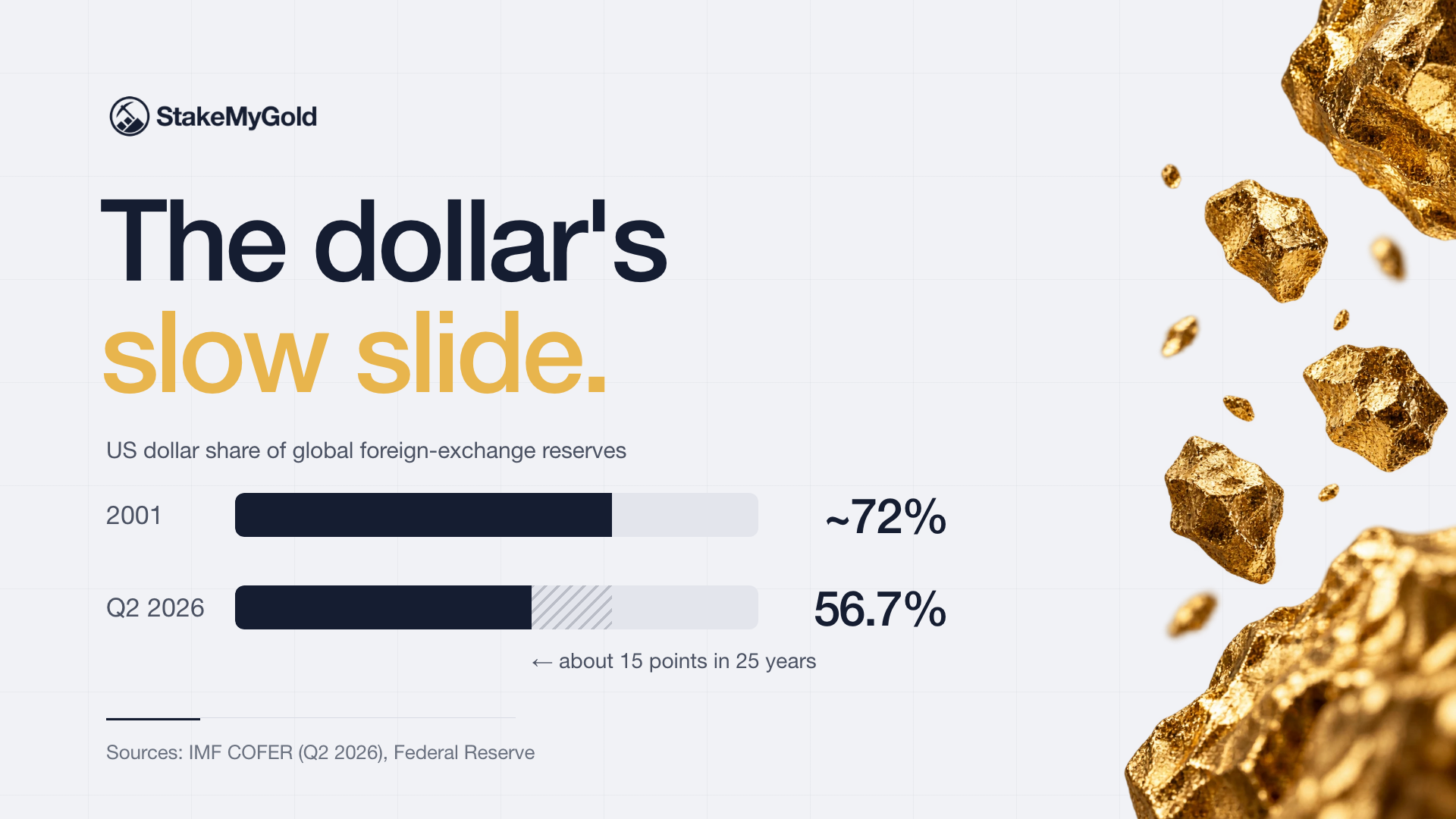
That is a drop of about 15 percentage points in 25 years. It is real. But much of it went to smaller "non-traditional" currencies such as the Canadian and Australian dollars, not to a single rival.
Part of the movement is also arithmetic. COFER values everything in dollars. When other currencies rise against the dollar, their share goes up even if no central bank sells anything. In Q2 2025 the dollar's share fell from 57.79% to 56.32%, and the IMF calculated that 92% of that drop came from exchange-rate moves. Held at constant exchange rates, the decline was about 0.12 points.
The Q2 2026 move was different. The IMF said currencies stayed within about 2% that quarter, dollar holdings were "largely unchanged," and euro holdings rose by nearly $100 billion. So the latest decline reflects central banks adding other currencies, not dumping dollars.
The Bank for International Settlements (BIS) surveys the global FX market every three years. In April 2025, turnover hit $9.6 trillion a day, and the dollar was on one side of 89.2% of all trades, up from 88.4% in 2022. The renminbi's share rose to 8.5%, still far behind the euro at 28.9%.
In Swift messaging data, the dollar carried about 50.1% of cross-border payments by value in the tracker Swift published in July 2026 (as reported by Trade Treasury Payments; Swift's own PDF does not state clearly which month the figure covers), with the renminbi fifth at about 3.1%. In trade finance (letters of credit and similar instruments), the dollar's share was about 81%.
For trade invoicing, the Federal Reserve's 2025 review found the dollar was used for 96% of export invoicing in the Americas, 74% in Asia-Pacific and 79% elsewhere outside Europe on average between 1999 and 2019. Europe is the exception, at 66% in euros, largely because of trade inside the euro area.
| Measure | Latest reading | Earlier reading | Direction | Source |
|---|
| Dollar share of allocated FX reserves | 56.70% (Q2 2026) | ~72% (2001); 58% (2024) | Down, slowly | IMF COFER; Federal Reserve |
| Gold share of global official reserves, at market prices | ~27% (end-2025) | 20% (end-2024) | Up, mostly price | ECB |
| Dollar on one side of FX trades | 89.2% (April 2025) | 88.4% (April 2022) | Up | BIS Triennial Survey |
| Dollar share of cross-border payments by value | ~50.1% | ~50% (2024) | Flat | Swift tracker (July 2026 report, via Trade Treasury Payments); Federal Reserve |
| Dollar share of trade finance | ~81.2% | n.a. | Dominant | Swift tracker (July 2026 report) |
| Dollar share of export invoicing, 1999–2019 averages | 96% Americas, 74% Asia-Pacific, 79% rest of world | n.a. | Dominant outside Europe | Federal Reserve |
| Renminbi share of FX reserves | 2.11% (Q2 2026) | 1.98% (Q1 2026) | Up, from a low base | IMF COFER |
Fewer than the headlines suggest. A September 2025 Federal Reserve working paper by Colin Weiss looked at countries that bought gold and disclosed the currency mix of their reserves. It found that the three largest gold buyers since 2000, China, Russia and Türkiye, cut the dollar share of their reserves as they bought gold. Outside those three, there were "few examples" of countries buying gold while meaningfully lowering their dollar share. Most were diversifying away from all foreign currencies a little, not targeting the dollar.
Trade is a separate story. China settled 27.2% of its goods trade in renminbi in 2024, up 2.4 points from 2023, according to People's Bank of China figures. That moves China's own trade off the dollar. It does not move the rest of the world's.
Gold is the reserve asset that has gained the most share, but mostly because its price rose, not because central banks bought vast new quantities.
The European Central Bank tracks this in its annual report on the international role of the euro. Its June 2025 edition found that gold, valued at market prices, made up 20% of global official reserves at the end of 2024, passing the euro's 16%. Its June 2026 edition put gold at about 27% at the end of 2025, ahead of US Treasuries at about 22% and the euro at 15%.
The Federal Reserve adds an important caveat. Gold's share of reserves rose from under 10% in 2015 to 23% in 2025, but the physical amount of gold held by central banks grew by less than 10% over that period. Most of the jump was the price.
The buying is still large by historical standards. According to the ECB, central banks bought more than 1,000 tonnes a year from 2022 to 2024 and about 850 tonnes in 2025. The World Gold Council reported net purchases of 289 tonnes in Q2 2026, led by Poland (51 tonnes) and China (33 tonnes), while Russia was the largest seller (22 tonnes). We cover these flows in detail in what record central-bank buying means for everyone else and in the 2026 central-bank data, including the debate over gold passing Treasuries.
One detail from the ECB's 2026 report links reserves to on-chain gold: Tether, a private stablecoin company, bought more than 100 tonnes of gold in 2025, more than any single central bank, including Poland.
In 2022, after Russia invaded Ukraine, the EU, the US, Japan and Canada froze about $300 billion of the Russian central bank's reserves, roughly $200 billion of it in Europe, mostly at the Belgian depository Euroclear. Every reserve manager noticed. A bond issued by another government, held in another country's system, can be blocked.
Gold stored in your own vaults is nobody else's liability. It pays no interest and costs money to store, but no foreign government can switch it off. That is the "neutral reserve asset" argument. It helps explain why Russia and China, two of the countries most exposed to US sanctions risk, are among the largest gold buyers. The Fed paper adds a caution: across all countries, the link between sanctions and gold holdings rests on a few cases.
Three forces account for most of it.
Sanctions. The 2022 freeze, plus the wider use of secondary sanctions (penalties on third parties that deal with a sanctioned country), gave governments outside the US alliance system a reason to hold fewer dollar assets. The September 2026 BRICS declaration again condemned "unilateral coercive measures," including secondary sanctions.
US policy uncertainty. The dollar index fell about 9.5% in 2025, its worst year since 2017, amid tariff shocks and questions about the US fiscal outlook. It has partly recovered in 2026, helped by the Fed's 16 September rate hike, its first since 2023. A falling dollar shrinks the dollar's reserve share on paper even without any selling.
China building alternatives. China has expanded renminbi settlement for its own trade and built its own cross-border payment system (CIPS). That reduces China's dollar use. It has not made the renminbi a major reserve currency: 2.11% of reserves, partly because China limits the movement of money in and out of the country (capital controls).
Because a cheaper dollar makes US exports cheaper abroad, which supports manufacturing. In January 2026, with the dollar at a four-year low, President Trump said of the decline, "I think it's great." Stephen Miran, who later chaired the Council of Economic Advisers, argued in a November 2024 paper that the dollar's reserve role keeps it overvalued and hurts US industry. Treasury Secretary Scott Bessent has said the US still has a "strong dollar policy." The administration wants a cheaper dollar without giving up its reserve role, and those two goals pull against each other.
BRICS countries are working on ways to pay each other in their own currencies. They have not created, approved or scheduled a common currency, gold-backed or otherwise.
BRICS began as Brazil, Russia, India, China and South Africa and has since added Egypt, Ethiopia, Iran, the UAE and Indonesia. Their leaders met in New Delhi on 12–13 September 2026, and China holds the chair in 2027.
| Claim | Status | What the record shows |
|---|---|---|
| "BRICS has launched a gold-backed currency" | False | No member government has issued or approved one. The 2026 declaration does not mention a common currency. |
| "The Unit is the BRICS currency" | Misleading | A pilot launched on 31 October 2025 by a Moscow research institute (IRIAS), with 100 Units issued, backed 40% by gold and 60% by BRICS currencies. It is not an official BRICS project. |
| "BRICS Pay is replacing SWIFT" | Unproven | Leaders have endorsed work on a Cross-Border Payments Initiative and interoperability between national systems. No common BRICS payment network is operating. |
| "BRICS Clear will replace Euroclear" | Under study | The 2024 Kazan Declaration agreed to "discuss and study the feasibility" of it, on a voluntary basis. |
| "BRICS wants to dump the dollar" | Disputed by members | India's foreign minister said in December 2024 that India has "never actively targeted the dollar." |
| "The US will punish BRICS de-dollarization" | Threatened | Trump threatened 100% tariffs if BRICS created a currency (January 2025) and an extra 10% on countries aligning with BRICS "anti-American policies" (July 2025). |
No. The rumor dates back at least to July 2023, when Russian state media reported that BRICS would announce a gold-backed currency at its Johannesburg summit. South Africa's BRICS ambassador, Anil Sooklal, responded: "There's never been talk of a BRICS currency, it's not on the agenda." No currency was announced. The Unit pilot of October 2025 revived the claim, but it came from a research institute, not from BRICS governments.
The declaration has 140 paragraphs. We searched the full text published by the Indian Prime Minister's Office:
That is de-dollarization at the edges of trade, written cautiously. It is not a currency launch.
Network effects. Traders use dollars because everyone else does. Each additional user makes the dollar more useful, which is why the BIS share went up, not down, between 2022 and 2025.
Liquidity. The US Treasury market is the deepest place to park large sums and get them back quickly in a crisis. Foreign investors held about $9 trillion of Treasuries in Q1 2025, according to the Fed.
No ready substitute. The euro has no single government bond market of comparable size. The renminbi is held back by capital controls. Gold pays no interest and cannot easily be used to settle a payment: the Fed paper notes that its use as a unit of account and medium of exchange "remains limited."
The Triffin dilemma. Economist Robert Triffin noted in 1960 that the country issuing the world's reserve currency must supply it to the rest of the world, usually by running deficits, which over time erodes confidence in it. This is the strongest long-run argument for de-dollarization. It is also why the process is slow: the same deficits keep the world supplied with dollars.
Stablecoins. Dollar-backed tokens made up about 99% of the stablecoin market in April 2025, according to the Fed. Crypto has, so far, extended the dollar's reach rather than reduced it.
Nobody expects a sudden loss, and the data above does not point to one. If the dollar's role kept shrinking gradually, the main channels would be:
History suggests a long transition. The US economy overtook Britain's in the late 1800s, but the dollar did not clearly replace sterling as the main reserve currency until after the Second World War.
De-dollarization adds steady, price-insensitive demand from central banks. It does not set the gold price from month to month.
The proof is 2026 itself. Gold hit a record above $5,500 an ounce in late January, then fell by roughly a quarter. It was near $4,200 on 2 October 2026, while the central-bank buying and the BRICS headlines continued. Interest rates, the dollar's exchange rate and investor flows moved the price more. We explain those forces in why gold is falling in 2026.
Two practical points follow. First, gold's 27% share of reserves is measured at market prices, so it shrinks when the price drops. Second, central banks are one buyer among several. Jewelry and investment demand, much of it in India and China, still matters a great deal, as we show in who actually buys gold.
Take a simplified reserve pool of $100 billion: $57 billion in dollars and $43 billion in other currencies. The dollar's share is 57%.
Now let the other currencies rise 5% against the dollar. Nobody trades anything.
| Before | After a 5% move in other currencies | |
|---|---|---|
| Dollar holdings | $57.0bn | $57.0bn |
| Other currencies, valued in dollars | $43.0bn | $45.15bn |
| Total | $100.0bn | $102.15bn |
| Dollar share | 57.0% | 55.8% |
The dollar's share fell 1.2 points with no selling at all. Applied to $13.22 trillion of global reserves, a 1.2-point change looks like about $160 billion moving out of dollars, but it is a change in valuation.
This is why the IMF attributed 92% of the Q2 2025 decline to exchange rates. When you read "dollar share falls," check whether the dollar also fell that quarter.
Central banks like gold because it is nobody's liability. For an individual, that is true only for metal you hold directly. Every other form adds at least one party you depend on.
| How you hold gold | Who you depend on |
|---|---|
| Coins or bars in your possession | Nobody for ownership; you carry theft and storage risk |
| Allocated metal in a vault | The vault operator and custodian; specific bars are held in your name |
| Gold ETF | The fund trust, its custodian, and your broker |
| Gold token (for example PAXG or XAUT) | The issuer, its custodian and vault, the smart contract, and the blockchain |
| Staked gold token | All of the above, plus the staking platform's contracts and whoever it lends to |
On-chain gold is non-sovereign in the sense that no central bank issues it. It is not free of counterparties. Check whether a token is backed by allocated or unallocated gold, who audits the reserves, and how redemption works.
StakeMyGold is a platform for staking gold-backed tokens. Today it supports GGBR on Ethereum, and its FAQ says it targets up to 15% APR for GGBR stakers. PAXG and XAUT are listed as coming soon.
It does not offer what central banks get from gold in their own vaults. Staking adds counterparties. Our own FAQ lists smart contract risk, rehypothecation and counterparty risk (an institutional partner could fail), liquidity risk, and gas fee volatility. Yield comes from lending activity, which is exactly the kind of claim on someone else that "no counterparty" gold avoids.
If what you want from gold is the neutral, cannot-be-frozen quality behind de-dollarization, physical metal you control comes closest. If you want gold exposure that earns a yield and you accept the extra layers, read is gold staking safe before you decide.
What does de-dollarization mean? It means governments, central banks and companies using the US dollar less for reserves, trade pricing, cross-border payments and borrowing. It describes a falling share, not the end of the dollar.
Is de-dollarization happening in 2026? Slowly in reserves: the dollar's share was 56.70% in Q2 2026, against about 72% in 2001. Not in FX trading, where the dollar's share rose to 89.2% in 2025, or in payments and trade finance, where it is flat or dominant.
Does BRICS have a gold-backed currency? No. No BRICS government has issued or approved one, and the September 2026 New Delhi Declaration does not mention a common currency. The "Unit" is a small pilot by a Russian research institute, not a BRICS project.
Which countries are de-dollarizing? According to a 2025 Federal Reserve paper, China, Russia and Türkiye are the clear cases: they cut the dollar share of their reserves while buying gold. Most other gold buyers diversified away from all foreign currencies a little.
Why does Trump want a weaker dollar? A cheaper dollar makes US exports more competitive. Trump called the dollar's January 2026 slide "great," while his Treasury Secretary says the US keeps a strong dollar policy.
Will de-dollarization push gold prices up? It supports long-run central-bank demand, but it does not drive short-term prices. Gold fell about a quarter from its January 2026 record while central banks kept buying.
De-dollarization is a measurable, slow shift in where central banks keep their savings, not a collapse of the dollar. The dollar still dominates trading, payments and trade finance. Gold has gained the most reserve share, mainly through its price, and remains the main reserve asset no other government can freeze. For individuals, that quality belongs to metal you hold yourself. Every wrapper around it, including tokens and staking, adds risk you should understand first.
This article is for information only and is not financial, investment or tax advice. Gold and gold tokens can lose value, and staking carries additional risks. Do your own research and consider speaking to a licensed adviser.
