On 1 September 2026, gold and silver coins became legal tender in Texas, under a state law signed in June 2025. Five weeks later, on 8 October, the Federal Reserve's weekly balance sheet listed the US government's gold at $11,041 million. That figure only works at $42.22 an ounce, about 1% of what gold actually trades for.
Both facts are leftovers of the same idea. So what is the gold standard? The gold standard is a monetary system in which a country defines its currency as a fixed weight of gold and promises to swap its paper money for that gold on demand. The United States ran on some version of it for most of the years from the 1870s to 1971.
This guide explains how the gold standard worked, its main types, the dates that ended it, why it ended, and what economists think of bringing it back. It also runs the numbers on what gold would have to cost to back today's dollars, which is the question most explainers skip.
The gold standard is a monetary system in which the unit of money, such as the dollar, is legally defined as a fixed quantity of gold, and the government or central bank stands ready to exchange paper money for gold at that fixed price. Money supply is limited by how much gold the system holds.
Three features made a currency "on gold":
When every major currency was fixed to gold, exchange rates between them were also fixed. The World Gold Council's history describes how trade imbalances were settled in gold: a country that imported more than it exported lost gold, its money supply shrank and prices fell until its goods became cheap enough to sell abroad again. Central banks sped this up by raising interest rates when gold was leaving.
The phrase has a second meaning too. In everyday speech, "the gold standard" means the best example of something, like a clinical trial design. This article is about the monetary system.
There were three main forms of the gold standard, plus a fourth hybrid built after World War II. They differ in who could get gold and in what form.
Type definitions follow AIER's explainer on gold standard variants; dates from the sources cited below.
Each step down the table needed less physical gold per dollar of money. That saved gold, but it also made the promise easier to break.
The gold standard did not end on a single date. It ran from the 1870s, was suspended in World War I, was rebuilt in weaker forms, and was finally removed from the international system between 1971 and 1978.
Britain was on gold long before anyone else. According to the World Gold Council, Germany's move in 1871 pulled others along, and by 1900 all countries apart from China and some Central American states were on gold. The US made it official with the Gold Standard Act of 1900, which held until 1933, as the Federal Reserve History essay on the Gold Reserve Act notes.
Wars are expensive, and governments pay for them partly by printing money. A fixed gold price makes that impossible, so most countries suspended convertibility in 1914. Afterwards, many returned in weaker forms. Britain returned to gold in 1925 at its old parity, which overvalued the pound, and after losing gold it suspended the gold standard in September 1931.
On 5 April 1933, Franklin Roosevelt signed Executive Order 6102. It required people to deliver gold coin, bullion and gold certificates to a Federal Reserve bank by 1 May 1933. There were exceptions: up to $100 in gold coin per person, rare coins valued by collectors, and gold used in industry or art. Violations could bring a $10,000 fine or up to ten years in prison.
Then the price changed. Roosevelt signed the Gold Reserve Act on 30 January 1934, which moved all monetary gold to the Treasury and paid holders $35 an ounce. That cut the dollar's gold value to 59% of its 1900 level. Americans could not legally own gold bullion freely again until 1974.
In July 1944, delegates from 44 nations met in Bretton Woods, New Hampshire. They fixed the dollar to gold at $35 an ounce and pegged other currencies to the dollar. The system became fully functional in 1958. Only foreign governments and central banks could swap dollars for gold, so this was a gold standard for countries, not for citizens.
When the system began working, the US held about three-quarters of the world's official gold. By the 1960s, foreigners held more dollars than the US had gold to pay them. On 15 August 1971, Richard Nixon told the nation he had directed his Treasury Secretary to "suspend temporarily the convertibility of the dollar into gold". The suspension was never lifted.
The "temporary" break was patched for a while. Congress raised the official price to $38 in the Par Value Modification Act of March 1972, and to $42.22 in 1973. That second rate survives in law today: 31 U.S.C. §5117 still values Treasury gold at "42 and two-ninths dollars" an ounce. Fixed rates collapsed anyway, and generalized floating began in March 1973.
IMF ministers met in Jamaica on 7–8 January 1976 to write floating rates into the rules. The resulting Second Amendment to the IMF's Articles took effect in April 1978. A Congressional Research Service report summarizes the effect: the official price of gold was abolished and gold was demonetized.
The gold standard ended because a fixed supply of gold could not keep up with what governments wanted money to do: pay for wars, fight depressions and finance a growing world economy. Three pressures did most of the damage.
For what happened to prices after the link broke, see our look at gold as an inflation hedge since 1971.
To back every dollar of US currency with Treasury gold, gold would need to be about $9,500 an ounce; to back the monetary base, about $21,000; to back M2, about $89,000. Gold closed near $4,190 an ounce on 9 October 2026.
Here is the arithmetic. The Treasury reports 261,498,926 fine troy ounces of gold (about 8,133 tonnes, 31 August 2026). Divide each measure of money by that number:
Our calculation: amount divided by 261.5 million ounces. Fed data from H.4.1 (8 Oct 2026) and H.6 (22 Sep 2026); gold price close of 9 Oct 2026.
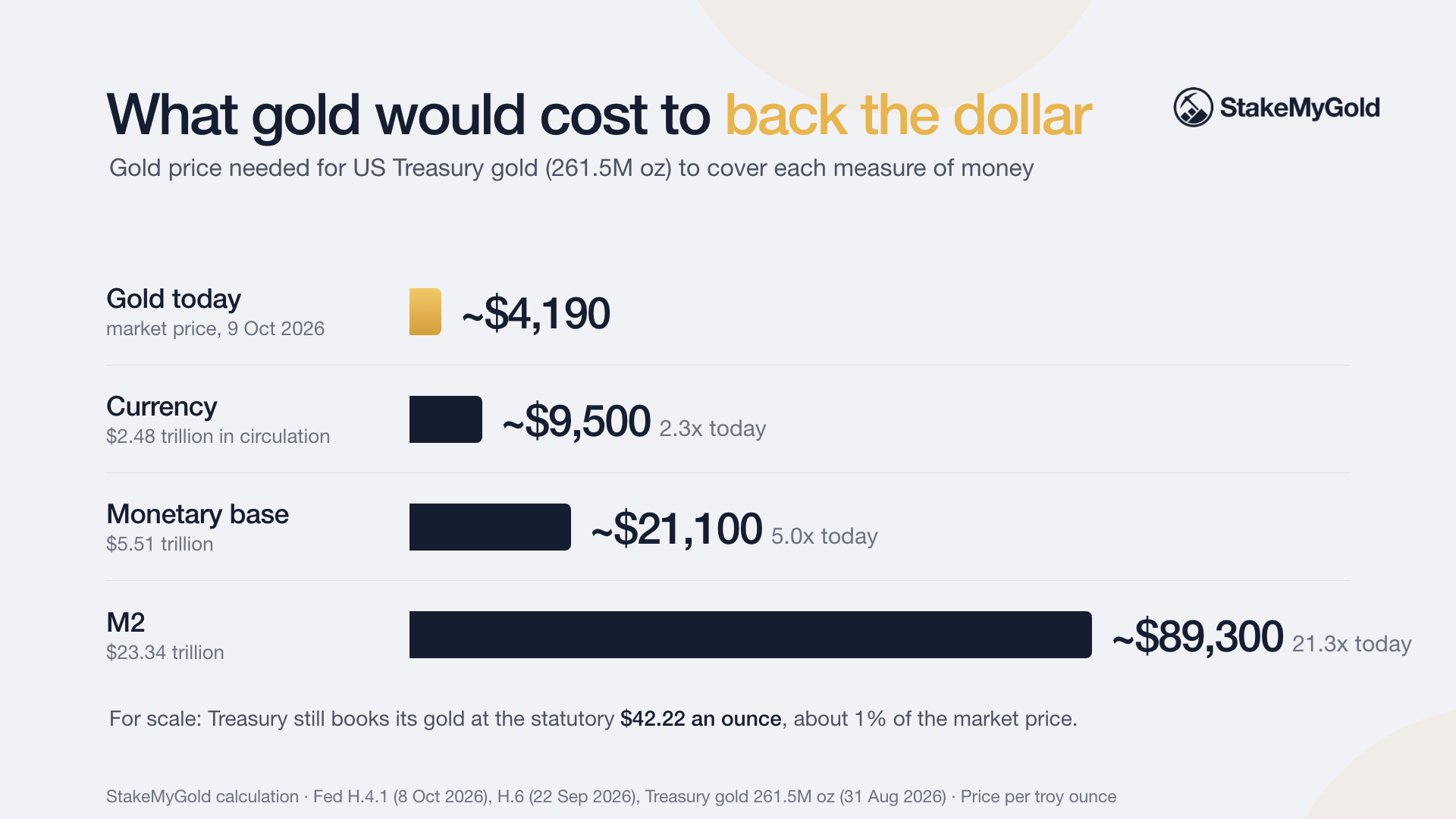
Two things stand out. First, at today's price, US gold already covers about 44% of paper currency, which is above the old 40% and 25% legal cover rules. A partial "gold cover" is not a fantasy on paper. Second, a full gold standard is a different story. The money people actually use is mostly bank deposits, and backing M2 would require gold at more than 21 times its current price, or a much smaller money supply.
The reverse also holds: if the government fixed gold at a price far above the market, as Roosevelt did in 1934, it would be devaluing the dollar against gold, not making it "sound". For where that gold sits, see how much gold is in Fort Knox.
Supporters say a gold standard would stop governments from printing money and keep prices stable over the long run; most economists say it would make recessions worse, tie the money supply to mining output, and that its record on short-run stability was poor. Both sides have real evidence.
| Type | How it worked | Where and when |
|---|
| Gold coin (specie) standard | Gold coins circulated as everyday money alongside notes; notes swapped for coins | Classical era, about 1870s–1914; US gold coins until 1933 |
| Gold bullion standard | No gold coins in circulation; notes swapped only for large gold bars | Interwar years, once gold coins had left everyday use |
| Gold exchange standard | Central banks held reserves in currencies that were themselves convertible to gold, such as pounds or dollars, to save on gold | Common in the 1920s |
| Bretton Woods (dollar-gold) system | Only the dollar was tied to gold, at $35 an ounce, and only foreign governments could convert; other currencies were pegged to the dollar | 1944 (fully working from 1958) to 1971 |
| Date | Event |
|---|
| 1871–1900 | Germany moves to gold in 1871; by 1900 almost every major economy is on a gold standard |
| 14 March 1900 | US Gold Standard Act makes gold the sole standard; the dollar equals $20.67 per ounce of pure gold |
| 1914 | World War I: most countries stop converting notes into gold |
| 1925 | Britain returns to gold at its prewar exchange rate |
| September 1931 | Britain suspends the gold standard |
| 5 April 1933 | Executive Order 6102 orders Americans to hand in most gold coin, bullion and gold certificates by 1 May 1933 |
| 30–31 January 1934 | Gold Reserve Act; the dollar is revalued to $35 an ounce |
| July 1944 | Bretton Woods conference sets up the dollar-gold system at $35 |
| 15 August 1971 | Nixon suspends the dollar's convertibility into gold for foreign governments |
| 1972–1973 | Official gold price raised to $38, then $42.22 |
| March 1973 | Major currencies begin to float |
| January 1976 | IMF ministers agree in Kingston, Jamaica, to legalize floating rates |
| April 1978 | IMF Second Amendment takes effect and ends gold's official role |
| What gold must back | Amount | Gold price needed | Multiple of ~$4,190 | Share covered at ~$4,190 |
|---|
| Currency in circulation | $2.48 trillion | ~$9,500/oz | 2.3x | 44% |
| Monetary base | $5.51 trillion | ~$21,100/oz | 5.0x | 20% |
| M2 | $23.34 trillion | ~$89,300/oz | 21.3x | 4.7% |
| Book value at $42.22 | $11.04 billion | n/a | n/a | 0.4% of currency |
In January 2012, the IGM Forum (now the Kent A. Clark Center) asked its panel of leading US economists whether a gold standard would make price stability and employment better for the average American. Of the 36 who answered, 15 disagreed and 21 strongly disagreed. None agreed.
Washington tested the idea once. The US Gold Commission, chaired by Treasury Secretary Donald Regan, recommended against relinking the dollar to gold in March 1982, though Rep. Ron Paul and businessman Lewis Lehrman dissented in favor of gold.
Could it come back anyway? In practice it would take an act of Congress, because the dollar's gold value has always been set by statute: in 1900, 1934, 1972 and 1973. The IMF is a second hurdle. Its Articles let members peg their currency to the SDR or to "another denominator, other than gold", so a US return to gold would also mean reopening its IMF commitments.
No country defines its currency as a fixed weight of gold today. But gold has not left the monetary system. It has moved from being money's anchor to being a reserve asset, an accounting entry and a private choice.
The worked example uses a simple division. A real return to gold would change everything in it: the gold price, the amount of money, interest rates and probably how much gold the Treasury holds. The table shows the size of the gap, not what would happen.
The historical numbers come from different periods with different data quality. Bordo's inflation and volatility figures for 1880–1914 rest on reconstructed price series. The IGM poll is from 2012 and reflects one panel of mostly US academic economists. None of this tells you what gold's price will do next.
StakeMyGold is a platform for staking gold-backed tokens, so we have an interest in gold. That is worth saying in an article about the gold standard.
Holding a gold token is not the same as living under a gold standard. It gives you gold exposure in a digital form, and staking adds a return paid in tokens. The live token today is GGBR, which is backed by certified in-ground gold reserves, not vaulted bars. PAXG and XAUT are listed as coming soon. Staking adds platform and smart contract risk on top of gold's price risk. Read the risks most platforms leave out before depositing anything.
When did the US go off the gold standard? In two steps. Americans lost the right to convert dollars into gold in 1933, under Roosevelt. Foreign governments lost it on 15 August 1971, when Nixon closed the "gold window". Gold's official role in the IMF ended in April 1978.
Who took the US off the gold standard? Franklin Roosevelt ended domestic gold convertibility in 1933 and revalued gold to $35 in 1934. Richard Nixon ended the dollar's convertibility for foreign governments in 1971.
Why did the US abandon the gold standard? In the late 1960s, foreigners held more dollars than the US had gold to redeem at $35 an ounce. Keeping the promise would have meant draining US gold or squeezing the economy, so Nixon suspended it.
Is any country still on the gold standard? No. No country fixes its currency to a set weight of gold and redeems notes in gold on demand. Zimbabwe's ZiG is partly backed by gold reserves but is not convertible into gold.
What would happen if the US went back to the gold standard? The Fed would lose most of its ability to respond to recessions, and the dollar's value would move with gold. On October 2026 data, backing the monetary base with US gold would need gold near $21,000 an ounce, or a much smaller money supply.
Is a gold-backed token a return to the gold standard? No. A token like PAXG is a private claim on gold that you choose to hold. The dollar is still the unit of account, and no one has to accept the token.
What does "gold standard" mean outside economics? It means the best or most trusted example of something, as in "the gold standard of clinical trials".
The gold standard tied money to a fixed weight of gold. It gave the 19th century low long-run inflation, and it made the 1930s worse. It ended in stages between 1914 and 1978 because a fixed amount of metal could not keep up with wars, depressions and a growing world economy.
What remains is real but smaller: gold is again a large slice of central bank reserves, and individuals can hold gold directly, through funds or as tokens. A full return would need gold at many times today's price, and almost no economist supports it.
This article is for informational purposes only and is not financial advice.
