
On 1 October 2026, police in Nairobi arrested 13 people, three of them police officers, after a US national was lured to Kenya for a gold deal. In the gang's hideout, detectives found a safe holding 65 bars "purported to be pure gold", along with fake dollars and bags of cement used to fake shipping weight. On 30 October, COMEX gold futures closed at $3,898.90 an ounce. At that price, faking gold pays well.
Most people asking how to tell if gold is real aren't holding a smuggled bar. They have a ring from a relative, a chain from a market stall, or a coin bought online. The good news is that a few home checks will catch most cheap fakes. The bad news is that several popular tests prove almost nothing, and the best fakes beat every test you can do in a kitchen.
The short answer: start with the stamp, a strong magnet and a close look at the wear points. For coins and bars, check the weight and size against the mint's published specs. Skip the vinegar, lighter and bite tests, because gold-plated items pass them. And if real money depends on the answer, take the piece to a jeweler or dealer with an XRF scanner or an electronic tester, which is often free when you are selling.
"Real gold" usually means solid gold alloy all the way through, not just on the surface. Pure gold is soft, so jewelry mixes it with other metals. The karat number says how much of the piece is gold, in 24ths. As the FTC puts it, a piece marked 18K is 18 parts gold and six parts other metal. Outside the US, you will often see a three-digit millesimal mark instead, the gold content in parts per thousand.
Plated and filled items carry gold only on the outside. Under the FTC Jewelry Guides, "gold filled" requires a mechanically bonded layer of at least 10 karat gold making up at least 1/20th of the metal's weight, and "gold plate" or "rolled gold plate" at least 1/40th. "Gold electroplate" needs a layer equivalent to at least 0.175 microns of fine gold, and "heavy gold electroplate" at least 2.5 microns.
Karat percentages are the karat number divided by 24. Plating terms follow the FTC Jewelry Guides.
Those three-digit marks come from the International Convention on Hallmarks, which recognises gold at 375, 585, 750, 916, 990 and 999. For how karats, troy ounces and fineness relate, see our guide to karats and fineness.
You can test gold at home with five checks that are safe and free or nearly free: read the stamp, try a magnet, inspect the wear points, weigh and measure, and run a density test. Do them in that order. Each one can expose a fake, but none of them can prove a piece is real.
Use a magnifier and look inside ring bands, on clasps and on necklace tags. A karat mark (10K, 14K, 18K) or a millesimal mark (417, 585, 750) is a good start. Letters such as GF, GP, RGP or HGE mean the gold is only on the surface.
In the US, the mark should not stand alone. Federal law requires anyone who stamps a gold quality mark to add their trademark or name, and the FTC's advice to shoppers is blunt: no trademark next to the karat mark, don't buy it.
A stamp is a claim, not proof. Stamping metal is cheap, and counterfeiters stamp "14K" too. A missing stamp doesn't prove a fake either, since old, resized or handmade pieces often lose or never had one.
Use a neodymium magnet, not a fridge magnet. Gold is not magnetic, so if the piece jumps to the magnet, it contains iron, nickel or steel and is not solid gold. A small steel spring in a clasp is normal, so test the chain or band, not the clasp.
A piece that ignores the magnet has only passed a low bar. On physics tables, copper and lead are diamagnetic and tungsten is only weakly paramagnetic. In plain terms, none of them stick, so brass, lead and tungsten fakes all pass.
Plating wears off first at the edges, the inside of a ring, clasp tips and the links of a chain. A different color showing through, usually reddish copper, gray or silver, means the gold is a surface layer. Solid gold wears down evenly and stays the same color.
For bullion coins, the mints publish exact figures, and a kitchen scale that reads to 0.01 gram plus a caliper will catch many fakes. The US Mint lists the 1 oz American Gold Eagle at 33.931 grams and 32.70 mm across, heavier than an ounce because it is 22 karat alloy, and the 24 karat American Buffalo at 31.103 grams and 32.70 mm. The Royal Canadian Mint lists the 1 oz Gold Maple Leaf at 31.11 grams and 30 mm.
A coin that is light, too thick or the wrong diameter is a fake or damaged. A coin that matches has cleared the biggest hurdle for cheap fakes, but not for tungsten ones.
This is the one home test that looks inside the metal. Gold is one of the densest metals there is, at 19.32 grams per cubic centimeter for pure gold. The same source gives about 15.6 for 18K and about 12.9 for 14K, though the exact figure depends on the alloy.
Here is the method. Put a cup of water on the scale and tare it to zero. Hang the item from a thin thread so it is fully under water without touching the bottom or sides. The reading in grams equals the item's volume in cubic centimeters. Divide the item's dry weight by that reading, and you have its density.
Take a 1 oz Gold Maple Leaf at 31.11 grams. If it is real, it displaces about 1.61 cubic centimeters of water, so the scale reads about 1.61 grams. Now compare fakes of the same weight, using densities from the Royal Society of Chemistry: copper at 8.96, lead at 11.3 and tungsten at 19.3, against gold at 19.3.
Volumes are weight divided by density. The tungsten row assumes a core with a gold skin of matching total weight.
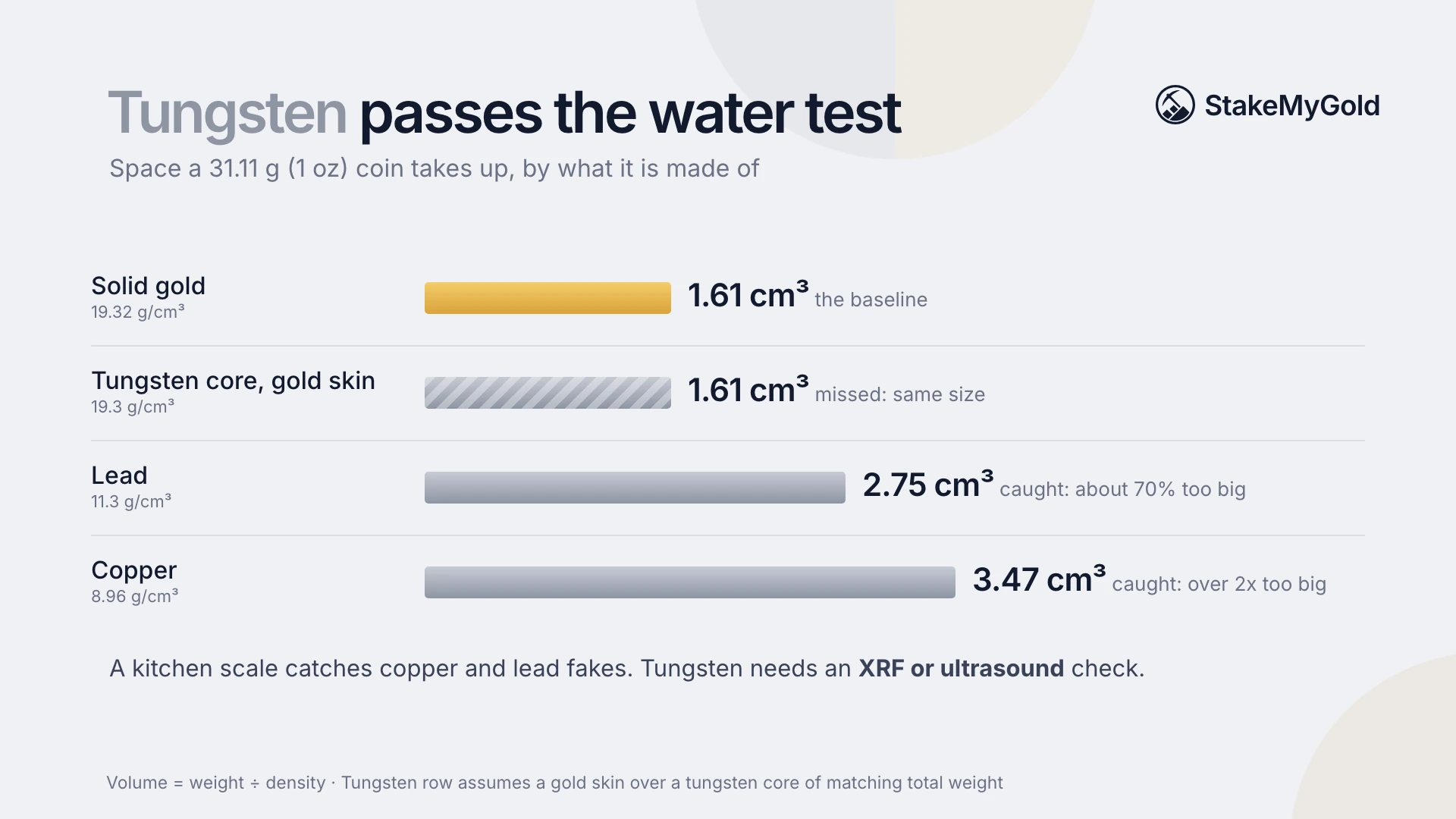
The test is strong against copper, brass and lead, because those fakes cannot hit both the right weight and the right size. Against tungsten it fails completely, because a gold skin over a tungsten core weighs the same and takes up the same space as solid gold.
It also has limits for jewelry. A 4 gram 14K ring displaces only about 0.31 grams of water, so a scale that reads to 0.01 gram gives you a rough number. Stones, hollow links and trapped air throw it off. Treat it as a screen for "much too light for gold", not a karat reading.
Several popular tests don't show what people think they show. Most of them test only the surface, and on a plated piece the surface is real gold. Others put the piece, or you, at risk.
| Mark | What it means | Gold content |
|---|
| 24K, 999 | Fine gold | 99.9% or more |
| 22K, 916 | Common in coins and Asian jewelry | 91.6% |
| 18K, 750 | Solid gold alloy | 75% |
| 14K, 585 | Most common US fine jewelry | 58.5% |
| 10K, 417 | Common in US jewelry | 41.7% |
| GF, 1/20 14K GF | Gold filled | Layer is at least 1/20 of the metal's weight |
| GP, RGP, GEP, HGE | Gold plated, rolled gold plate, gold electroplate | Thin surface layer |
| 925 | Sterling silver, sometimes gold plated | No gold beyond plating |
| A 31.11 g "coin" made of | Density (g/cm3) | Volume it needs (cm3) | What the test shows |
|---|
| Gold (99.99%) | 19.32 | 1.61 | Baseline |
| Copper | 8.96 | 3.47 | Caught: more than twice too big |
| Lead | 11.3 | 2.75 | Caught: about 70% too big |
| Tungsten core under gold | 19.3 | about 1.61 | Missed: difference is far below 0.01 g |
| Test | What people claim | What it actually shows |
|---|
| Vinegar | Real gold won't change color | Gold doesn't react, but neither does a gold-plated surface. Only catches bare base metal |
| Lighter or flame | Fake gold darkens | A plated surface is gold, so it passes. Heat can crack stones and damage solder or finishes |
| Bite | Real gold dents | Pure gold is soft, but so is lead. Can damage the piece and your teeth |
| Float or drop in water | Real gold sinks | Every common metal sinks. Only the volume measurement above tells you anything |
| Ceramic streak | Gold leaves a gold streak | Plating streaks gold until it wears through. Scrapes metal off the piece |
| Skin turns green | Means it's fake | Copper and silver in real 10K and 14K alloys can mark skin too |
| Home acid kit | Shows karat | Tests the spot you scratch. Plating can fool it, and the acids are corrosive |
The pattern is the same throughout. A test that only touches the surface cannot tell solid gold from gold over something else. That is exactly how most fakes are made.
Acid testing is the one on this list that jewelers use too, on a scratch made on a black touchstone, a dark stone that holds a thin streak of metal for testing. In trained hands it gives a fair karat estimate for solid alloys. At home, you need to file through any plating, handle nitric acid safely and read faint color changes, and you will still leave a mark on the piece.
For coins and bars, check weight and size against the mint's specs, look for the issuer's security features, and buy from sellers who can trace the metal. Then remember that the hardest fakes are built to pass exactly those checks.
Modern bullion carries anti-counterfeit features. The Gold Maple Leaf has radial lines, a micro-engraved maple leaf and Bullion DNA, a registration system the Royal Canadian Mint says lets dealers authenticate coins dated 2014 and later. PAMP Suisse bars that bear the VERISCAN logo can be checked with a phone app that compares the bar's surface with a record made at production. A sealed assay card is useful, but it proves the card and the seal, not the metal inside.
The real threat to bullion is tungsten. The London Bullion Market Association says London vaults installed ultrasonic testing in the early 2000s because of concern about tungsten inserts, since tungsten's density is almost identical to gold's. It adds that such inserts have turned up in small bars but never in the large bars held by central banks and the London Good Delivery system.
A tungsten-core fake is a bar or coin with a tungsten center wrapped in real gold. A well-made one passes the weight check, the size check, the magnet test and the density test, and its gold skin passes surface tests. Catching it takes ultrasound or cutting into the bar, and dealers add electronic testers as a further screen. For a closer look at how dealers catch counterfeit coins and bars, and why provenance beats gadgets, see gold coins vs bars.
Jewelers, pawnbrokers and bullion dealers use tools that see past the surface or measure a property a fake can't easily copy. Each still has blind spots, so serious buyers combine two or more.
| Method | How it works | Strength | Blind spot |
|---|---|---|---|
| Touchstone and acids | Metal streak tested with acids of known strength | Cheap, quick karat estimate | Surface only. Marks the piece |
| XRF scanner | X-rays read the elements in the outer layer | Non-destructive, reads exact alloy | One benchtop model reads only 15 to 20 microns deep |
| Electronic resistivity tester | Compares the metal's electrical resistivity with the expected value | Quick, no chemicals, doesn't mark the piece | You must pick the right alloy. Best paired with weight and size checks |
| Ultrasound | Sound waves look for inserts inside a bar | Finds foreign bodies, including tungsten | Needs equipment and training |
| Fire assay | Melts a sample and weighs the gold | Measures gold content directly | Destroys the sample |
XRF is often described as definitive, but it reads only the outer layer. One maker's analyzer measures to a depth of 15 to 20 microns, while a coin or small bar is a few millimeters thick, or thousands of microns. That is deep enough to see through typical plating but not to find a tungsten core.
Electronic testers such as Sigma Metalytics' verifiers test the characteristic resistivity of the sample and flag it if the reading doesn't fit the alloy you selected. Fire assay, the cupellation method set out in the international standard ISO 11426, measures gold content directly, but it melts part of the piece.
If you plan to sell, you rarely need to pay for any of this. Dealers test before they pay, and you can watch them do it. Our guide to selling gold covers what to expect at the counter.
No home test proves gold is real. They can only prove some pieces are fake. Passing every check in this guide still leaves room for a well-made tungsten or plated fake.
The density figures here are typical values. Real alloys vary with their recipe, so density can tell you a piece is far too light for gold, but not its exact karat. Mint specifications cover new coins in good condition, and worn or cleaned coins can drift slightly.
This guide also doesn't value anything. A real 10K chain and a real 24K coin are worth very different amounts per gram. For what a bar is worth by size, see how much a gold bar is worth.
StakeMyGold doesn't buy, sell or test physical gold, so it can't help you check a ring or a coin. It is a platform for staking gold-backed tokens, starting with GGBR, with PAXG and XAUT listed as coming soon.
Tokens move the question elsewhere. You can't put a token on a scale, so you rely on what the issuer discloses about the gold behind it and who checks it. That is a different risk, not a smaller one. GGBR, for example, is backed by certificates for gold still in the ground rather than bars in a vault, a difference we explain in vaulted gold vs in-ground gold.
StakeMyGold's own smart contracts are audited by CertiK. Those audits check code, not metal. The platform also says it is independent of the token issuers, so checking the backing is still your job.
How do I test if my gold is real at home? Read the stamp and look for a maker's trademark, hold a strong magnet next to it, and look at the edges for a different metal showing through. For coins, weigh and measure them against the mint's specs. These checks catch many fakes but can't prove a piece is real.
Does real gold stick to a magnet? No. Gold is not magnetic, so a piece that sticks is not solid gold. A piece that doesn't stick isn't proven real, because copper, brass, lead and tungsten don't stick either.
What is the difference between gold plated and gold filled? Both are base metal with gold on the outside. Under the FTC's guides, gold filled means a bonded layer of at least 10K gold making up at least 1/20th of the metal's weight. Gold plate can be much thinner, down to 1/40th for mechanical plating or 0.175 microns for electroplate.
Which gold is pure, 999 or 916? 999 is fine gold, at least 99.9% pure. 916 is 22 karat, about 91.6% gold, the alloy used in coins such as the American Gold Eagle.
Does the vinegar test work on gold? Only partly. Gold doesn't react with vinegar, but a gold-plated surface doesn't either, so a plated fake passes. Vinegar can only expose bare base metal.
To tell if gold is real, start with the stamp, a magnet and the wear points, then weigh and measure coins against the mint's numbers. Ignore vinegar, flame and bite tests, which a gold-plated fake passes. A careful density test catches brass and lead, but nothing you can do at home catches a tungsten core. When the amount at stake is large, rely on a dealer's XRF, resistivity or ultrasound test, and on where the gold came from.
This article is for informational purposes only and is not financial advice.
