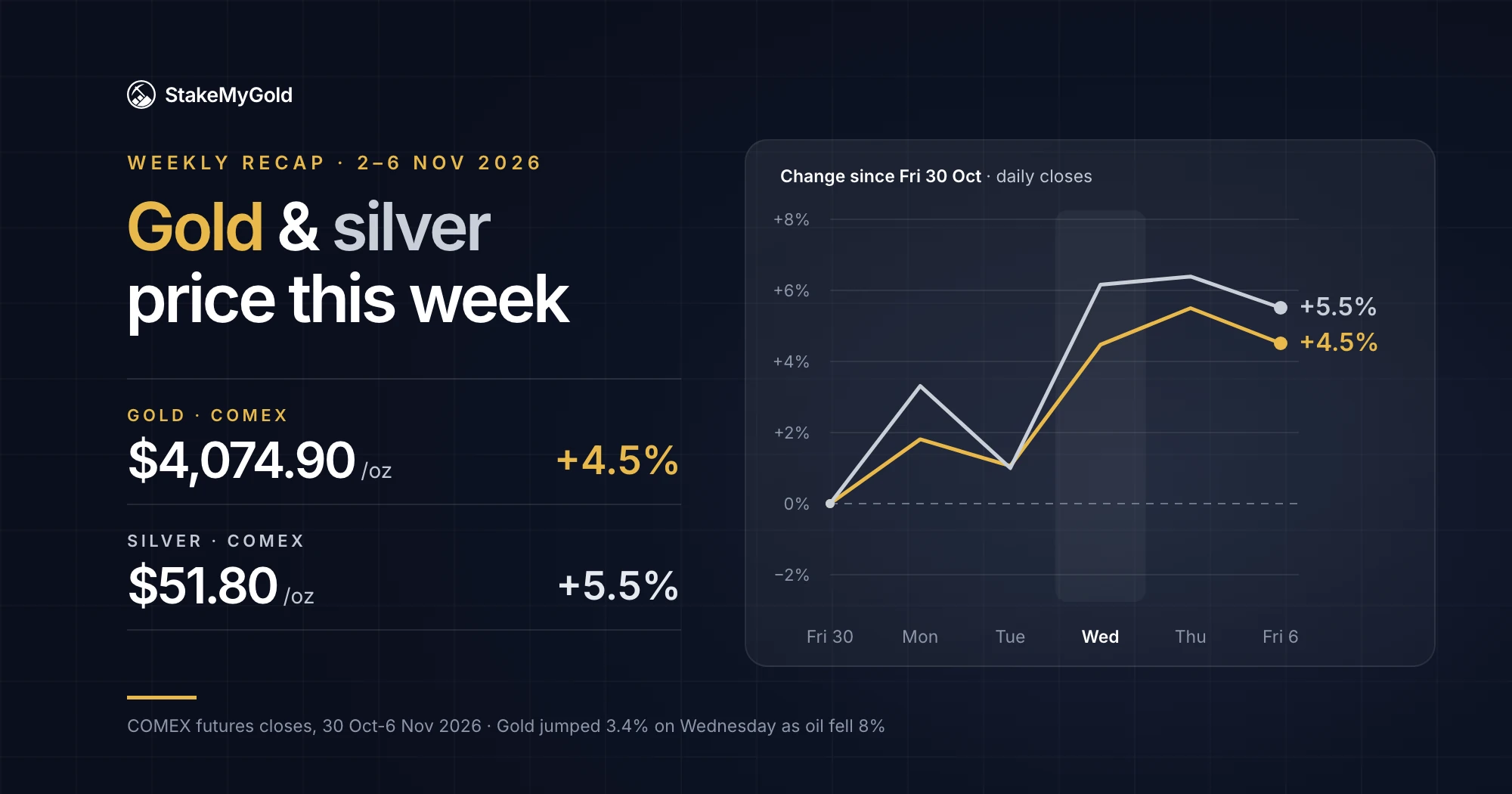
On Friday, 6 November 2026, spot gold ended near $4,070 an ounce, back above $4,000 a week after it fell to its lowest level in a year. The gold price this week rose 4.5% on COMEX futures, from $3,898.90 to $4,074.90. Silver rose 5.5% to $51.80, back above $50.
The midterm elections did most of the work. Democrats won control of both the House and the Senate on Tuesday, and on Wednesday the dollar, Treasury yields and oil all fell. Gold jumped 3.4% and silver 5.1% that day. Oil had already dropped on Monday, after Iran offered to reopen the Strait of Hormuz.
A strong October jobs report on Friday took some of the gain back, because it kept a December rate hike in play. Next week, the main test is October inflation data on Tuesday, 10 November.
Gold rose on Monday, Wednesday and Thursday, and fell on Tuesday and Friday. Silver followed the same path with larger moves. The table shows daily closing prices for front-month COMEX futures.
COMEX front-month futures closes via Yahoo Finance (gold) and Yahoo Finance (silver). Spot prices quoted by dealers run a few dollars lower.
The gold-silver ratio is the number of ounces of silver that one ounce of gold buys. It eased from 79.4 to 78.7, because silver rose a little more than gold. We explain what the gold-silver ratio measures in a separate guide.
Other markets, Friday 30 October to Friday 6 November:
| Close | Gold ($/oz) | Silver ($/oz) | Gold-silver ratio |
|---|
| Fri 30 Oct (prior week) | 3,898.90 | 49.10 | 79.4 |
| Mon 2 Nov | 3,969.60 | 50.72 | 78.3 |
| Tue 3 Nov | 3,940.40 | 49.59 | 79.5 |
| Wed 4 Nov | 4,073.00 | 52.12 | 78.1 |
| Thu 5 Nov | 4,113.50 | 52.23 | 78.8 |
| Fri 6 Nov | 4,074.90 | 51.80 | 78.7 |
| Week | +4.5% | +5.5% | -0.8 |
| Market | 30 Oct | 6 Nov | Week |
|---|
| Platinum (COMEX, $/oz) | 1,438.00 | 1,538.20 | +7.0% |
| US dollar index (DXY) | 101.88 | 102.30 | +0.4% |
| US 10-year Treasury yield | 4.93% | 4.86% | -0.07 points |
| WTI crude oil ($/barrel) | 104.12 | 90.83 | -12.8% |
| S&P 500 | 7,580 | 7,377 | -2.7% |
| Nasdaq Composite | 25,437 | 24,579 | -3.4% |
Daily closes via Yahoo Finance (COMEX, ICE, CBOE, NYMEX). Our calculations.
Gold and silver rose this week because the midterm results pushed yields and the dollar lower, oil fell on hopes of US-Iran talks, and markets cut their bets on a December rate hike. Friday's strong jobs report was the brake. Here is each one, with who reported it.
On Tuesday, 3 November, Democrats won control of both chambers of Congress, ending Republican control, Kitco reported on 4 November. Markets read the result as gridlock: less room for new deficit spending, and more scrutiny of AI investment and of US operations involving Iran. The 10-year Treasury yield fell to about 4.88%, its lowest in nearly two months, and the dollar weakened. Trading Economics called the takeover unexpected and said it weakened the dollar and yields. Gold rose 3.4% and silver 5.1% on Wednesday.
On Monday, Iran said it could reopen the Strait of Hormuz and resume nuclear talks within two days, if the US lifts its naval blockade of Iranian ports and eases oil sanctions, according to Kitco's Monday report. Washington had not accepted the offer. WTI still fell 7.4% that day. On Wednesday, Brent fell about 8.7% to $94.62 a barrel, its lowest in about two months, as the election raised hopes for talks. This matters because in October, high oil prices raised the risk of more inflation and more Fed hikes. Cheaper oil cut that risk.
There is no deal yet. US forces struck Iran's Qeshm Island on Monday night, and renewed tanker attacks near Hormuz lifted Brent back to $98.29 on Thursday.
On Thursday the S&P 500 fell 4.36%, its steepest drop since April 2025, and the Nasdaq 5.5%. Chip stocks led the fall on worries about AI spending and tighter rules for data centers after the Democratic wins, Kitco reported on 5 November. Investors bought bonds, and the 10-year yield fell to about 4.82%, its lowest since early September. The same report said futures cut the odds of a December hike to about 66% to 69%, from about 83% on Wednesday. Gold rose 1.0% that day. Silver, which has more industrial demand, was nearly flat.
On Friday, the US economy added 165,000 jobs in October, against about 65,000 expected, and unemployment fell to 4.1%. Wages rose 0.4% in the month. Before the report, traders saw a 70% chance of a December hike on CME FedWatch, Reuters reported. The data made a hike look more likely. The dollar index rose 0.7% and gold fell 0.9%.
A weak dollar explains Wednesday, not the whole week. The dollar index ended the week 0.4% higher, because Friday's jump erased its midweek drop. Forced selling also did not repeat. Last week, a 1.8% fall in the S&P 500 on a Friday dragged gold down 3.3%. This week, a 4.4% fall on Thursday came with a gold gain. Kitco's Neils Christensen argued on Friday that the Fed, not the election, still sets the direction: in his words, "political developments remain a secondary concern" for gold. For the bigger picture, see last week's recap and why gold has been falling in 2026.
Yes, but not often. We measured every Friday-to-Friday change in COMEX gold and silver from January 2000 to 6 November 2026, 1,366 weeks in all, plus every daily close.
What came next? After the 43 earlier gold weeks this strong, gold was higher four weeks later 53% of the time, with a median gain of 1.6%. Across all weeks the rate was 56%. For silver, the rate after strong weeks was 54%, the same as for all weeks. A big up week has not, on its own, said much about the next month, so this is not a signal. For a look at the drop from January's peak, see whether gold is in a bubble, and for silver, why silver has been falling.
The gold price next week depends mostly on Tuesday's inflation data and on whether US-Iran talks go anywhere.
| Date (ET) | Event | Why it matters for gold and silver |
|---|---|---|
| Tue 10 Nov, 8:30 a.m. | October consumer price index (BLS) | Hot inflation would keep December hike odds high |
| Fri 13 Nov, 8:30 a.m. | October producer price index (BLS) | A second read on price pressure |
| Ongoing | US-Iran talks via Qatar | A deal could push oil lower; more attacks could push it higher |
| Fri 4 Dec, 8:30 a.m. | November jobs report (BLS) | The last jobs report before the Fed meets |
| Tue 8 - Wed 9 Dec | Next FOMC meeting | The hike decision markets are pricing |
Dates from the BLS and Federal Reserve calendars, checked 7 November 2026.
Hot inflation data, or oil climbing back above $100, would add pressure. A soft CPI or progress on talks could help. We do not forecast the price; for bank scenarios, see how high gold could go in 2026.
One week is short for a long-term holder, and one good week does not undo October. Our tables use futures closes, which differ from spot and from dealer prices. The rate-hike odds come from news reports, not from our own reading of CME data; reports this week gave different figures, and the odds change daily. We could not find gold ETF flows for this week, so we leave them out. The "what came next" figures describe the past and do not predict the rest of November.
StakeMyGold is a gold-only platform with no silver product. Holders of GGBR, a gold-backed token, can stake it to earn a return paid in gold. That return is small next to a 4.5% weekly move in either direction, and the FAQ says yields are not guaranteed. For someone holding gold for years, staking is one way to earn on it while waiting, with smart contract and counterparty risks of its own.
Why did gold go up this week? The midterm results pushed Treasury yields and the dollar lower on Wednesday, oil fell almost 13% on hopes of US-Iran talks, and markets cut their bets on a December rate hike. COMEX gold rose 4.5% from 30 October to 6 November 2026, with 3.4% of that on Wednesday.
Is gold back above $4,000? Yes. COMEX gold closed at $4,074.90 on 6 November 2026, and spot gold ended near $4,070. A week earlier it had closed at $3,898.90.
Did the midterm elections move gold? Yes, on Wednesday. Democrats won both the House and the Senate, and gold rose 3.4% as yields, the dollar and oil fell. Much of that move came through oil and rate expectations, and Friday's jobs report showed the Fed still matters more.
Why did silver rise more than gold? Silver is a smaller market and part of its demand comes from industry, so it swings harder in both directions. It rose 5.5% this week against 4.5% for gold, after falling much more in October. Our analysis shows silver swings about twice as much as gold.
Will gold keep rising? Nobody can say. Since 2000, after weeks as strong as this one, gold was higher four weeks later 53% of the time, a little below the 56% rate for all weeks. Next week's inflation data is the nearer test.
Gold rose 4.5% and silver 5.5% this week, their first weekly gain in four weeks. The midterm sweep, falling oil and lower yields did the lifting, mostly on Wednesday, and gold held up through Thursday's stock sell-off. A strong jobs report on Friday kept a December hike in play. October's inflation data on 10 November is next week's main test.
This article is for informational purposes only and is not financial advice.
