Why is gold going up? Right now, it is not. On Friday, 20 November 2026, COMEX gold futures closed at $3,515.40 an ounce, down 9.5% in a week and their lowest close since August 2025. But gold rose in eight separate weeks between late July and early November, and each rise had a cause you can name and date.
Gold goes up when the cost of holding it falls or the demand for it jumps. In practice that means one of six things: markets expect lower interest rates (or fewer hikes), the US dollar weakens, central banks buy, investors pour money into gold funds, a crisis sends buyers to safety, or worries about government debt grow. In 2026, the first of those has mattered most.
This page explains each force with 2026 examples and keeps a running record of every recent week gold went up and why. We update it every Monday.
Gold fell 9.5% in the week to 20 November 2026, from $3,886.30 to $3,515.40, its third-worst week since 2000. Fed officials pointed to more rate hikes, and an AI-led stock sell-off pushed investors to sell gold and silver to raise cash, Kitco reported on 20 November. For the full story, read why gold is dropping. The last week gold went up was the week to 6 November (+4.5%).
Gold goes up when holding it gets cheaper or when someone big needs to buy it. These are the six forces that do it, roughly in the order they have mattered in 2026:
Usually one or two of these dominate in any given week. The table below shows which ones did.
Gold last went up in the week to 6 November 2026. Here are the last eight weeks in which COMEX gold rose, the closing price that week, the main cause reported at the time, and who reported it.
Weekly change in COMEX front-month gold futures, Friday close to Friday close, from Yahoo Finance (GC=F); our calculation. Spot gold and futures can differ in a given week, and in the week to 31 July some spot reports showed a small fall.
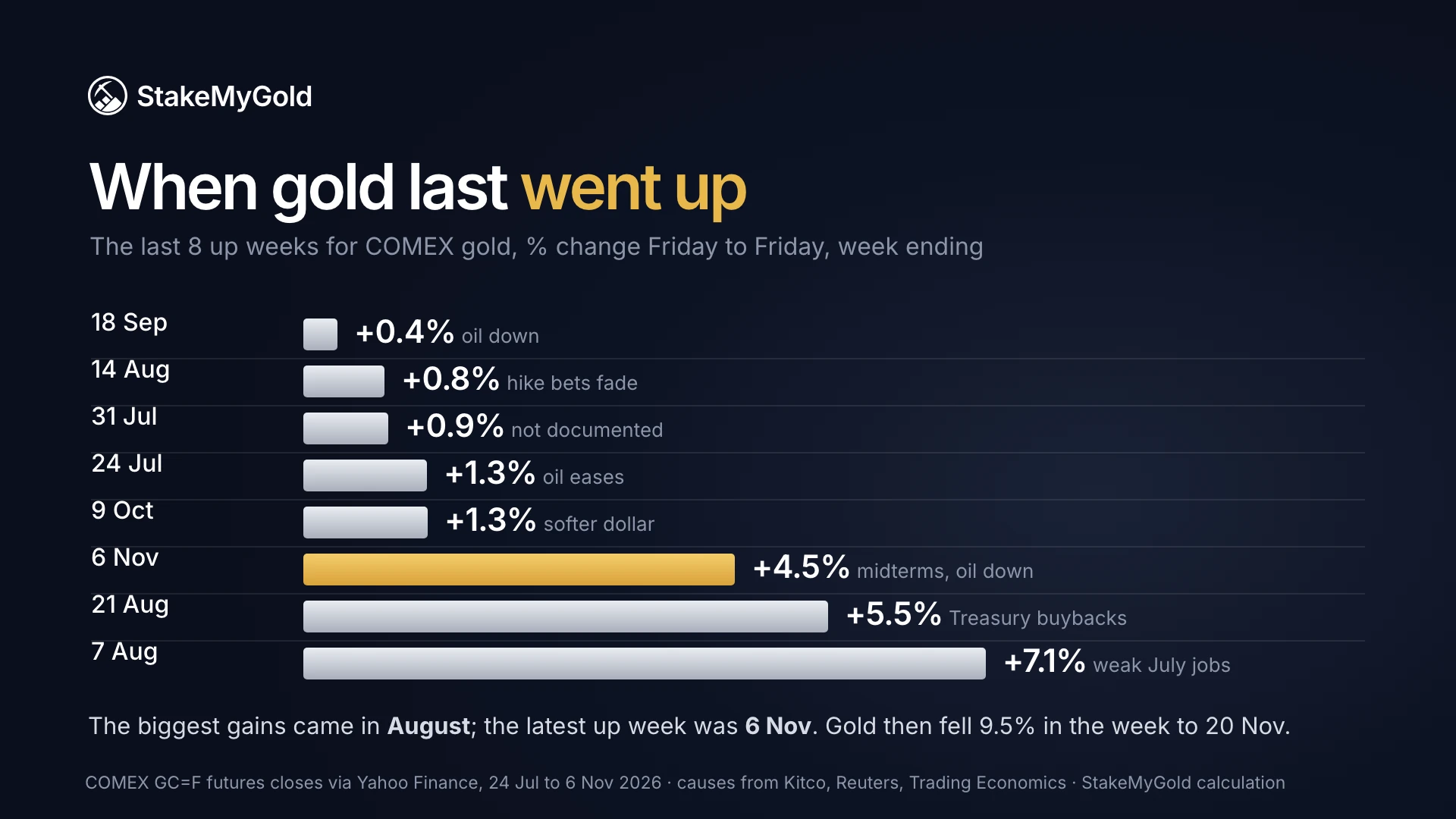
Two patterns stand out. First, the biggest gains came in August, when weak US data and the Treasury's buyback plan landed in the same month. The 7.1% rise in the week to 7 August was gold's sixth-best week since 2000 by our count. Second, almost every cause in the table runs through interest rates: cheaper oil, weak jobs data and softer inflation all mattered because they lowered the odds of another Fed hike.
Each force below opens with what it does, then shows when it showed up in 2026.
When markets expect lower rates, or fewer hikes, gold tends to rise. The reason is opportunity cost: the income you give up by holding something that pays nothing. A Treasury bill paying 4% makes a non-paying bar of gold look expensive to hold. When expected rates fall, that cost shrinks. What matters most is the real interest rate, meaning the rate after inflation.
The Fed has been raising rates in 2026, one reason gold is down for the year. But gold rose whenever the market priced fewer hikes than before. In the week to 7 August, the US economy unexpectedly lost 23,000 jobs in July, Kitco reported. CME FedWatch odds of a September hike fell to 55% from 67% the week before, according to Reuters. Gold rose 7.1%. Hikes alone do not decide the direction: across six earlier Fed hiking cycles, gold rose in three, fell clearly in one and was roughly flat in two.
Gold is priced in dollars worldwide. When the dollar weakens, an ounce costs less in euros, yen or rupees, so foreign demand rises and the dollar price tends to climb.
| Week ending | Change | Close ($/oz) | Main cause | Source |
|---|
| Fri 6 Nov 2026 | +4.5% | 4,074.90 | Democrats won Congress; yields, the dollar and oil fell | Kitco, 4 Nov |
| Fri 9 Oct 2026 | +1.3% | 4,216.30 | Softer dollar; oil cooled after Trump ruled out an attack on Iran before the midterms | Trading Economics, 9 Oct |
| Fri 18 Sep 2026 | +0.4% | 4,424.90 | Oil fell; small gain despite a Fed rate hike that week | Kitco, 18 Sep |
| Fri 21 Aug 2026 | +5.5% | 4,680.60 | Treasury doubled long-bond buybacks; the dollar fell | Kitco, 21 Aug |
| Fri 14 Aug 2026 | +0.8% | 4,437.30 | July inflation as expected; bets on a September hike faded | Kitco, 14 Aug |
| Fri 7 Aug 2026 | +7.1% | 4,399.70 | US jobs fell in July; Iran peace hopes cut oil and hike odds | Reuters via Kitco, 7 Aug |
| Fri 31 Jul 2026 | +0.9% | 4,107.00 | Cause not documented | COMEX data only |
| Fri 24 Jul 2026 | +1.3% | 4,070.80 | Oil eased on peace-talk reports; 10-year yield fell from an 18-month high | Kitco, 24 Jul |
The clearest 2026 example came in the week to 21 August. The US Treasury said it would double buybacks of 10- to 30-year bonds to at least $4 billion per operation, the dollar fell, and gold rose 5.5% to above $4,600. FXTM's Lukman Otunuga called the weaker dollar gold's "clearest tailwind," Kitco reported.
Central banks are the steadiest buyers in the market. They bought 321 tonnes in the third quarter of 2026, taking purchases for the first nine months to 675 tonnes, 6% more than a year earlier, the World Gold Council reported on 3 November. China's central bank added the most gold since October 2023 in July, its fifth straight monthly purchase, Reuters reported on 7 August.
This force rarely explains a single week. It explains why gold has a buyer even when prices fall. Our guide to central bank gold buying covers who is buying and why.
Gold ETFs hold physical metal for their shareholders, so when money flows in, the fund has to buy bars. These flows are fast and can reverse just as fast. The World Gold Council counted 211 tonnes of ETF inflows in the third quarter, reversing outflows in the second. During the August rally, Commerzbank's Carsten Fritsch noted 18 tonnes of ETF inflows in a single day, the most since September 2025, according to Kitco.
A safe haven is an asset people buy when they are scared, because they expect it to hold its value. Gold is the classic one. But 2026 shows the link is not automatic. In March, with the US-Iran war under way and oil above $112, gold had its worst week since 2011, CNBC reported, as investors who had piled in during the rally sold out. Since then, gold has gained more from peace hopes than from war: the rallies in early August and early November both came as talks with Iran pushed oil lower, which eased inflation worries and, with them, the odds of more Fed hikes.
Stock crashes cut both ways too. On 5 November, gold rose 1.0% as the S&P 500 fell 4.4% and rate-hike bets eased, Kitco reported. Two weeks later, a deeper stock sell-off pulled gold down with it as investors sold whatever they could to raise cash.
Some investors buy gold as protection against governments that borrow and print too much. The Treasury's August buyback plan was read by many as an effort to hold down long-term yields, and analysts quoted by Kitco linked it to US debt nearing $40 trillion. Rich Checkan of Asset Strategies International called the buybacks "incredibly inflationary." This is a slow force: it shapes the long-term story more than any one week. For the long record, see whether gold has really hedged inflation since 1971.
Gold's eight up weeks since July look strong on their own. Chained together, they add up to a 23.7% gain: $1,000 of gold that only experienced those eight weeks would have grown to about $1,237.
But gold did not only have up weeks. On 17 July it closed at $4,018.80. On 20 November it closed at $3,515.40, 12.5% lower. So $1,000 of gold held through the whole period would be worth about $875. The down weeks in between, including the 9.5% fall in the week to 20 November, more than erased the gains.
That is the trap in asking only why gold is going up. A rally explains a week. It does not tell you the trend.
Gold goes up in a little more than half of all weeks. We counted every Friday-to-Friday change in COMEX gold futures from September 2000 to 20 November 2026: 771 of 1,368 weeks were up, or 56.4%.
2026 has been worse. Of 47 weeks so far, 22 were up. Since the record close of $5,318.40 on 29 January, 19 of 42 weeks were up. The up weeks have also been smaller: +2.7% on average, against -3.3% for the down weeks. Weekly prices come from Yahoo Finance's COMEX gold history, and our method is explained in our guide to how the gold price is set.
The causes in the table come from same-day news reports. Markets do not publish why each buyer bought, so "main cause" is the best reported explanation, not proof. One week, the week to 31 July, has no clear documented cause, and we say so rather than guess. Our figures use front-month futures closes, which can differ from spot prices and from what a dealer charges you. Nothing here predicts where gold goes next; for bank forecasts, see our gold price prediction for 2027.
StakeMyGold lets holders of GGBR, a gold-backed token, stake it and earn rewards. Its yield strategy page says rewards are paid in GGBR from a pre-funded reward wallet, at a target of up to 12% APR that is "not guaranteed." That does not make gold go up, and it does not protect you when gold falls. For someone who plans to hold gold through weeks like these, staking is one way to earn something while waiting, with smart contract and liquidity risks that the FAQ lists.
Why is gold up today? On any given day, gold usually rises because the dollar or Treasury yields fall, or because new data cuts the odds of a Fed rate hike. For the most recent full week, gold fell 9.5% to $3,515.40 on 20 November 2026; its last up week was the week to 6 November.
Why is gold going up when the Fed is raising rates? Because markets move on expectations. In 2026 gold rose in weeks when the odds of the next hike fell, such as the week to 7 August, even though the Fed was still in a hiking cycle.
Does gold go up when stocks fall? Sometimes. On 5 November 2026 gold rose as the S&P 500 fell 4.4%, but in the week to 20 November gold fell with stocks as investors sold to raise cash.
What was gold's biggest recent weekly rise? The week to 7 August 2026, when COMEX gold rose 7.1% to $4,399.70. By our count, only five weeks since 2000 were stronger, including the week to 23 January 2026 (+8.4%).
Will gold go up again? No one knows. The forces on this page tell you what to watch: Fed rate expectations, the dollar, oil, central bank buying and ETF flows. We update this page every Monday with the latest week.
Gold goes up when holding it gets cheaper or when big buyers step in. In 2026, that mostly meant weeks when the market priced fewer Fed hikes, helped by cheaper oil, a weaker dollar or steady central bank demand. Its last rise was the week to 6 November. The latest week went the other way, a 9.5% fall, so read why gold is dropping for the other half of the story.
This article is for informational purposes only and is not financial advice.
