On Friday, 13 November 2026, spot gold traded near $3,883 an ounce after a steep weekly loss. Kitco explained the fall in one line: a 10-year Treasury yield near 5.15% was "increasing the opportunity cost of holding non-yielding bullion".
"Non-yielding" is the part that surprises many gold owners. If you hold bars, coins or a gold ETF, the question is simple: does gold pay dividends or interest at all? And if not, is there a way to make it earn something?
The short answer: no. Gold itself pays no dividends and no interest. A bar does not earn anything while it sits in a vault. You can earn a yield linked to gold, but only by adding a borrower, a company or an options strategy, and each one brings a new risk. This guide covers the five main ways, what each paid in November 2026, and what you give up for it.
No. Physical gold does not pay dividends or interest. Bullion bars, coins and physical gold ETFs produce no income. Your return comes only from selling at a higher price than you paid. The gold dealer BullionVault puts it plainly in its investor guide: gold bullion pays no interest or dividends.
The same is true of the big gold ETFs. The SPDR Gold Trust (GLD) holds gold bars and charges a sponsor fee of 0.40% a year. It pays that fee by selling gold. Its SEC filing says the trustee will sell the Trust's gold as necessary to pay the Trust's expenses. In December 2023, each GLD share was backed by about 0.0927 ounces of gold, and that number keeps falling slowly as the fee is paid.
So a physical gold ETF has a slightly negative yield in ounces: you end each year with a little less gold per share than you started with.
Income on an investment always comes from someone paying you. Two terms explain why gold has no one paying:
A gold bar has neither. It is not a loan to anyone, and it does not run a business. It just exists. That is part of its appeal: there is no borrower who can default and no company that can go bust. But it also means gold's yield, the income an asset pays as a percentage of its value, is zero.
Every way to earn a yield on gold works by adding one of those missing pieces: lending the gold to a borrower, owning a company that profits from gold, or selling something (such as an option) to another investor. When you see a "gold yield", the first question is always: who is paying it?
A zero yield is not free. Money in gold is money not earning a safe interest rate. Economists call this the opportunity cost: the return you give up by choosing one option over another.
Here is what US Treasuries, the benchmark "safe" rate, paid on 20 November 2026, according to the US Treasury:
| US Treasury maturity | Yield on 20 Nov 2026 | Income on $10,000 for one year |
|---|
Par yields from the US Treasury daily yield curve. The 10-year yield was 5.15% a week earlier, on 13 November.
In plain terms: a gold holder needs the price to rise by about 4.5% a year just to match a 1-year Treasury bill. When yields go up, that hurdle goes up, which is one reason gold often struggles when rates rise. We go through the history in what happens to gold when interest rates rise.
Many investors hold gold anyway, for things a Treasury bill does not offer, such as having no issuer that has to pay them back. But the cost of holding it is real, and it is the reason people look for a gold yield in the first place.
There are five main ways to earn income linked to gold. They differ in who pays you, what you are paid in and what new risk you take on.
Examples are snapshots, not offers. Sources are linked in each section below.
Gold leasing means lending your gold to a business for a fee, usually paid in gold. Jewelers, refiners and mints borrow metal for their stock, because owing ounces rather than dollars protects them from price moves. The fee they pay, expressed per year, is the gold lease rate. It is the closest thing to a true gold interest rate.
There is no longer a public benchmark for it. The London Bullion Market Association (LBMA), the main gold trade body, stopped publishing GOFO, the gold forward rate once used to estimate lease rates, after 30 January 2015. Market rates still exist and can jump. The World Gold Council estimated that one-month lease rates in London reached as high as 5% in January 2025, when traders shipped gold to New York ahead of possible US tariffs, before falling back to about 1% by late February.
Retail investors can reach this market through a few specialist firms. Monetary Metals, for example, reported paying a weighted average of 3.96% a year on gold, paid in gold, in June 2026, from leases to businesses such as jewelry makers and refiners.
The catch: once your gold is lent, you no longer own specific bars. You own a promise from the borrower to give metal back. We explain the mechanics in how gold lease rates work and compare retail products in our guide to the gold savings account.
The most common "gold dividend" comes from shares in companies that dig gold up or finance those that do. They pay dividends out of profits, and profits tend to rise when the gold price rises.
A mining stock is not gold, though. It carries the risks of any business: costs, debt, accidents, politics in the countries where it operates. Boards can cut dividends when profits fall. Our comparison of gold mining stocks vs gold shows why miners usually swing more than the metal, in both directions.
Physical gold ETFs such as GLD and IAU do not pay dividends. Gold miner ETFs pass on the dividends of the stocks they hold. A third type, the covered-call or "income" gold ETF, pays regular cash by selling options.
A call option gives its buyer the right to buy an asset at a set price. The seller collects a fee, called a premium, and in return gives up gains above that price. A covered-call fund collects those premiums and pays them out.
One example is the FT Vest Gold Strategy Target Income ETF (IGLD), which uses options on GLD. Its issuer listed a 7.21% distribution rate and a 30-day SEC yield of 4.73% as of 30 October 2026, with a 0.85% expense ratio. Three things to know before reading that 7.21% as "interest":
Some governments have paid interest on gold to pull household jewelry into the banking system. India ran the best-known programs, but they have mostly closed to new money:
Both were built for Indian savers. They are a reminder that when a government pays you to hold gold, the deal lasts only as long as the government finds it worth paying for.
A gold token is a digital token on a blockchain where each unit is a claim on real gold held by an issuer. The best known are PAXG and XAUT. Like bars, the tokens themselves pay nothing. There are two ways people try to earn on them.
DeFi lending. You deposit tokens in a lending pool and earn whatever borrowers pay. Our guide to DeFi lending explains how pools set rates. For gold tokens, the answer in November 2026 was simple: nothing. On 22 November 2026, about $52 million of XAUT sat in Aave V3 on Ethereum earning a 0% supply rate. Every other gold-token pool over $1 million listed by DefiLlama also showed 0%. People deposit gold tokens to borrow dollars against them, not to lend the gold out, so there is no interest to pass on.
Staking programs. Staking here means locking tokens with a platform in exchange for rewards. These yields are set by the platform and paid from a reward budget, a lending business or incentives, not by an open market of borrowers. That makes the source of the money the key question. Rates are usually quoted as APR, and our guide to APR vs APY explains how to compare them. For the risks, see is gold staking safe.
Here is what $10,000 might earn over one year in each route, using the dated figures above. At about $3,883 an ounce (13 November 2026), $10,000 buys roughly 2.6 ounces.
Illustration only. Rates change; the lease and ETF figures are past snapshots, not quotes. Ignores taxes, trading costs and gold price moves, which would swamp all of these numbers in most years.
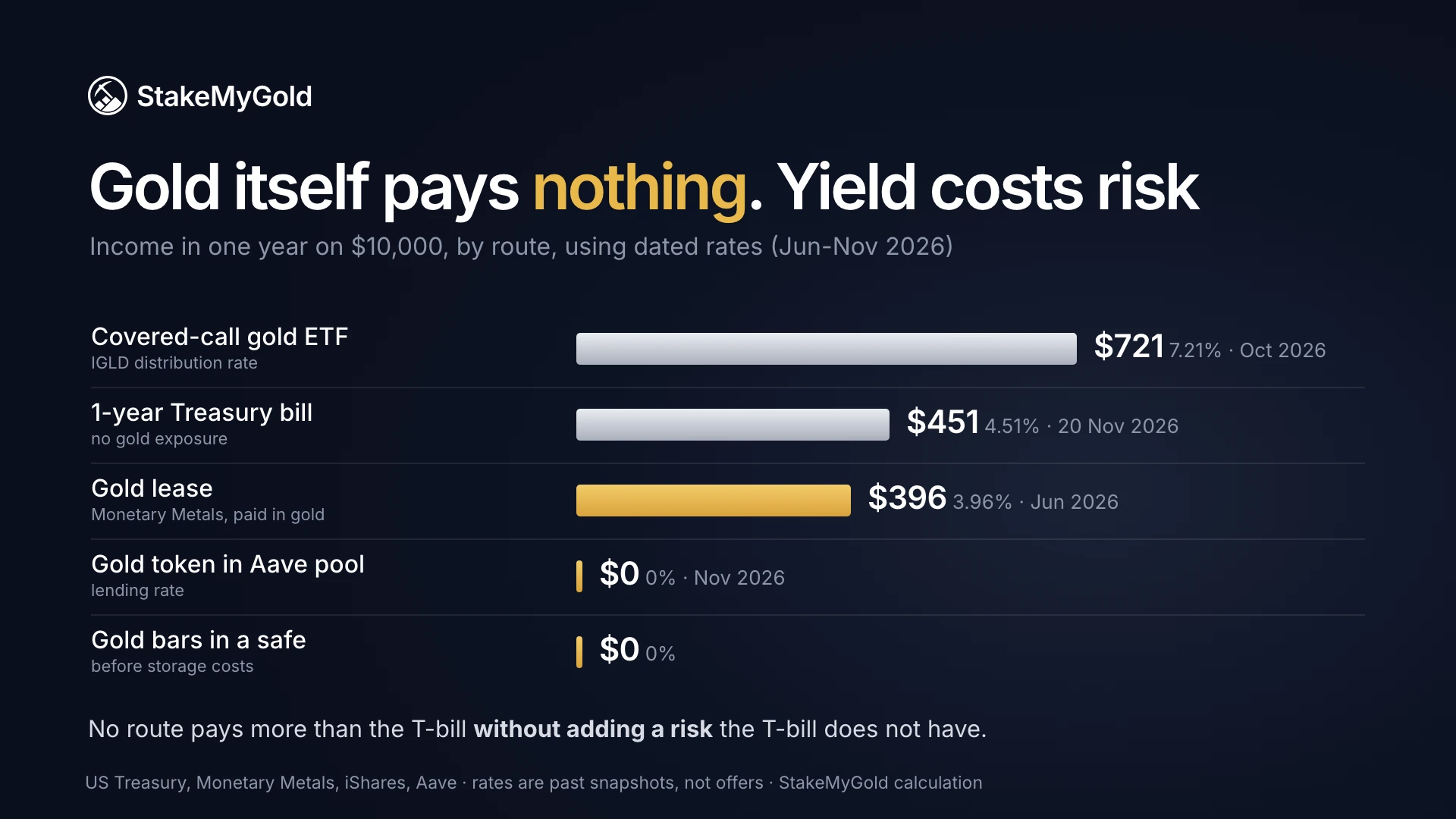
Two things stand out. First, no route pays more than the Treasury bill without taking a risk the bill does not have. Second, gold's price can move far more than any of these yields in a single year. Gold fell 9.5% on COMEX in the week to 20 November 2026 alone. A yield adds to your result. It does not protect you from a price drop.
Before you chase a gold yield, run it through four questions:
This guide does not tell you whether gold is a good buy now, or which route suits you. That depends on your taxes, your time horizon and how much of your money is in gold to begin with.
All the rates here are snapshots. Lease rates, Treasury yields, ETF distributions and staking targets change, sometimes monthly. The lease and covered-call figures are one provider each, not market averages. Tax treatment also varies widely: dividends, option distributions, lease income paid in gold and token rewards can each be taxed differently. Check with a tax professional where you live.
StakeMyGold is route 5: a staking platform for gold-backed tokens on Ethereum. Today you can stake GGBR (Goldfish). Staking for PAXG and XAUT is listed as .
| 3 months | 4.32% | about $432 (if rolled over at the same rate) |
| 1 year | 4.51% | about $451 |
| 10 years | 4.92% | about $492 a year |
| Route | Who pays you | Paid in | Dated example | Main added risk |
|---|
| 1. Leasing or lending physical gold | A business that borrows the gold | Gold | 3.96% (June 2026) | Borrower default; your gold becomes an IOU |
| 2. Mining and royalty stocks | The company, from profits | Dollars | Newmont $0.26 a quarter (Q3 2026) | Stock market and company risk |
| 3. Covered-call gold ETFs | Buyers of the options the fund sells | Dollars | 7.21% distribution rate (Oct 2026) | Capped upside, full downside |
| 4. Gold deposit schemes and gold bonds | A bank or government | Gold or local currency | India's main schemes now closed to new money | Program risk, local rules |
| 5. Tokenized gold staking and DeFi | A platform's reward program, or on-chain borrowers | Usually tokens | 0% on gold-token lending pools (Nov 2026) | Smart contract and platform risk |
| Where the $10,000 goes | Stated rate | Income over one year | Paid in | What you give up |
|---|
| Gold bars in a safe | 0% | $0 (minus storage and insurance) | Nothing | Nothing beyond the opportunity cost |
| Physical gold ETF (GLD) | -0.40% fee | about -$40 in gold | Fewer ounces per share | Small yearly fee |
| 1-year Treasury (no gold) | 4.51% | about $451 | Dollars | All gold price exposure |
| Gold lease (Monetary Metals) | 3.96% | about $396 worth of gold | Gold | Lent gold is an IOU |
| Covered-call gold ETF (IGLD) | 7.21% distribution rate | about $721 | Dollars | Part of the upside; some may be your own capital |
| Gold token in an Aave lending pool | 0% | $0 | Nothing | Smart contract risk for no income |
The main product is liquid staking. You deposit GGBR and receive stGGBR, a receipt token that grows in value against GGBR. The stGGBR page shows an 8% to 12% target APR after fees, a 5% performance fee on yield, no lock-up and withdrawals that can take up to 7 days. It also says the rate can change and rewards are not guaranteed. The staking page lists Flexible Term pools of 3, 6 or 12 months, where an early exit costs 30% of the interest earned in that term.
Ask question 1 of our own product, too. The How Rewards Work page says rewards are paid in GGBR by I-ON Digital from a reward wallet, funded by 750,005 GGBR that I-ON received in June 2026 under a prior gold lease agreement. I-ON's off-chain gold lending does not fund rewards today, DeFi strategies are conditional, and other income sources are only planned. So for now the yield comes from a reserve, not from an ongoing borrower. That is a real difference from a lease, and you should weigh it.
A staking reward also does nothing for you when the gold price falls, and it adds smart contract and platform risk that a bar in a safe does not have.
Does gold pay dividends? No. Gold bars, coins and physical gold ETFs pay no dividends. Dividends come from company profits, so you only get them by owning shares, such as gold miners or royalty companies, or funds that hold them.
Does gold pay interest? Not on its own. You earn interest on gold only by lending it to someone, for example through a gold lease, a bank gold deposit or a lending platform. The borrower pays the interest, and you take the risk that they do not return the gold.
What is the gold interest rate? The closest thing is the gold lease rate, the yearly fee a business pays to borrow gold. There has been no public benchmark since the LBMA stopped publishing GOFO in 2015. In June 2026, one retail leasing firm reported paying 3.96% a year, in gold.
Do gold ETFs pay dividends? Physical gold ETFs such as GLD and IAU do not. Gold miner ETFs pass on dividends from the companies they hold. Covered-call gold ETFs pay regular distributions from selling options, which may include a return of your own capital.
Why do people own gold if it pays no yield? For what it does in a portfolio rather than for income: it has no borrower who can default, and many investors hold it as a hedge against currency or banking stress. The trade-off is the yield you give up, about 4.5% on a 1-year Treasury in November 2026.
Can you earn interest on PAXG or XAUT? Rarely from lending. On 22 November 2026, gold-token lending pools on Aave and other protocols paid 0%, because few people borrow gold on-chain. Yields on gold tokens mostly come from staking programs, where the platform sets the rate.
Gold does not pay dividends or interest. That is not a flaw so much as the price of having no borrower and no company behind it. In November 2026, the cost of that choice was roughly 4.5% a year, the rate on a 1-year Treasury bill.
You can earn a yield linked to gold through leasing, mining and royalty stocks, covered-call ETFs, deposit schemes or tokenized gold. Each one works by adding someone who pays you, and each one adds that someone's risk. Ask who pays, why, what you hold and what you are paid in. If the answers are unclear, the yield is not worth it.
This article is for informational purposes only and is not financial or tax advice.
