On the evening of 29 October 2026, thieves drained about $6.3 billion from Binance's hot wallets. Within about an hour, a wallet tied to the attack deposited 60 million USDT on Aave, the largest DeFi lending protocol, and borrowed 19,762 wrapped ether worth about $44.6 million. Aave's risk managers responded by freezing 292 lending markets on Aave V3 and V4. The loan was backed by more collateral than it borrowed, so lenders lost nothing.
A week later, Aave said it held $33 billion in net deposits and $12 billion in active loans. That is a lot of money lent with no bank, no loan officer and no credit check. So how does it work, and where does the interest come from?
The short answer: DeFi lending is borrowing and lending crypto through code instead of a company. Lenders put tokens into a shared pool and earn interest. Borrowers take tokens out by locking up more collateral than they borrow. The interest rate moves on its own with how much of the pool is borrowed, and if a loan gets too risky, the code sells the borrower's collateral to repay it.
DeFi lending is a way to lend or borrow crypto through programs on a blockchain, with no bank or company in the middle. Lenders deposit tokens into a shared pool and earn interest. Borrowers post collateral and take tokens out. Rates and liquidations are set automatically by code.
A few terms make the rest of this guide easy to follow:
The sector is large but concentrated. On 16 November 2026, DefiLlama counted roughly $45 billion in assets across its lending category, and Aave V3 alone held about $14 billion of it, with Morpho Blue close behind at about $10 billion. Those totals count deposits sitting in the pools, not the loans taken out of them, which is why Aave's own deposit figure is higher.
DeFi lending works in five steps, the same on almost every pool-based protocol:
Notice what is missing: no application, no credit score and no human approval. The collateral is the only thing standing between the lender and a loss. The borrower side, including how much you can borrow and how far prices can fall before liquidation, is covered in our guide to how borrowing against gold tokens works. The rest of this article focuses on the lender side: where the yield comes from.
The interest a lender earns in DeFi lending comes from borrowers. No one else pays it. The key number is the utilization rate: the share of a pool that is currently lent out. If a pool holds $100 million and borrowers have taken $80 million, utilization is 80%.
Aave sets the borrow rate with what it calls a two-slope model with an optimal usage ratio. Below that optimal point, the borrow rate climbs gently as utilization rises. Above it, the rate climbs steeply. The steep slope is deliberate: it makes borrowing expensive and lending attractive just when the pool is running low on cash, which pulls in new deposits and pushes borrowers to repay.
Lenders then get a share of what borrowers pay. A useful rule of thumb is:
Supply rate ≈ borrow rate × utilization × (1 − reserve factor)
The reserve factor is the slice of borrower interest the protocol keeps. Aave defines it as the portion of the interest that goes to the market's treasury. The utilization term matters too: if only 50% of the pool is lent out, the interest from that half is spread across the whole pool.
Here is how the two slopes play out with made-up settings. These are not the live settings of any Aave pool, which differ by token and change by governance vote.
Illustration only: base rate 0%, first slope 4%, optimal usage 90%, second slope 60%, reserve factor 10%.
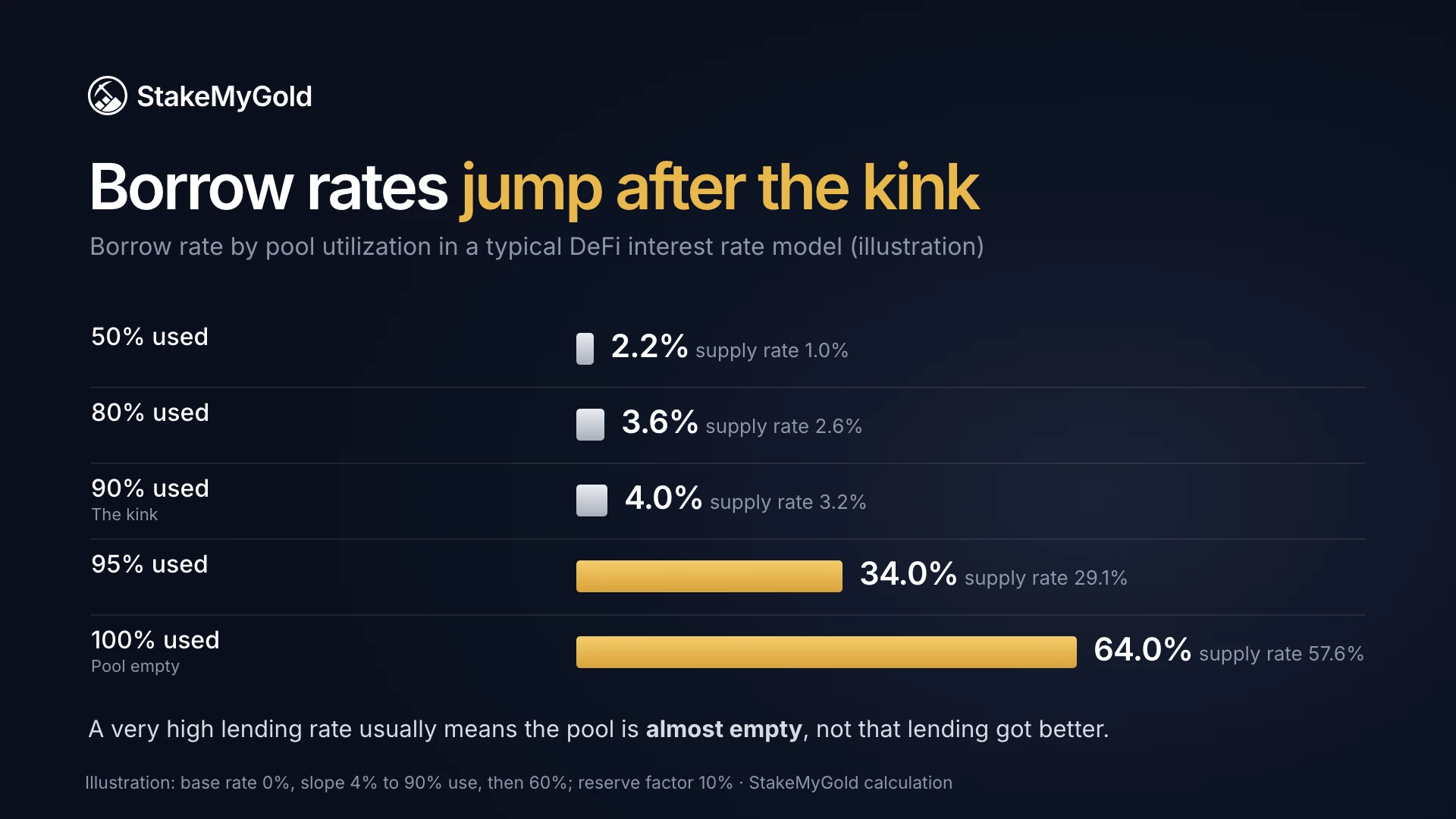
The jump after the kink is why you sometimes see DeFi pools paying 20% or more for a few hours. Such a rate usually means the pool is almost empty and borrowers are being pushed to repay, not that lending has suddenly become a better deal.
Here is the formula checked against real numbers. On 16 November 2026, DefiLlama's data for Aave V3's USDC pool on Ethereum showed:
Plug those into the rule of thumb: 5.27% × 0.945 = 4.98%. The pool actually paid lenders 4.45%. The gap, about 11% of the borrower interest, is the protocol's cut plus small effects from compounding and rounding. It is consistent with a reserve factor of around 10%. The rule of thumb holds.
Now say you supply $10,000 of USDC at that rate:
Two caveats change the picture. First, the rate is variable. It can change with every new block (about every 12 seconds on Ethereum) as people deposit, borrow and repay, so the $445 is a snapshot, not a promise.
Second, look at what 94.5% utilization means for getting your money back. Only about $154 million of USDC was sitting unlent in that pool. You can only withdraw cash that is in the pool. If many lenders wanted out at once, they would have to wait until borrowers repaid or new lenders arrived. The steep part of the rate curve is designed to make that happen fast, but it is a queue, not a guarantee.
| Utilization | Borrow rate | Supply rate (10% reserve factor) |
|---|
| 50% | 2.2% | 1.0% |
| 80% | 3.6% | 2.6% |
| 90% (the "kink") | 4.0% | 3.2% |
| 95% | 34.0% | 29.1% |
| 100% | 64.0% | 57.6% |
DeFi lending protocols cannot sue a borrower, check their income or send a debt collector. Most borrowers are just wallet addresses. So the only protection lenders have is collateral worth more than the loan.
Each collateral token gets a loan-to-value (LTV) limit: the most you can borrow as a share of what your collateral is worth. A 75% LTV means $10,000 of collateral lets you borrow up to $7,500. If prices move against the borrower and the loan crosses a higher "liquidation threshold," anyone can repay part of the debt and take collateral at a discount.
The October 2026 Binance case showed this in action. The attacker's Aave position held about $59.9 million of collateral against $43.8 million of debt, and Aave's risk manager said it did not put suppliers at risk. The thief got a loan. The lenders were still covered.
Overcollateralization also explains who borrows in DeFi. It is mostly people who already own crypto and want dollars without selling it, or traders who want leverage. It is not a way to borrow money you do not have.
DeFi lending is often confused with CeFi lending (centralized finance): crypto companies that take your tokens and lend them out themselves. The difference matters most when something goes wrong.
| DeFi lending protocol | CeFi crypto lender | US bank savings account | |
|---|---|---|---|
| Who holds your money | A smart contract | The company | The bank |
| Who decides who borrows | Code rules set by governance | The company, often in private | The bank |
| Can you see the loans? | Yes, every loan is on-chain | Usually not | No, but regulators can |
| How rates are set | Automatically, by utilization | By the company | By the bank |
| Deposit insurance | None | None | FDIC, up to $250,000 per depositor, per bank, per ownership category |
| Main failure mode | Code bugs, bad price data, frozen markets | Company mismanagement or fraud | Bank failure (insured up to the limit) |
The best-known CeFi failure is Celsius. According to the US Commodity Futures Trading Commission, Celsius pitched itself as a "safe" alternative similar to a traditional bank, promised high yields, halted withdrawals on 12 June 2022 and filed for bankruptcy on 13 July 2022, with liabilities exceeding assets by more than $1 billion.
Bank deposits are covered by the FDIC up to the standard $250,000 per depositor, per bank, per ownership category. Nothing in DeFi or CeFi lending carries that cover.
DeFi does not remove risk. It moves it from a company's honesty to code quality and market design.
If the code has a bug, the pool can be drained. In March 2023, the lending protocol Euler lost about $197 million in a single attack. The attacker later returned the recoverable funds, which is rare. Audits lower this risk but do not remove it.
An oracle is the price feed that tells the smart contract what collateral is worth. If it reports a wrong price, healthy loans can be liquidated or bad loans can be left open, and lenders absorb the loss.
As the worked example showed, you can only withdraw what is not lent out. A pool at 95% or more utilization can leave lenders waiting.
Protocols can change their own rules. In October 2026, Aave's guardian multisigs (wallets that need several signers to act) froze 292 markets within about two and a half hours. Frozen markets took no new deposits, while users could still repay and withdraw. That protected lenders, but it also shows that someone can pause a "decentralized" market. Afterward, Aave's risk manager kept several tokens at a loan-to-value of zero, meaning they could not be used to borrow.
If you lend USDC, you are exposed to Circle, the company behind it. If the token you lent loses its value, the interest will not save you.
In the US, the IRS treats digital assets as property, and income received in digital assets must be reported. Interest earned in tokens is generally taxable when you receive it. Rules differ by country, so check with a tax professional.
Gold tokens such as Tether Gold (XAUT) and Pax Gold (PAXG) are now part of DeFi lending, but mostly as collateral, not as something that earns interest.
On 16 November 2026, about $50 million of XAUT was supplied to Aave V3 on Ethereum, earning a 0% supply rate. That is not a glitch. People deposit gold tokens to borrow dollars against them, not to lend the gold out. With no borrowers for the gold, there is no interest to pass on. And after the October 2026 freeze, XAUt and PAXG were among the tokens Aave's risk manager kept at zero loan-to-value, which for now limits even that use.
So if a product offers you a yield on gold, ask who is borrowing the gold and why. In the traditional market, the answer has long been banks, refiners and jewelers who lease metal, which we explain in our guide to gold lease rates. In DeFi, a gold yield has to come from a borrower somewhere, or from a reward budget that will eventually run out. Our guide to tokenized gold covers what backs the tokens themselves.
The rates in this article are a snapshot from 16 November 2026. DeFi rates change every few seconds and can double or halve in a day. The illustration table uses made-up settings, not any pool's real parameters.
This guide also does not rank DeFi lending platforms or tell you which is safest. It explains the mechanism. Checking a specific protocol means looking at its audits, its history, its oracle setup and how it handled past stress, and even that cannot rule out a new bug. Nor can it tell you where crypto or gold prices are headed, which matters more for a borrower than any interest rate.
StakeMyGold is a gold staking platform, not a DeFi lending protocol. You stake GGBR, a gold-backed token, and earn rewards in GGBR.
Our yield strategy page lists DeFi lending and liquidity, naming Aave and Compound, as a conditional strategy, subject to scale, liquidity and risk requirements. In other words, it is not something staked GGBR does today. The same page describes gold-backed lending to a partner, I-ON Digital Corp, as the active strategy, and states that returns are not guaranteed.
Our FAQ explains how rewards are funded today and lists the risks, including smart contract and counterparty risk.
On rates, our staking page lists the Flexible Term at 10% APR for 12 months, 8% for 6 months and 6% for 3 months, and the stGGBR page shows a target of 8% to 12% APR after a 5% performance fee on yield. Rates can change, so check them on the day you stake. The questions this article taught you to ask of any lending pool apply to us too: who pays the yield, and what happens if they stop.
What is DeFi lending in simple terms? It is lending and borrowing crypto through smart contracts instead of a bank. Lenders put tokens in a pool and earn interest, and borrowers lock up collateral worth more than what they borrow.
How do DeFi lending pools set interest rates? They follow utilization, the share of the pool that is lent out. As utilization rises, the borrow rate rises, slowly at first and then steeply past an "optimal" point. Lenders earn roughly the borrow rate times utilization, minus the protocol's cut.
Is DeFi lending safe? It is not risk-free. Overcollateralization protects lenders from borrower defaults, but code bugs, bad price feeds, frozen markets and stablecoin failures can still cause losses, and there is no deposit insurance.
How much can you earn from DeFi lending? It changes constantly. On 16 November 2026, Aave's main USDC pool on Ethereum paid lenders about 4.45% a year, and its USDT pool about 3.1%. Much higher rates usually mean a nearly empty pool or a riskier token.
What is the difference between DeFi and CeFi lending? In DeFi, a smart contract holds the funds and every loan is visible on the blockchain. In CeFi, a company holds your tokens and decides how to lend them, as Celsius did before it went bankrupt in 2022.
Can you earn interest on gold tokens through DeFi lending? Usually not directly. On 16 November 2026, Tether Gold supplied to Aave earned 0%, because gold tokens are used as collateral rather than borrowed. A yield on gold has to come from someone who wants to borrow gold.
DeFi lending is a pool of tokens run by code: lenders supply, borrowers lock up more collateral than they take, and the share of the pool that is lent out sets the rate. When a pool pays more, it is usually because it is nearly empty.
Before you lend, find out three things: who is borrowing, how full the pool is, and what happens to your money if the code, the price feed or the token fails. Those three questions work for any yield offer, including one on gold.
This article is for informational purposes only and is not financial advice.
