On 9 September 2026, the most-traded COMEX copper contract, for December delivery, settled at a record $6.8885 a pound. It had risen 24% from its 20 March low. If you are asking why is copper going up, that run is the story: mines produced less, Congo banned concentrate exports, AI data centers and power grids needed more metal, and US buyers stockpiled ahead of a possible tariff.
That was the rally. It is not what copper is doing now.
The short answer: copper went up in 2026 because supply fell short while demand from electrification and data centers kept growing, and the threat of US import tariffs pulled metal into American warehouses. Since mid-October, those same forces have weakened, and copper has fallen six weeks in a row. This page explains both, and is updated every Monday.
COMEX December copper fell 9.9% in the week of 16-20 November 2026, from $6.0905 to $5.485 a pound. It was its worst week of the year and its sixth straight weekly loss, and it left copper 20.4% below the 9 September record, which puts COMEX copper in a bear market. The main causes were Fed signals of more rate hikes, a selloff in AI stocks and fund selling; on the LME it was copper's biggest weekly drop in 19 months, Reuters reported on 20 November. The full breakdown is on our page on why copper is dropping.
Copper went up in 2026 for five reasons that fed on each other: weak mine supply, demand from electrification and AI data centers, US tariff stockpiling, Chinese buying, and fund money chasing the trend. Supply did most of the work.
Global mine output fell 1.1% in the first half of 2026, Saxo Bank's Ole Hansen wrote on 8 September, citing the International Copper Study Group, as Codelco and Freeport-McMoRan posted double-digit declines. Grasberg in Indonesia, the world's second-largest copper mine, has been running below capacity since a fatal mudslide in September 2025. On 22 September, Trading Economics noted that outages in Indonesia and Congo had cut an estimated 600,000 tonnes from expected annual output. Chile, the largest producer, reported its lowest monthly output since February 2011 for August.
Then on 6 August, the Democratic Republic of Congo banned exports of copper concentrate, and copper futures rose above $6.70 a pound, a record at the time. Concentrate is crushed ore that still has to be smelted into metal. Reuters noted that Congo mostly ships refined metal, so the ban's direct effect was small, but it pushed copper near a six-month high in an already tight market.
Smelters felt it too. The International Energy Agency says benchmark smelter fees for 2026 were settled at zero, the lowest ever agreed, a sign that ore is scarce.
Copper carries electricity, so anything that uses more power uses more copper. Data centers need about 20 to 40 tonnes of copper per megawatt of capacity, according to the Copper Development Association, as cited by BMI. S&P Global expects copper demand to reach 42 million tonnes by 2040, about 50% above today, with a 10-million-tonne shortfall if new mines are not built.
This story cuts both ways. Because copper now trades partly as an AI bet, it fell with AI stocks in November.
Since 1 August 2025, the US has charged a 50% tariff on semi-finished copper products, while refined copper is exempt. The President's proclamation set up a possible duty on refined copper of 15% from 2027 and 30% from 2028, still undecided. Traders bought ahead of it. More than 200,000 tonnes of copper arrived at US ports in July 2026, the largest monthly inflow in over a decade.
That metal got stuck in the US. COMEX held about 70% of exchange stocks by early September, Saxo noted, leaving London and Shanghai short. So a COMEX premium opened up: the extra price of copper in New York over London. By our measure, comparing COMEX March 2027 copper with LME three-month copper, it was $876 a tonne on 14 August. By 20 November it was $48.
China uses around 60% of the world's copper, according to J.P. Morgan. The Yangshan premium, what Chinese importers pay over the LME price, climbed to $121 a tonne in mid-September, its highest since November 2022. Shanghai exchange stocks fell to their lowest since January 2024 by 30 September, Reuters reported.
Fund managers kept adding long positions (bets on higher prices) in early August, Trading Economics reported. Rising prices attract trend-following money, which pushes prices higher still. It also works in reverse, which is part of why the November fall was so fast.
The last week copper rose was the week to 9 October 2026, up 2.2%. Here are the last eight weeks it went up, newest first, with the main cause reported at the time.
Weekly change is our calculation from Friday closes of COMEX December 2026 copper (HGZ26) via Yahoo Finance. Causes are what reporters said at the time; "cause not documented" means we found no dated report for that week.
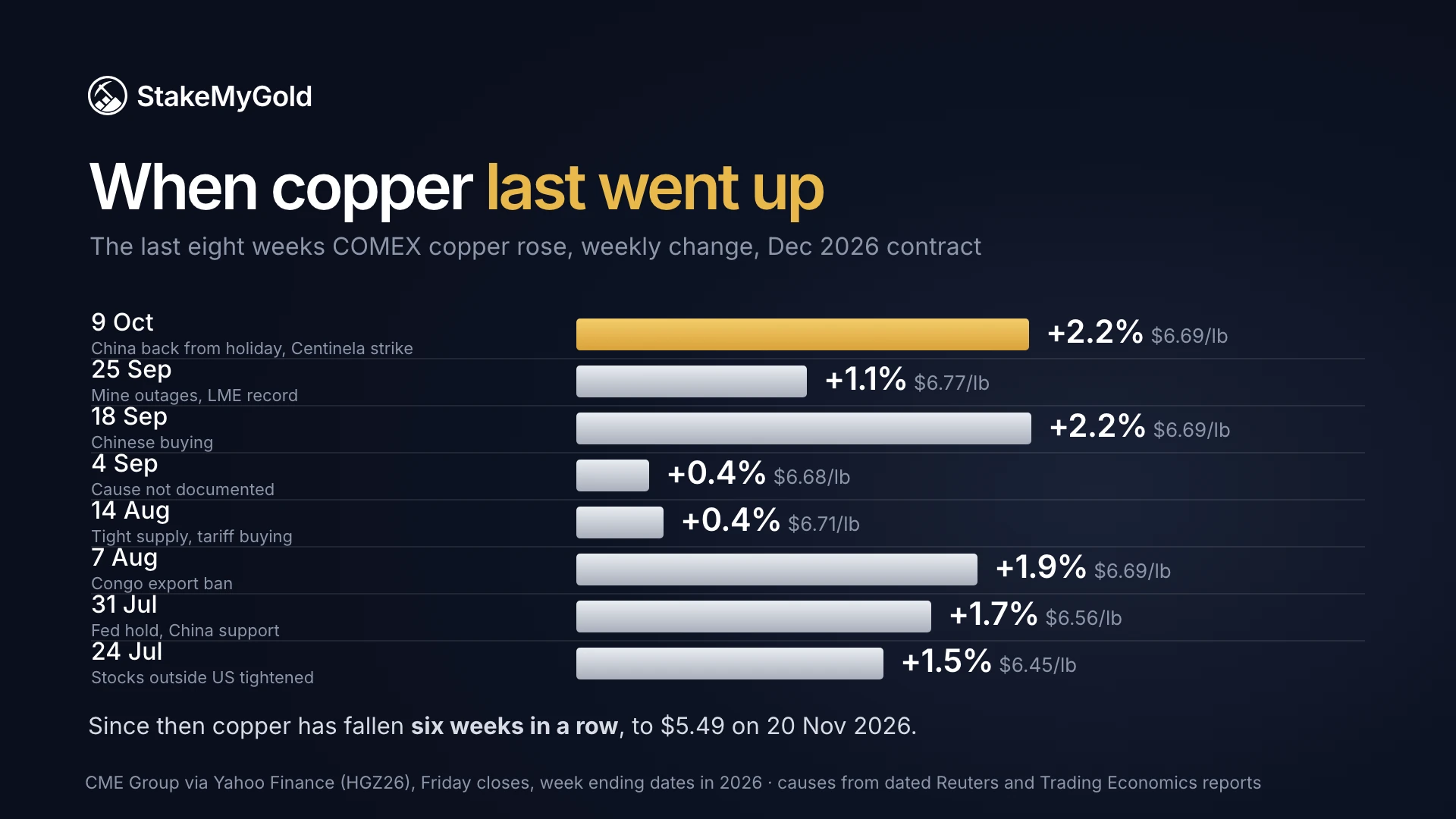
Two things stand out. Every one of these weeks was modest, and all but one had a supply or stockpiling story behind it. The last up week is now six weeks old.
Copper's record came in two parts. On COMEX, the December contract settled at $6.8885 a pound on 9 September, after gaining 3.1% in two sessions. On the LME, three-month copper touched an all-time high of $14,875 a tonne on 10 September, Reuters reported, and its highest settlement, $14,760, came on 22 September.
On 8 September, Saxo's Hansen tied the record to "persistent supply tightness" meeting strong demand. As the title of his note put it, metal was piling up in the wrong place: the US. The peak did not last. The next day, COMEX copper fell 5.0%. By mid-September, reports that the administration had postponed a decision on refined copper tariffs had sent it to multi-week lows. Copper rallied again on Chinese buying, but never closed above the 9 September level.
Say you bought $10,000 of copper exposure at the 20 March 2026 COMEX December close of $5.5655. That is about 1,797 pounds. At the 9 September record of $6.8885, it was worth about $12,377, a 23.8% gain. At the 20 November close of $5.485, it was worth about $9,855, a 1.4% loss. That round trip took eight months, and ignores fees and futures roll costs.
Copper is expensive because it is hard to mine more of it quickly and the world keeps needing more. The continuous COMEX contract closed at about $5.48 a pound on 20 November 2026, roughly eight times its close of $0.65 at the end of 2001. That is before inflation.
| Week ending (2026) | Change | Close ($/lb) | Main cause | Source |
|---|
| Fri 9 Oct | +2.2% | 6.692 | Traders back from China's week-long holiday; strike at Antofagasta's Centinela; weak Chilean output | Trading Economics, 8 Oct |
| Fri 25 Sep | +1.1% | 6.766 | Mine outages in Indonesia and Congo; LME settlement record on 22 Sep | Trading Economics, 22 Sep |
| Fri 18 Sep | +2.2% | 6.6915 | Chinese buying: Yangshan premium highest since November 2022 | Trading Economics, 18 Sep |
| Fri 4 Sep | +0.4% | 6.6825 | Cause not documented | |
| Fri 14 Aug | +0.4% | 6.7145 | Tight supply, Congo's export ban, tariff-driven US buying | Trading Economics, 11 Aug |
| Fri 7 Aug | +1.9% | 6.6865 | Congo banned copper concentrate exports; El Teniente setback | Trading Economics, 6 Aug |
| Fri 31 Jul | +1.7% | 6.560 | Fed held rates; China signaled targeted policy support | Trading Economics, 31 Jul |
| Fri 24 Jul | +1.5% | 6.4495 | Copper stocks outside the US tightened | Reuters via The Daily Guardian, 24 Jul |
Four reasons explain the high price:
If you sell scrap, these exchange prices set the trend, but dealers pay well below them.
Copper turns up when supply looks short or demand looks strong. These are the signals to watch, most of them on our copper price prediction page with dates:
This page records what moved copper, not what will move it next. The causes in the table are what analysts and reporters said that week, and several drivers overlap. Our weekly changes use the COMEX December 2026 contract; the continuous contract (HG=F), the LME and spot prices differ slightly. The COMEX premium compares prices taken at different times of day, so read it as a trend. A record does not predict another one: copper fell 20% within ten weeks of this one.
StakeMyGold is a gold platform. Its staking page covers only GGBR, a gold-backed token, so you cannot buy, hold or stake copper with us. We track copper because many gold holders watch it as a signal of economic growth. If your interest is gold, start with the five forces moving gold in 2026.
Why is copper up today? As of the 20 November 2026 close, copper was not up: COMEX December copper fell 9.9% that week, its sixth weekly loss in a row. The last week it rose was the week to 9 October. We update this page every Monday.
Why is copper so expensive? Mines struggle to raise output, demand from grids, data centers and electric vehicles keeps growing, and US tariff fears pulled metal into American warehouses. Copper cost about eight times more in November 2026 than at the end of 2001, before inflation.
What is the record copper price? COMEX December 2026 copper settled at a record $6.8885 a pound on 9 September 2026. LME three-month copper touched $14,875 a tonne on 10 September and settled at a record $14,760 on 22 September.
Will copper go up again? Nobody knows. Forecasters split on whether 2027 brings a surplus or a deficit. A US duty on refined copper, falling stocks or a mine outage would support prices.
Does copper move with gold? Not reliably. On COMEX December futures, both fell in the week to 20 November, copper 9.9% and gold 9.5%. Two weeks earlier, in the week to 6 November, gold rose 4.5% while copper fell 3.8%.
Copper went up in 2026 because mines fell short, Congo restricted exports, data centers and grids needed more metal and US buyers stockpiled ahead of tariffs. That took COMEX copper to a record on 9 September. Since then, rate fears, the AI selloff and fading tariff bets have pushed it 20% lower. Next, watch the tariff decision, warehouse stocks and the Fed's 8-9 December meeting.
This article is for informational purposes only and is not financial advice.
