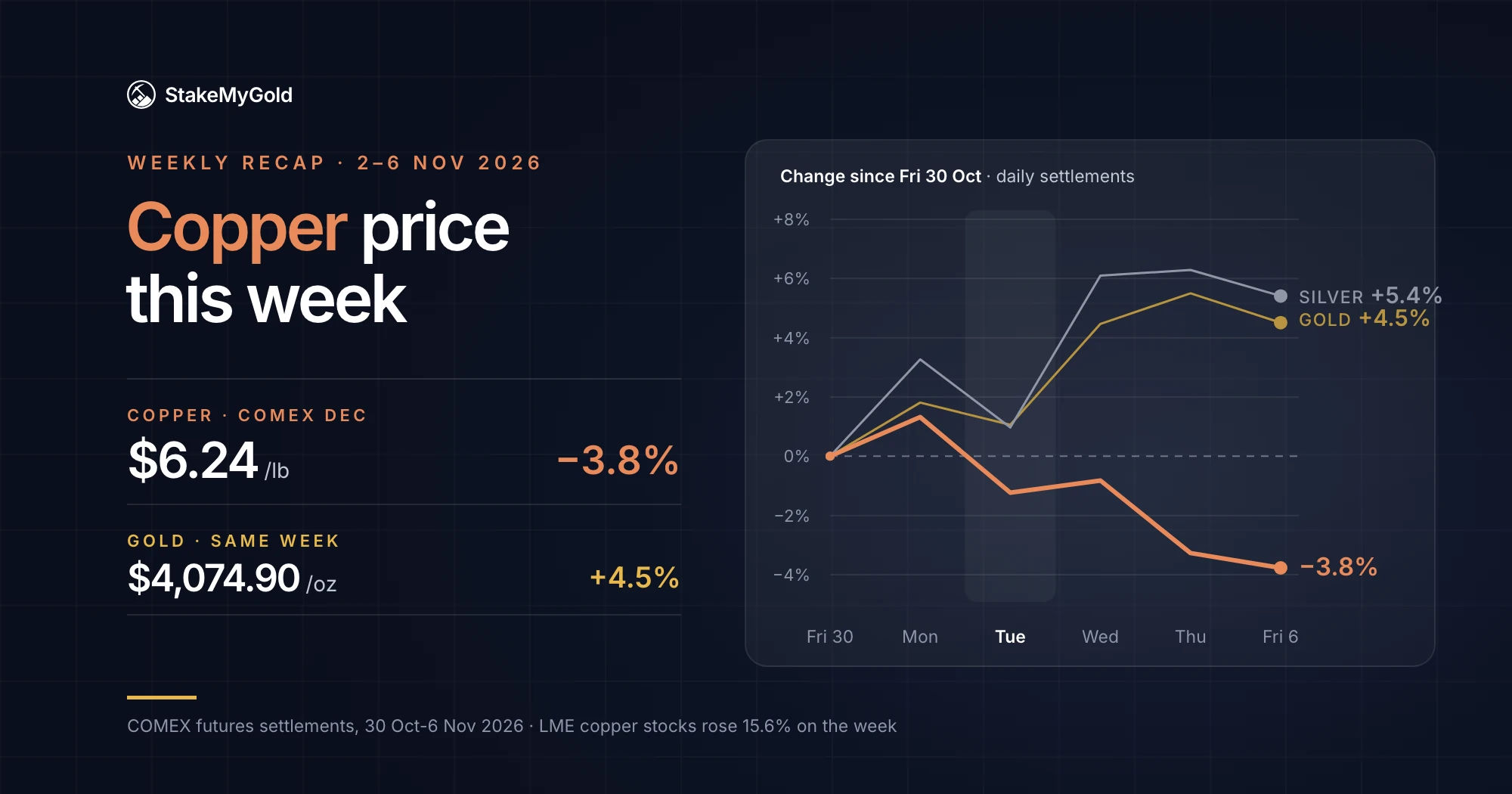
Copper had its worst week since March in the week of 2-6 November 2026. The most-traded COMEX copper contract, for December delivery, settled at $6.2375 a pound on Friday, 6 November, against $6.482 a week earlier, a 3.8% loss. In London, the three-month copper contract settled at $13,780 a tonne, down 3.3%.
The copper price this week fell on two days. On Tuesday, US election day, it lost 2.5% as AI stocks sold off. On Thursday, after Democrats won control of both chambers of Congress, it lost another 2.5%, as traders priced in more resistance to AI data centers and a lower chance of US tariffs on refined copper.
The short answer: copper fell because the midterm result weakened two stories that had held it up, data-center demand and tariffs, while metal kept arriving at London Metal Exchange (LME) warehouses. Gold went the other way and rose 4.5%.
COMEX copper finished the week 3.8% lower and LME copper 3.3% lower. Monday was the best day on COMEX; Tuesday and Thursday did the damage.
COMEX settlements from Yahoo Finance (December 2026 contract); LME three-month settlements and stocks from Westmetall. Futures prices differ from spot quotes, and COMEX and LME prices differ from each other.
Daily moves differ between the exchanges because the LME settles around midday in London, before most of New York's session. Much of Thursday's COMEX drop shows up in Friday's LME number.
It was COMEX copper's worst week since the week to 20 March 2026, when it fell 6.6%. The metal is still up 5.5% since 31 December 2025, but it now sits 9.5% below its record close of $6.8885 on 9 September 2026.
Copper fell in the week of 2-6 November 2026 because the US midterm result raised doubts about demand from AI data centers and lowered the odds of US tariffs on refined copper. A sell-off in tech stocks and a jump in LME inventories added to the pressure. Record-high premiums for physical metal in China limited the fall.
Data centers and the power lines that feed them use a lot of copper, so the AI build-out has been a big part of the bull case. Democrats won both chambers of Congress in the 3 November vote, and in Texas, Governor-elect Gina Hinojosa has proposed a statewide moratorium on new data center permits, CNBC reported on 5 November. Projects already under construction would reportedly be exempt.
On Thursday, copper hit its lowest level since July as concerns over tighter regulation and opposition to data center projects cast doubt on future demand, Trading Economics reported. TD Securities went further. AI-driven copper demand "could fall meaningfully short of current projections," Bart Melek, its global head of commodity strategy, wrote on 5 November, as reported by The Northern Miner.
Traders have shipped large amounts of copper to the US, betting on duties on refined metal: COMEX stocks rose about 62% from January to 4 November, The Northern Miner reported. A July 2025 proclamation allows refined copper duties of 15% from January 2027 and 30% in 2028, pending a presidential decision. After the Democratic gains, many traders see aggressive tariffs as less likely, according to Melek. Fitch's research unit BMI called US tariff uncertainty "the clearest near-term catalyst for copper," per the same report.
On Tuesday, LME copper touched $13,883, its lowest since 19 August, and Marex analyst Ed Meir said the metal was "catching up" with the rout in AI chip stocks, Reuters reported. The same day the yuan weakened after China's central bank raised the foreign currency reserve requirement for banks, which makes dollar-priced metal dearer for Chinese buyers.
Thursday was worse for stocks. The S&P 500 fell 4.4% that day, and copper miners fell harder: Freeport-McMoRan lost 7.5% and Southern Copper 6.5%.
LME copper stocks rose on four of five days. By Tuesday they hit a four-month high of 309,650 tonnes after a 17,325-tonne inflow into US-registered warehouses, Reuters reported. By Friday they stood at 316,675 tonnes, more than double the end-2025 level. Rising stocks signal that metal is easier to find.
Buyers in China still paid up for physical metal. The Yangshan premium is the extra price Chinese importers pay over the LME for copper delivered to China. It topped $200 a tonne on Wednesday, the highest since BMI's records began in 2017. BMI also cut its forecast for 2026 mine output growth to 1.1% from 2.4%. And Chinese smelters are squeezed, with spot treatment charges at a record low of minus $246.40 a tonne on 30 October, per Argus data cited by Reuters.
Copper fell 3.8% while gold rose 4.5% and silver 5.4%. Wednesday was the turning point for precious metals: gold jumped 3.4% in one session, while copper rose 0.4%.
December 2026 contract settlements via Yahoo Finance. "2026 so far" compares with each contract's 31 December 2025 settlement.
Gold had its biggest one-day gain since 19 August on Wednesday as energy prices and Treasury yields fell, Trading Economics reported, and investors moved out of AI stocks into defensive assets. The same rotation that hurt copper helped gold. Our gold and silver recap for the same week covers that side, and what happens to gold when interest rates rise explains why Friday's jobs data trimmed the gain.
The copper-gold ratio is the copper price divided by the gold price. Copper tracks factories and gold tracks fear and monetary demand, so a falling ratio is often read as markets turning more cautious about growth. On COMEX December prices ($/lb divided by $/oz, times 1,000), it fell 7.9% this week, from 1.66 to 1.53. That was its biggest weekly drop of 2026, and it came one week after the ratio set its 2026 high.
The ratio is now lower than on all but about 7% of trading days since 2001; its median over that period is 2.29. Like the gold-silver ratio, what it measures is not what it predicts.
Rarely, and mostly in crises. We checked every week since 2001 using continuous front-month copper and gold futures. Gold rose 4% or more while copper fell 3% or more in the same week only 10 times, counting this one. Six of those came in 2007-2009, around the financial crisis. The others were January 2015, February 2016 and March 2023, the week after Silicon Valley Bank failed.
What came next was mixed. In six of the nine earlier cases, copper was higher four weeks later, and in six it was higher 13 weeks later. That is close to the base rate: copper rose in about 56% of all four-week windows and 57% of all 13-week windows since 2001. Nine cases are too few to treat as a signal.
| Date (2026) | COMEX copper, Dec contract ($/lb) | Daily change | LME 3-month copper ($/t) | LME copper stocks (t) |
|---|
| Fri 30 Oct (prior week) | 6.4820 | 14,250 | 274,000 | |
| Mon 2 Nov | 6.5675 | +1.3% | 14,242 | 293,775 |
| Tue 3 Nov | 6.4020 | -2.5% | 14,001 | 309,650 |
| Wed 4 Nov | 6.4290 | +0.4% | 14,095 | 312,250 |
| Thu 5 Nov | 6.2700 | -2.5% | 14,030 | 318,675 |
| Fri 6 Nov | 6.2375 | -0.5% | 13,780 | 316,675 |
| Week | -3.8% | -3.3% | +42,675 (+15.6%) |
| Metal (COMEX Dec futures) | 30 Oct | 6 Nov | Week | 2026 so far |
|---|
| Copper ($/lb) | 6.4820 | 6.2375 | -3.8% | +5.5% |
| Gold ($/oz) | 3,898.90 | 4,074.90 | +4.5% | -9.4% |
| Silver ($/oz) | 49.276 | 51.942 | +5.4% | -28.7% |
Inflation data and data-center politics top the list. For copper, also watch the LME stock reports.
| Date (2026) | Event | Why it matters for copper |
|---|---|---|
| Daily | LME stock reports and the Yangshan premium | Whether metal keeps flowing in and Chinese demand stays firm |
| Ongoing | Data-center policy after the midterms, including the Texas moratorium proposal | The demand story behind this week's drop |
| Tue 10 Nov, 8:30 a.m. ET | US consumer price index for October | Hot inflation would add to rate-hike bets before the 8-9 December Fed meeting |
| Fri 4 Dec | US jobs report for November | The last payrolls report before the Fed decides |
One bad week says little about copper's direction. The midterm effect on data centers is a forecast: CNBC notes that much of the capacity due in 2027 is already being built. Futures settlements differ from spot and dealer prices and between exchanges. Our history check starts in 2001, uses continuous front-month prices, and finds only nine earlier cases, too few for a forecast.
StakeMyGold is a gold platform. It has no copper product, and you cannot buy or stake copper, silver or platinum with us. We cover copper because many gold holders watch it as a growth signal next to gold. If your interest is gold, start with the five forces moving gold in 2026.
Did copper prices go up or down this week? Down. COMEX December copper fell 3.8% to $6.2375 a pound, and LME three-month copper fell 3.3% to $13,780 a tonne, in the week to 6 November 2026.
What was the copper price on 6 November 2026? COMEX December copper settled at $6.2375 a pound, its lowest close since 8 July, and LME three-month copper at $13,780 a tonne.
Why is the copper price falling after the midterms? Analysts said Democratic gains could slow AI data center construction, a key source of expected copper demand, and make US tariffs on refined copper less likely. A tech sell-off and rising LME stocks added to the drop.
Did copper do worse than gold this week? Yes. Copper fell 3.8% while gold rose 4.5% and silver 5.4%, so the copper-gold ratio had its biggest weekly drop of 2026.
Copper lost 3.8% this week, its worst week since March. The midterm result hit two stories that had propped it up, AI data centers and tariffs, while LME stocks rose 15.6%. Gold rallied on the same rotation out of tech. Next, watch US inflation on 10 November and whether metal keeps piling up in LME warehouses.
This article is for informational purposes only and is not financial advice.
